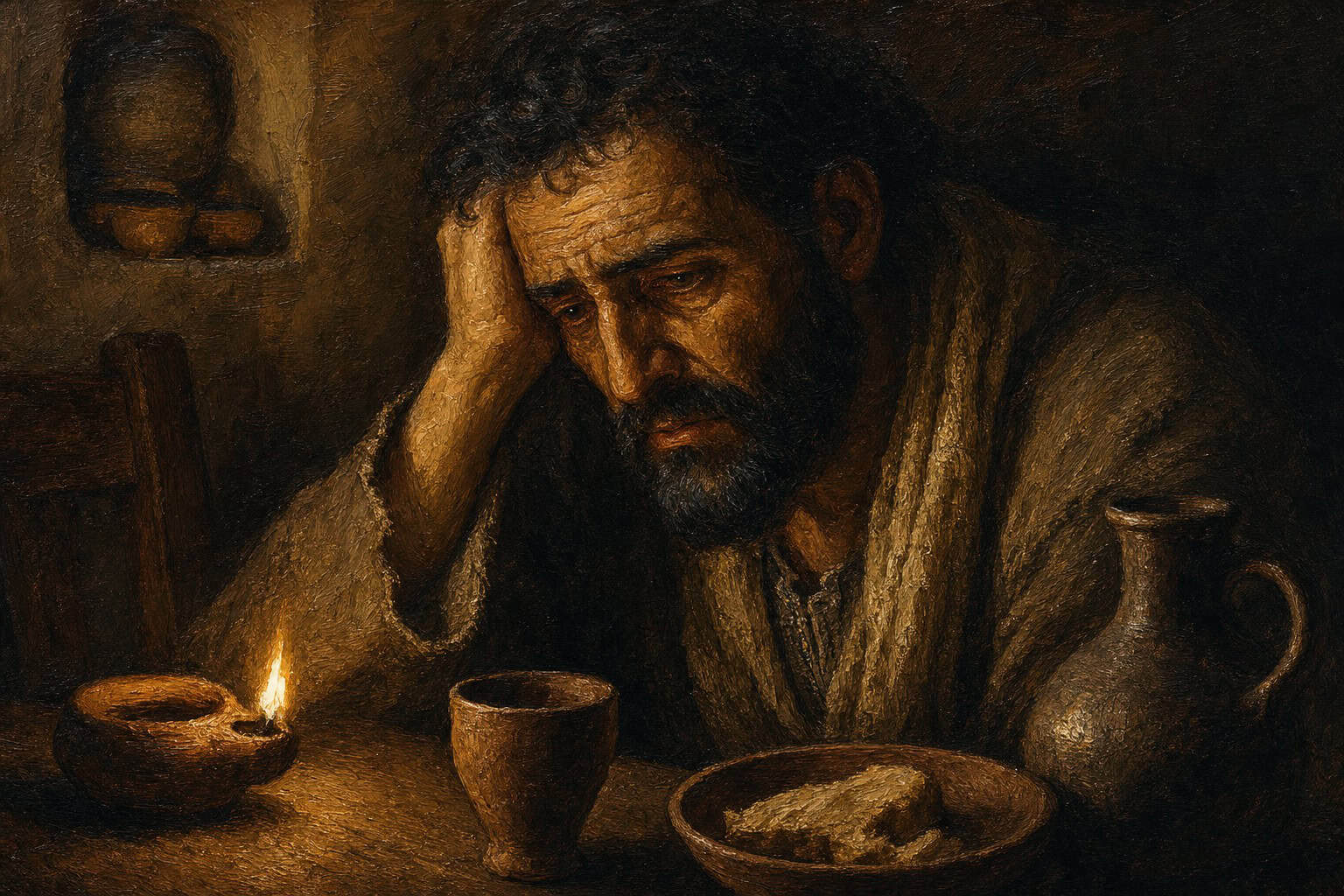
God is in the silence. Not the answer you wanted, but a nearness that stays when the noise dies down—drawn from Confessions to the Empty Chair.
The Hour the Kettle Stops Ticking
You know the exact hour. It comes late, after the last dish is dried and set on the rack, after the last message has gone unanswered and the phone has finally gone dark on the nightstand. The kettle you boiled an hour ago has stopped its faint clicking as the metal cools. The house settles into its own small noises—a pipe knocking somewhere behind a wall, the low drone of the street outside, your own pulse thudding in your ears the moment nothing else is loud enough to hide it. You have talked all day, to people and to screens and to the endless running commentary inside your own skull, and now the talking has stopped, and you wait for God to fill the gap He left, and He does not. You strain toward Him the way you strain to catch a voice through plaster, ear pressed almost to the wall, and what comes back is nothing, and the nothing arrives like a sentence handed down. You prayed and got quiet in return. You knelt on the cold floor until your kneecaps ached against the boards, and you stood up no more certain than when you went down, your legs stiff, your heart flat. So you decide the silence means He is gone, or offended, or was never bending an ear to you at all. This is the cruelest turn of it: the quiet you came to as shelter twists into evidence against you. You wanted to be still and know Him, and instead the stillness only sanded the loneliness down to something sharper. Your chest tightens. Your hands lie open on the blanket and do not know what to hold. And underneath the disappointment sits an older ache, one you have hauled since you were small—the dread that when you finally get quiet enough to be heard, no one on the other side will answer. You built your days loud on purpose. You learned early that silence is the room where being left behind lives, where the sound of a departing car fades and does not come back. So now, when someone tells you God dwells in the silence, it lands like a jab at a bruise. If He is truly there, why does it feel so much like a chair pulled up to a table laid for one? You do not want a teaching about silence. You want the silence to crack open. You want a word, a warmth on the back of your neck, anything that says you are not talking to the ceiling. And every night the room keeps its counsel and gives you back your own breathing, in and out, in the dark.
The Static You Keep to Drown the Nothing
Watch what your hands do with the quiet the moment it arrives. You reach for the phone before your feet have found the cold floor. You fill the drive with a voice, the shower with a song hummed off-key, the meal with a screen propped against the salt shaker, the slow fall toward sleep with someone reading you something so you will not have to lie there alone with the inside of your own head. You call it staying current, staying busy, staying reachable. But some plain and stubborn part of you knows the real name for it: you are running. You are outrunning the exact instant when the static drops and you have to feel what has been sitting beneath it the whole time. Because beneath it is a hunger you cannot name and cannot feed—a reaching that stretches past every good thing your arms have ever closed around. You loved someone with your whole body and it was not enough. You got the thing you were sure would settle you, and the wanting only packed its bags and moved to a new address inside you. You stood in a field at dusk, or in a church with the light coming sideways through old glass, and felt beneath the beauty a homesickness for a home you have never once seen. This is the ache the silence uncovers, and this is why you bolt from it. The noise is a wall, and you lay it up course by course, telling yourself the wall keeps you safe—from the emptiness, from the fear, from the questions that have no clean answers. And it does keep you safe, in its way. That is the trap sprung tight. The wall works. It holds the drop at arm’s length. But the same wall that seals the emptiness out seals you in, cut off from the very One you are afraid was never there to begin with. You cannot catch a voice through a wall you raised precisely to block the quiet. You cannot be found by a God you have carefully arranged never to be alone with for more than a minute. So the longing goes hungry, not because there is no bread on offer, but because you will not sit still at the table long enough to be served it. There is a bitter pride tangled in it, too. You take a hard satisfaction in your own fortress, in how skillfully you have learned to need nothing, to feel nothing, to wait on nothing. You mistake the numbness for peace. You mistake the citadel for a home with a fire in it. But a fortress no one ever visits is only a cell wearing a grander name, and the ache does not pack up and leave. It waits behind the static, patient as the tide against a pier, rising the instant you go quiet, reminding you that you were shaped to reach for something the world can neither hand you nor hush.
The Table Set Where You Swore It Was Bare
Then one night the noise simply gives out on you. Maybe you are too tired to lift your arm toward the distraction. Maybe grief has drained the charge out of everything you own, and there is nothing left to switch on, no voice left to summon into the room. You lie flat in the dark, and the silence comes, the very one you have dodged for years, and you brace your whole body for the verdict you are certain is coming. And here is the turn you did not see arriving. The silence is not empty. It is not the blank absence you feared and rehearsed. It is a fullness so quiet you had mistaken it your whole life for nothing—the way you can sit at a kitchen table beside someone you love and say not one word, and feel, in that wordlessness, more held than any conversation ever held you. You understand, lying there, that you had been listening for the wrong thing all along. You wanted a voice loud enough to out-shout your own static. But He does not compete with your noise. He does not shout over the wall. He waits down beneath it, in the low place, in the still air under the running commentary and under the fear and under every stone you set to keep Him out. The longing you took for proof of His absence was, the entire time, the pull of Him drawing you in. The hunger was the hand on your back. You had been reaching in the dark and naming it abandonment, when it was the reach itself He had planted in you so you would come and sit at the table and finally stop pretending you needed no one at all. Something loosens in your chest as you lie there, some knot you have carried so long you forgot it was a knot and not simply the shape of you. You do not hear words. You hear the house breathing and your own slow breath answering it, and for once the two do not frighten you. You have spent years reading the quiet as a slammed door, and now you feel it, impossibly, as an arm laid across your shoulders in the dark—no lighter for all its wordlessness, no less real for leaving your questions right where they lay.
The silence you fear is not God’s absence but the room He clears to sit down beside you.
What the Stillness Refuses to Carry Off
Do not mistake this for a rescue. The silence hands you no answers. You wanted Him to explain the suffering, to justify the losses one by one, to lay the reasons out flat on the table like papers under a lamp, and He does not do it. The questions stay right where they were. The wound keeps its raw edges. You rise from that quiet no better informed than you went down into it, and this is the part that gnaws at you afterward, in the gray light of the next morning, over cold coffee. Because what you were given was not information but company. Not a solution but a presence you cannot photograph. And your restless, argumentative mind, so trained to demand proof it can hold up to the window, wants to explain the whole thing away by noon. You wonder if you imagined the nearness. You wonder if the peace was only exhaustion, only your worn nerves finally letting go, only your brain soothing itself with a story it needed to make it to sunrise. This is the honest doubt that trails every real encounter, and you must not paint over it with something more comfortable. Maybe it was nothing. Maybe you simply talked yourself into being held. The suspicion is real and you cannot scrub it out entirely. But notice, then, what will not fit inside that tidy explanation. Notice that the longing did not vanish once you were held—it deepened. If the silence had merely soothed you, you would have felt full, finished, closed like a satisfied mouth. Instead you feel drawn further in, thirstier, more awake than ever to the distance between the little you tasted and the whole you were made for. That is not the signature of a mind sedating itself. A mind sedating itself wants to stop wanting. But this wants more, and wants it harder. The nearness in the stillness did not end the ache; it widened it, the way a single sip of water on a cracked tongue tells you at once exactly how far gone your thirst has been. So you are left standing in a strange middle place. You cannot prove you were held. You cannot forget that you were. You go back out to your loud life, your commute, your screens, your table with its single chair pushed in, and you carry now a rumor of Presence you cannot verify and cannot dismiss. The fortress you built still stands. But you have found a seam in it, a hairline place where the silence got through to you, and you know already you will keep coming back to that seam, even though being seen through it frightens you—because the fear of being seen has finally grown smaller than the fear of being wholly alone.
The Rumor You Cannot Stop Following
So you begin, clumsy and self-conscious, to make room for the quiet instead of bolting from it. You leave the radio off for one long stretch of the drive and let the tires hum against the road. You lie down at night without the voice piped into your ear. You sit at the table and let the fork scrape the plate and do not reach for a screen to cover the sound. It is awkward at first, like relearning how to sit with someone you have avoided for years, and the old dread rises up through the floor of you—the childhood fear that the quiet means abandonment, that no one is coming up the walk, that the chair across from you will stay pushed in forever. But you stay in it a little longer each time, one more breath, one more minute past the point you used to flee. And slowly you learn the difference between the silence that accuses and the silence that keeps you company. You learn that He rarely breaks in with thunder or a bright torn-open sky; far more often He simply sits down in the dark beside you and does not get up to leave, present in the tear you turned your face away so no one would see, walking through the very mess you were sure had disqualified you from His company for good. He does not fix it. He is there in it. That is the scandal and the mercy at once, bound together, refusing to come apart. You wanted Him to haul you up out of the pit, and instead you find Him already at the bottom of it, closer than your own breath, quieter than your own crowding thoughts, waiting in the exact stillness you spent a whole life drowning out with anything you could switch on. The longing does not resolve. It never will, not here, not fully—it is the thin line tied between you and a home you have not yet reached, and every silence gives it a small tug. You come to understand, slowly, that the reaching is not a flaw to be cured but a homesickness to be honored, the surest evidence that you were made for more than the static can ever pour into you. Anthony Adoré follows this same descent into the quiet in Confessions to the Empty Chair—not to press comfort into your hands, but to sit honestly in the dark alongside you and name plainly what he found waiting there. You will not walk away with the silence solved and shelved. You will walk away suspecting, as he came to, that the emptiness you dreaded was only a room being cleared, and that the One you were sure had walked out was waiting the whole while for you to stop shouting long enough to hear the chair scrape back and feel Him sit down.