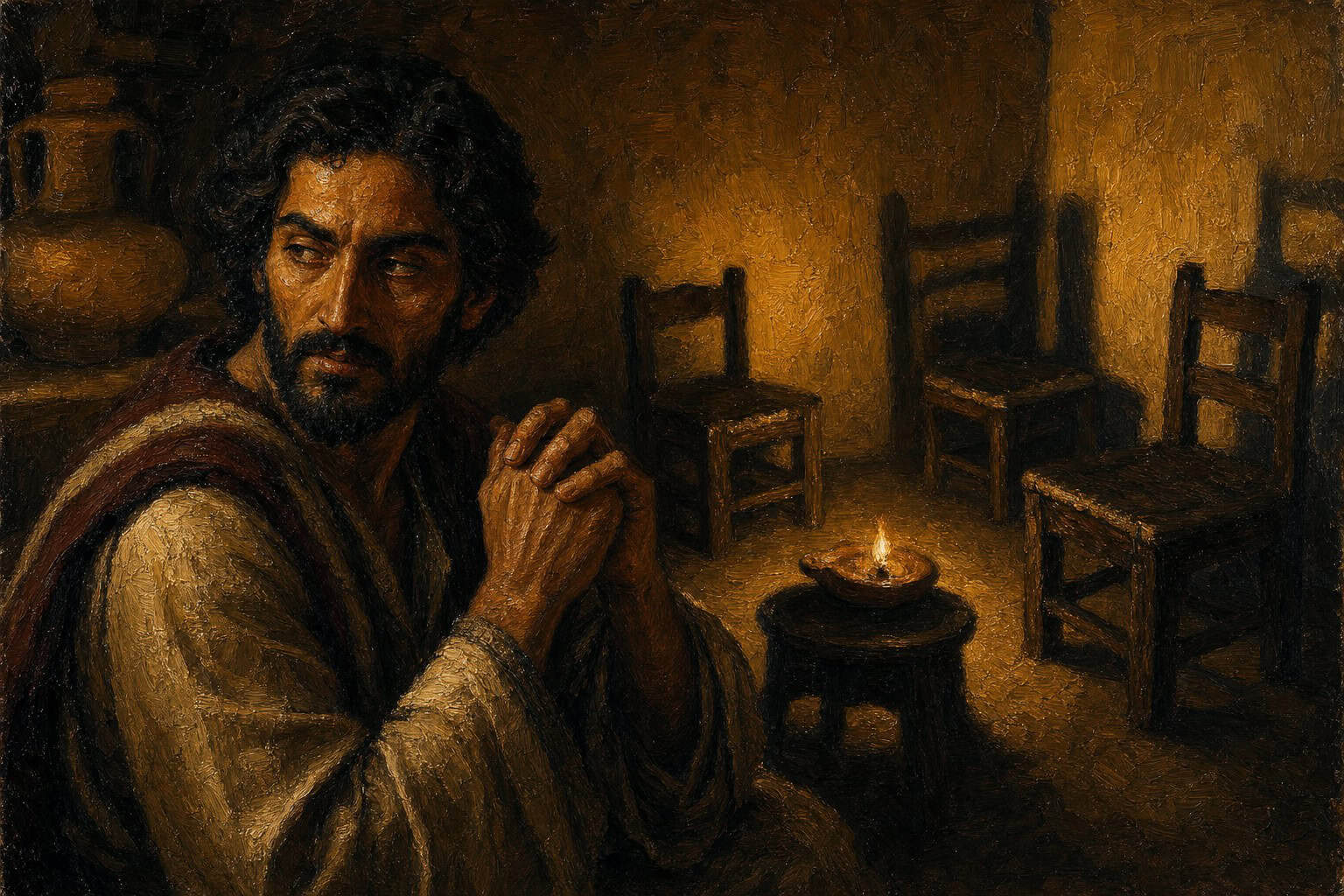
Do the missionary ladies keep their men from meeting? A reflection on the dread of exposure and the hidden hierarchy of a woman’s heart.
The Guest List Nobody Is Allowed to Read
You have felt this without ever finding a name for it. The people you keep close never sit at the same table. You steer them into separate rooms, separate evenings, separate versions of your own voice, and you tell yourself it is only good manners, only scheduling, only the way a busy life falls out. But beneath the arrangement there is a fear with hands, and it works while you sleep. This is the fear the chapter in Fractions of the Soul pries open, and the question you typed into the search bar is exactly its question: do these women keep their suitors apart on purpose? The passage does not sketch a schemer twirling a mustache. It shows something quieter and far more frightening. Each man believes he is essential. Each has been told, in the private grammar his heart needs, that his protection is not superfluous, that his table is comfortable enough, that his leadership is neither insufficient nor redundant. Then the narrator lays out the exact sentences she must never let them speak to one another. My lessons are boring and unappreciated. My food is not sweet or nourishing enough. Let the one you love more than me protect you, teach you, feed you instead. Those sentences are true. But they only become true if the men compare notes across a shared table. So she makes certain they never do. She entertains each one alone, winds the key in each of their backs alone, and the whole delicate machine runs on a single law: the men must never look upon one another. If they did, they would read the ranking at once. They would see the hidden order, the place each of them actually holds in the spectrum of her heart, and that reading would be an ending. So the plain answer to your search is yes, and it is more than yes. The separation is not cruelty for its own sake. It is architecture, built room by room, plank by plank. It is a survival strategy, because for her, being seen in full is not embarrassment. It is annihilation, the collapse of the whole economy of mystery she has been living inside. The chapter sits early in the book, laying the groundwork for everything that comes after, and it insists you feel the terror in her keeping before you rush to judge it. That is the strange mercy of the writing. It will not let you sneer from a safe distance. It makes you stand inside the fear you thought belonged only to her, and then it turns your own head slowly toward your own guest list.
Winding the Key in Each Man’s Back
The picture that carries this passage is not a locked room and not a mirror. It is a hand reaching behind a man to wind a key, the way a child winds a tin toy, and then setting him down to walk his small mechanical circle while she turns and reaches for the next. Read it slowly and it stops being clever and starts being sad. Every man in her orbit is doing something for her. One provides. One protects. One teaches. One feeds, both the body and that stranger hunger the passage calls emotional food. Each investment feels, to the man making it, like devotion freely given, the free spending of a whole heart. But he has never seen the ledger. He does not know his provision is one line among several. He cannot see that his protection overlaps another man’s, that the sweetness he brings is being quietly graded against sweeter tables he will never be shown. The narrator reaches here for cold, spatial words on purpose. Interstellar. Mathematical. The vocabulary of measurement and vast distance. He is trying to say that her interior has a shape you could almost calculate, if only you held the right instruments, and you do not, and you never will. This is where the reckoning begins to bite, and it bites the reader as hard as it bites her. Because if you are honest with yourself, you have wound the key too. You have handed one friend the version that keeps them loyal and another the version that keeps them soft and forgiving. You have managed the room so that your own contradictions never breathe the same air. The passage refuses to make this a woman’s crime alone. It describes a woman, yes, at length and without flinching, but the machine it exposes belongs to anyone who dreads being compared. The dread is not of being known. It is of being ranked, of having the true hierarchy of your loves laid out in daylight and therefore fixed and therefore judged. And there is a further, harder turn the older, reflecting voice cannot avoid. The suspicion he brings to her may be building the very cage he thinks he is only discovering. His dread does not simply detect her second life waiting there in the dark. It helps draw the outline of it. The more fiercely he watches for the hidden ranking, the more hidden it becomes, the more she folds it away where the watching cannot reach. So the two of them tighten the same knot from opposite ends. She conceals because he searches. He searches because he half-remembers concealing. And the tin toys keep walking their little circles across the floor, winding down, waiting for the hand that will wind them again before they can stop and simply stand still in the open.
The Singularity No Telescope Can Reach
Then the passage does the thing that lifts it above ordinary complaint. It reaches up past the ceiling toward the sky. It compares a woman’s secrecy to a black hole, to that region beyond the event horizon where light itself cannot climb back out to be counted. You can measure how such a thing bends the bodies drifting around it. You can write the formulas that match the scattered evidence. But you cannot see the singularity at the center, and the narrator says it plainly: seeing a woman’s true intentions is, for now, as impossible as illuminating that dark core. This is not despair dressed up in the borrowed robes of physics. It is a confession about the limits of every human instrument he owns. He has only observation and deduction. He watches, he reasons, he gathers evidence night after night, and still the center stays black and gives nothing back. He turns the same failing tools over in his hands until his fingers ache, and the readings never resolve. He builds his careful case against the dark and the dark absorbs it whole. And here comes the hardest sentence the chapter sets down, the one that cuts the searcher and the seer in the same stroke. Even if she volunteers full transparency, even if she opens every drawer, how would he measure whether what she shows him is true? She tells the specific narrative she wants believed. So does everyone he has ever met. So, he knows, does he. There is no definitive method, no proof, and she knows there is none, and that knowledge is her last and quietest protection.
She does not fear being seen; she fears being compared, for comparison is the one telescope that maps the true order of her heart.
After the Instruments Fail You
So the fallout is not a discovery at all. It is the slow, sober arrival at the far end of your own tools, where they lie useless in your hands. You wanted to catch her. You wanted the men to meet at last, the ranking to spill out across the shared table, the truth to stand exposed and undeniable in ordinary lamplight. And the passage tells you, without raising its voice, that even total exposure would not settle it, because you cannot verify the heart of another person by force or by ambush. This is where the reckoning turns inward and stops being about her. The narrator has to ask himself what he was really doing on all those managed nights, steering his own people into separate rooms, deciding which face each one would be handed at the door. Was her secrecy truly so foreign to him? Or was he studying it so closely precisely because he recognized it, because it wore his own habits? The self-deception the chapter circles is never only hers. It is the quiet, unreflective turning-away from the beliefs we cannot afford to hold up to the light. She avoids the confrontation that would unweave her carefully kept worlds. He avoids the confrontation that would name his own management, his own winding of keys, his own graded and secret loves. And the loneliness at the bottom of both is enormous and, worse, shared. To be fully known, the fear runs underneath everything, is to be abandoned, because once the true hierarchy of the heart is visible it can be weighed and found wanting and walked away from. So she stays dark in order to stay held. He watches in order to stay safe. Neither one takes the step across the cold distance toward the other, and the space between them fills with instruments and formulas and evidence and never once with a plain hand held out. And this is precisely the place where the God of this book does not swoop in to repair anything. There is no rescue staged here, no tidy midnight repentance, no light suddenly flooding the room and dissolving the fear. What there is, if you read patiently and do not demand your comfort, is a presence that sits down inside the dark beside the one who is keeping it. It walks with the man in the very act of his suspicion and his failure, in the middle of his sin rather than after it, and it does not lift him out. Grace here does not illuminate the black center or force it to give up its light. It stays near the man who cannot make it do so, near his exhaustion, near his shame, and lets him feel that he is not, after all, watching entirely alone.
The Trust You Cannot Prove and Must Still Make
Where all of this finally settles is a question the narrator poses and then deliberately refuses to close. Is the juice worth the squeeze? He asks it of her, coolly, as though weighing an investment. But by now you feel it swing back and land squarely on him, and on you reading over his shoulder. If you can never verify another soul, if every instrument you own fails at the horizon of their interior and comes back empty, then a relationship is not a courtroom that grinds toward a verdict. It is a wager renewed each ordinary morning. You do not get proof handed to you with your coffee. You get a person, and a choice to trust them or not, and the humbling, leveling knowledge that they hold the same unprovable dark in you that you cannot pierce in them. The chapter’s cold star-language is not the last word, though the passage lets it stand a while and does not hurry to soften it. What lingers underneath the physics is warmer and far more terrible: the raw ache of wanting to be known completely and the matching terror that being known completely would cost you everything you have arranged to keep. Fractions of the Soul will not press a resolution to that ache into your hands. It does the harder thing instead. It names the fear with unnerving precision, sits down beside it on the floor, and refuses to lie to you about how much of another heart you can ever actually see across the dark. So, then, do the missionary ladies keep their men apart on purpose? Yes. And so, the book quietly insists before you can feel clean about it, have you, in your own rooms, with your own carefully scheduled guests, protecting your own hidden order from the one comparison that would map it whole. The reflecting voice does not let himself off the hook. He asks what he refused to see, what he actually did with all that suspicion, whom he flattened into a mirror for his own old wounds instead of meeting as a stranger who might have surprised him. Those questions do not get answered on this page, and that is the whole point of the page. You keep reading to sit with a man honest enough to leave them open and bleeding, and to watch, page after page, what a God who declines to fix things chooses to do instead of fixing them: he stays, and he does not look away, and he does not go.