The intimacy acceleration test: why closeness feels engineered to break you, and what the rush past someone’s real horizon actually costs.
The Race You Started Without Deciding To
You know the pace before you can name it. Three weeks in and you are already speaking the language of forever, already handing over the parts of yourself you kept sealed for years. The body moves faster than judgment here. Your hands find each other in the dark of a parked car, and something in your chest reports back that this must be love because it burns so cleanly. But underneath the burning there is a quieter voice, the one that keeps a ledger, and it is uneasy. It notices how little you actually know. You have accelerated toward this person the way a driver takes a curve too fast, trusting the road to hold. There is a test running, though no one announced it, and you are the one being tested: can you tell the difference between knowing a soul and rushing past it? You feel the difference in your gut, in the slight nausea that comes after the high, when you lie beside them and realize the person breathing next to you is still, in most ways, a rumor you have chosen to believe. You catch the smell of their skin and it is familiar, but the interior behind it is a locked room you have decorated from your own imagination. The distance is real. It does not shrink because you moved your body close. It sits there, considerable, patient, waiting for you to notice it. Fractions of the Soul keeps returning to exactly this — the honest gap between what we observe from afar and what we could know if we dared to come close and stay. Speed does not close that distance. Speed only hides it. You have taken the breadcrumbs — a laugh, a scar mentioned once, the way they answer their phone — and you have built a whole person out of them, then fallen in love with your construction. The reckoning waits. It always waits. What you did was skip the slow labor of arriving at someone, and you called the skipping intimacy. Your flesh remembers the acceleration as pleasure. Your soul remembers it as a debt. Somewhere between the two, the truth of who this person actually is keeps trying to reach you, faint as a struck tone across a room, and you keep turning up the noise so you will not have to hear how far away they still are. You keep the music loud. You keep the calendar full. You do anything but be still long enough to feel the emptiness of what you have not yet learned. The test is not whether you can go fast. The test is whether you can bear to slow down and see what is truly there, and stay when what is there does not match your wanting.
Two Tuning Forks and the Silence Between Them
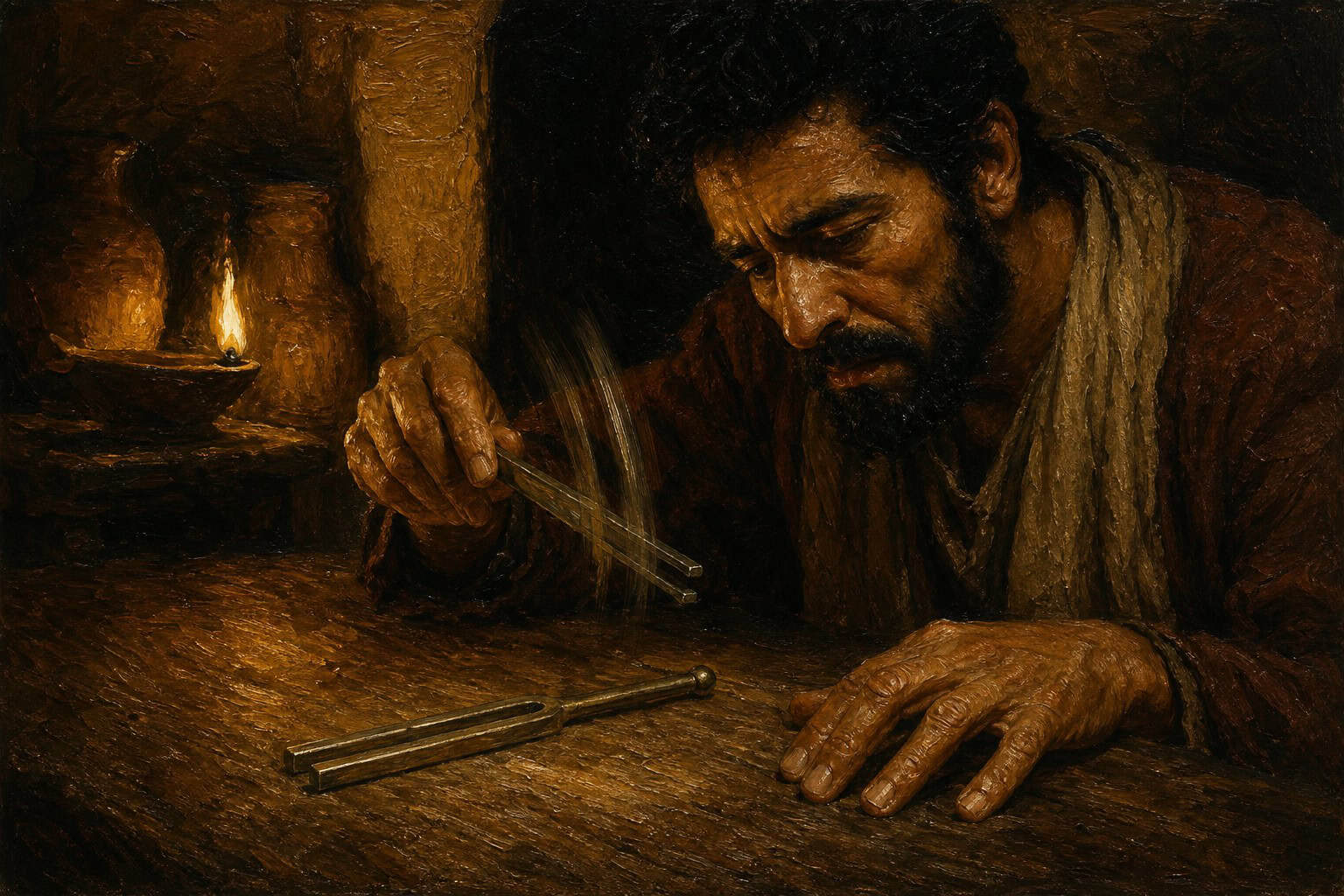
Strike a tuning fork and set another beside it, and the second begins to hum on its own — but only if it is close. Move it across the room and the hum dies to nothing. This is the physics of every attempt you have made to understand another person, and it explains the ache of your accelerated closeness better than any tender word. You are trying to vibrate with someone at a distance you have refused to actually cross. You have positioned your body next to theirs, in the bed, at the table, in the shared apartment you took too soon, and you have mistaken the nearness of skin for the nearness of soul. But the fork does not lie. If you are truly far from them inside — if you have never done the patient work of imagining your way into their fear, their history, their private grief — then no matter how close your bodies press, the resonance stays faint. You feel it as a strange loneliness in the middle of embrace. You are held and unmet at once. Your arm goes numb under their weight and you lie awake counting the ways you do not know them. The tension the book names so precisely is that accuracy and distance move against each other: the farther you are, the more you get wrong, and the more you get wrong, the more you love a phantom. Acceleration tricks you into thinking you have arrived when you have merely trespassed. You skipped the slow tuning. And now you are afraid to strike the note honestly, to ask the questions that might expose how little vibration there really is between you. Because if you asked, you might learn you have been humming alone this whole time, filling the silence with your own sound and calling it a duet. Your body knows. It has always known. The dread that gnaws at you when they are away and unreachable, the way the empty space between you fills with the ghosts of who they might be when you cannot see them — that is not paranoia. That is the fork telling you the truth about the distance you never closed. When you sit beside them and feel that low, hidden fear, you are not simply anxious. You are living beside a person who is also a crowd of unknown versions, all of them out of reach. You accelerated to escape the fear of that distance. Instead you built a bond, a nightly ritual of touch, a whole shared life on top of it, and now the structure trembles at the exact frequency of everything you refused to learn. You cannot tighten a bolt you never named. You can only feel the shaking and pretend it is passion.
The Moment the Phantom Fails to Answer
It comes on an ordinary evening. They say something — a small thing, a preference, an opinion about their own past — and it does not match. It contradicts the person you built. For a second your mind scrambles to fold it into the story, to explain it away, to keep the construction standing. You reach for the version you know. You try to make the new fact bow to the old picture. Then it will not fold. The real person has stepped out from behind the phantom, and the phantom has no face. This is the turn the accelerated soul dreads most: the instant your fiction meets a fact it cannot absorb. You feel it physically, a dropping sensation, the floor of certainty giving way beneath your feet, the blood loud in your ears. You realize you have been in love with an interpretation. You took the considerable distance between watching someone and truly reaching them, and instead of crossing it honestly you papered it over with speed and desire and the flattering conviction that you simply knew. You confused your reading of them with them. Now the incorrectness of your reading stands in the open, plain as a stain, and you are exposed in it. The reckoning arrives not as thunder but as a quiet, unbearable clarity. There is no one to blame but the one who chose the pace. You did this. You chose the rush because the rush spared you the terror of actually reaching out and being wrong. You wanted love without the vulnerability of learning someone slowly, connection without the risk of being corrected. You wanted a person who would hold still while you imagined them. And here is the strange grace the book will not let you refuse: this failure, this shattering of the phantom, is the first true thing that has happened between you. For the first time you are looking at a person and not a projection. The one in front of you is finally more than your longing made them. It hurts, and the hurt is the proof that something real has arrived. You have wanted, all along, to be spared this exact moment, and the sparing was the whole disease.
You cannot skip the distance between two souls; you can only pretend you have, and the pretense is where the wound begins.
Standing in the Wreckage of Your Own Certainty
So the story falls, and you are left holding pieces. The nights of easy fusion look different now — not sacred but hasty, not intimate but avoidant. You see how the acceleration served your fear. You would rather have loved a version you controlled than risk the slow, humiliating work of learning someone who might not fit your longing. The falling action of this is not dramatic. There is no scene, no thrown plate, no slammed hallway. It is a hundred small, sober re-readings that happen in your own head while you brush your teeth, while you drive, while you lie awake at three in the morning. You go back over the breadcrumbs and see how you bent each one to say what you wanted it to say. The scar they mentioned once — you made it mean tenderness, when it might have meant something you never bothered to ask about. The way they answered their phone — you read devotion, or coldness, whatever your mood required that day. You realize your reading of them was never neutral. It was always shaped by what you needed to be true, by the fear you were trying to outrun, by the loneliness you would not name. Interpretation, you understand now, is confession. It tells more about the one who reads than the one who is read. And in the wreckage you feel the peculiar exhaustion of a person who has been carrying two lives at once — the phantom and the real — and can carry the phantom no longer. Your shoulders ache with it. Your appetite is gone. There is grief in this, and it is not a healthy, productive grief. Do not let anyone tell you the grief is a sign of growth, as though naming it heals it. It does not heal it. You sit in the ruined certainty and it hurts, plainly, in the body, in the chest, in the food that will not go down. But here is where the book’s quieter faith lives: God does not lift you out of this collapse. He does not restore the phantom or hand you the finished person you wanted, wrapped and forgiven. He sits with you in the rubble of your own bad reading. He is present in the very sin of your haste — not congratulating it, not erasing it, simply near, the way a companion is near who does not flinch at your failure and does not leave when the room goes ugly. You are not abandoned to the wreckage. You are accompanied within it. And that accompaniment, faint as a struck tone crossing the widest room, is the first thing in this whole affair you did not construct yourself. It came toward you. You did not have to imagine it into being.
The Slow Work That Speed Was Fleeing
What remains, when the acceleration ends, is the ordinary and terrifying task you were trying to skip: actually coming close. Not with your body flung across the distance, but with your attention, your patience, your willingness to be wrong and corrected and wrong again, and to stay in the room while it happens. You learn that to know a person is to begin at a little distance, watching, listening, letting the faint vibration grow only as you dare to move nearer over time. You learn it is a labor of days and years, not weeks. There is no test to pass quickly. There is only the choice the book puts squarely on you: stay sealed in the safety of your own perspective, loving phantoms you can control, or risk the exposure of reaching toward a real soul who will surprise you and unmake your certainties. The first is lonelier than it looks. It feels like safety and tastes like starvation. The second is more painful than you want, and more alive than anything you have felt. You have known both now, in the flesh — the hollow ease of the phantom, the raw ache of the real — and you cannot unfeel the difference. This is the reckoning that does not resolve into a lesson. You will always be tempted to accelerate again, to skip the distance, to build a person out of breadcrumbs because building is easier than waiting. The temptation is fitted exactly to your particular fear, and it knows your name and your hour. But now you also know something it does not want you to know: that the distance between two souls is not an obstacle to love. It is the very space in which love happens — slowly, imperfectly, one honest question at a time, one correction at a time, one small surprise you did not plan. Fractions of the Soul does not promise you will cross it cleanly. It promises only that the crossing is the thing, and that you are not making it alone. Somewhere in the sixth chapter the narrator bends over his own record of everyone he loved too fast and understood too little, and he does not absolve himself with a soft word. He counts. He faces what he did with the people who deserved his patience and received his projection instead. He names the ones he watched from a safe distance and never dared to reach. If you have felt this test running in your own life — if you suspect you have been loving a construction and calling it a person — this book will not hand you comfort. It will do the harder, kinder thing. It will teach you how to be still, and how to see a face that is not the one you invented.