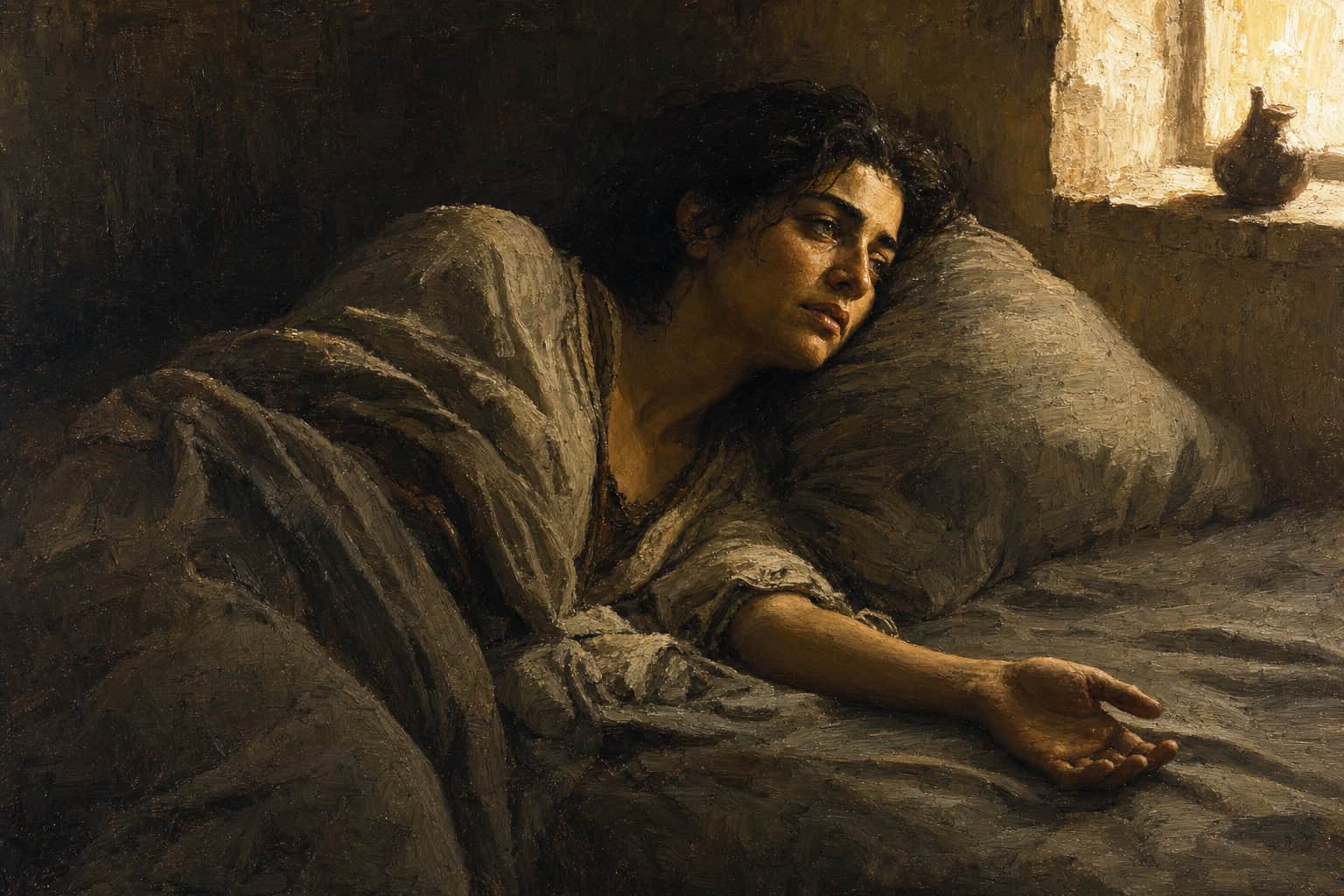
Why women feel pain, hollowness, or grief after sex – the ache after the sheets go cold, read honestly through the exile of the heart.
The Warm Body Beside You Turns Into a Stranger
You remember the way the phone lit the ceiling at two in the morning, the last message before he came over, all fire and promise. The screen burned blue against the dark and you read the words twice, three times, and something in your stomach lifted like a bird startled off a wire. You told yourself this was closeness. You told yourself the pull toward him was the truest thing you had ever felt, truer than your own hunger, truer than sleep, truer than the small voice that had been trying to speak all week and could not get a word in. And then it happens, the thing search engines cannot explain and friends do not want to hear: after the act, in the dark, the body that was just against you becomes a body you do not know. His breathing slows and thickens. Yours does not. There is a coldness that comes in from somewhere, not through the window but through the chest, a slow leak of something that was supposed to have been filled and instead sits emptier than before you started. You reach for him and he is already asleep, or already checking the screen, thumb moving in the glow, and the warmth you spent yourself to earn is gone before your heart has even stopped pounding. This is not the ache of a bad man or a wrong night, though God knows it can be that too. It is older than the night. It is the ache of having given everything through the one door you believed led somewhere wide, and finding the room behind it small enough to touch both walls at once. You lie there and the ceiling is the same ceiling it was an hour ago. The sheets go cold at the edges first, then creep inward toward your hip, your shoulder, the small of your back. And a question you did not plan to ask arrives without knocking: what did I think would be here? You wanted to be met. You wanted the closeness to keep its promise past the closing of eyes, into the long ordinary hours when nothing is happening and a person is simply near. Instead there is a distance you cannot name, a homesickness for something you cannot even picture, as if you had traveled a great way to a place you were certain was home and found the lights off and the doors locked from inside. The pain after is real. It is not weakness and it is not hormones lying to you, though the body does grieve chemically, the flood receding like a tide that leaves the wet sand cold and ridged. It is the soul noticing that it was promised a country and handed a merry-go-round. And the worst of it is how quiet the noticing is. No one shouts. He sleeps. You stare. The ache does its slow work in the dark and asks for nothing but your attention.
The Merry-Go-Round That Spins in One Spot
Notice how fast the wanting comes back. By morning the cold is half forgotten and the phone is warm again in your hand, and you are counting the hours, doing the sums of when you can be near him again without seeming to need it. This is the thing that fools everyone, the thing that makes the pain so hard to trust: the more it hurts after, the harder you run toward the next time. You mistake the running for progress. You feel the blood move, the pulse quicken, the whole body vibrate with the nearness of him, and you tell yourself, this is life, this is depth, this is love finally arriving after all the false ones. But a merry-go-round vibrates too. It shakes hard enough under your feet to feel exactly like speed. You grip the pole and the world blurs at the edges and your stomach drops and you are certain, dead certain, that you are going somewhere. Then the music winds down and slows and stops, and you are standing precisely where you got on, a little dizzy, no farther. That is the trap the ache has been trying to show you all along. When two people fold their whole existence into each other’s presence, when the texts and the photographs and the late calls all serve one single purpose, to keep the fire lit so the thing does not die, they are not building anything that will stand. They are feeding a hunger that eats itself. It grows louder without growing larger. There is more of it every week and yet it reaches no farther than it did the first night. You cannot grow past the borders of another person’s body, and if that body has become the only country you have, then your whole world is the width of a bed and the length of a man asleep. The intensity feels like intimacy and it is not the same thing at all. Intimacy would let you rest. This does not let you rest. This demands assurance, again, and again, proof that the love is real precisely because it never manages to feel real for long. Real things do not need to be checked hourly. And here is the part that turns the knife slowly: something in you already knows. Under the wanting, quieter than the wanting but steadier, there is a small clear voice saying this is not enough and this will not hold you. You drown it in more nearness. You answer the doubt with the body because the body is the only language the two of you ever agreed to speak, the lowest word you both understood. But the doubt is not a defect in you to be corrected. The doubt is the truest thing in the room, truer than his sleeping face, truer than your own reaching hand. It is the part of you still remembering there is somewhere larger than this, still homesick under all the noise, still refusing, God bless it, to call the spinning a journey.
You Were Not Made to End in the Flesh
Here is the turn, and it is not comfortable, so I will not soften it. The pain after is not the sign that something went wrong with the act. It is the sign that you were made for more than the act could ever carry, and your body is honest enough to grieve the difference out loud, in the dark, when your mind has run out of excuses. Consider plainly what you actually did tonight. You took the deepest thing you have, your whole self offered through the flesh, and you asked it to do the work of a home. You asked one act to become the entire language of being known, seen, kept. And when it could not be that, when the warmth drained out and the stranger slept beside you with his back turned, the emptiness that rushed in to fill the space was not a lie your body invented to punish you. It was the truth your soul refused to swallow. A love that lives on the flesh and the flesh alone always fails in the end, not because the flesh is dirty but because the flesh was never meant to be everything, was never built to hold the whole longing of a person to belong. It was meant to be one word in a long conversation between two lives, one expression of tenderness among a hundred others, the visible sign of a bond made mostly of unglamorous things. When it becomes the only word either of you knows, it stops meaning anything at all. Desire without love reaches after union and never arrives at more than a passing fire, and when the fire burns down the two of you are strangers again in the ash, which is exactly the thing you felt when you turned your head on the pillow and did not recognize the face you had wanted so badly hours before. The ache is your dignity speaking, not your shame. It is the part of you that will not be reduced to a mechanism, will not sign the paper that says you are only chemistry chasing its next flood, only an animal running an old program. You are homesick, plainly and simply homesick, and the ache is the proof that you still carry the memory of home somewhere under the ribs, that you have not managed to forget it no matter how many nights you tried.
A hunger that eats itself in the dark wakes hungrier, and calls the hunger love.
Naming the Cold Instead of Numbing It
So what do you do with this in the grey light, when the flood has finished receding and the shame is standing there in its place, dressed and waiting? The first temptation is to explain it away fast. You reach for the tidy words, the crash, the biology, the tide, and you say to yourself, it is only that, it is only the chemistry going out with the night, there is nothing here worth grieving. But listen to how quickly your hand shot out for that explanation. The rush to explain the pain is itself a confession that the pain frightens you more than you will admit. You would rather be a machine that malfunctioned than a soul that was genuinely disappointed, because a malfunction is nobody’s fault and a disappointment turns and asks you a question you cannot dodge. It asks what you were truly seeking under all of it. It asks whether the man was ever the point, or whether you were using him quietly the way he may have been using you, each of you a mirror the other kept staring into, hoping to catch sight of something that was never once in the glass. This is the hard place and I promised I would not tie it off neatly, so I will not. Sometimes the ache does not lift by afternoon. Sometimes you go home to an empty apartment and the cold you carried out of that bed is somehow already waiting for you there, in the still air, in the unmade couch, and the phone stays dark all day, and the assurance you were counting on does not come, and you simply have to sit down in the middle of it. But I have found something in that sitting that I did not go looking for and did not expect. The ache is not abandonment, though it wears its face. God does not stand at the edge of the room waiting for you to climb up out of the dark and clean yourself off before He will come near. He is already in the room while the sheets are still cold, closer than the man was. He does not fix it. He does not flood you with a warmth to replace the warmth you lost, does not stand over you reciting what you did wrong. He simply stays, and does not look away, and does not leave. There is a nearness inside that emptiness that the fullness of the night before never once had, a quiet that is nothing like the quiet of a stranger breathing beside you, the quiet instead of someone who has decided, for reasons you cannot fathom, not to go. This is not comfort that erases the wound. It is company down inside it. And slowly, without any arranging on your part, the emptiness stops feeling like a sentence and starts feeling like room, actual room, for something the body was never able to give you, room for the country you have been homesick for the whole time.
Homesick for a Country the Bed Cannot Be
You will not solve any of this by tonight, and I will not pretend you can. The pull will come back before the week is out. The phone will light the ceiling again, and the running toward the next nearness will feel, in the moment, like the only true thing left in a false world. I know exactly how it feels. I ran that same circle far longer than I want to write down, and I dressed it up carefully as love, and I called the spinning a journey right up until the music finally stopped and I stood in the wreckage of it not recognizing the person who had built the whole thing with his own hands. What I can tell you from the far side is that the ache after is not your enemy and never was. It is the last honest thing left in a dishonest arrangement, the one witness that would not be bought off. It is the part of you that kept the address of home folded in a pocket even while you were living a thousand miles from it, the part that would not agree to settle for a love the exact size of a bed. The pain is grief, plain grief, and grief always means you loved something real, even if you kept looking for it in the wrong country night after night. You were made to be met all the way down, in the daylight, over years, in a love that does not die the instant two bodies part on the mattress, a love that grows out past the borders of any one person because the thing it was truly reaching for was never a person at all. This is not a scolding, and I would not scold you at two in the morning. It is a mercy, though it will not feel like mercy in the cold. The tenderness you keep reaching for is not a lie in you. The hunger itself is not shameful. Only the door you have been forcing it through is too narrow, and every single time you force it you come out the other side bleeding and call the blood love and go looking for the door again. There is a wider way home than this, and the strange thing is that it runs straight through the very ache you are trying to numb tonight, not around it. I wrote all of it down, the running and the cold and the odd nearness in the dark, in Fractions of the Soul, because I could not find one person who would name this pain honestly, without either shaming it into silence or explaining it away into nothing. The ache is telling you the truth. Do not silence it with the next warm body in the next dark room. Sit inside it long enough to hear what it has been trying to remember. It remembers a home. And the thing I still cannot quite believe, sober and awake in the morning light, is that the home has never once stopped remembering you.