Losing emotional control? A raw look at why cold reason can’t cap the mountain of feeling – and where God waits inside the flood.
The Low Flame I Refused to Name
There was a night I sat at the edge of my bed and decided I would simply not feel it anymore. I remember the exact stillness I forced into my shoulders, the jaw I set, the breath I held shallow so the swell in my chest would have less room to rise. I told myself discipline meant refusing the heat behind my eyes, refusing the undignified froth of grief, refusing to be a man ruled by the wet chaos of his own heart. I thought if I clenched everything hard enough I could keep the fire low and the surface flat. In the fourth chapter of Fractions of the Soul, the narrator arrives at that same false calm, and he catches the lie in it faster than I ever did. He describes a mind clamped shut over its own boiling, and he already knows what a clamped lid produces. Not peace. Pressure. Then the eventual blowout that flings the lid into the air and scatters the mess across everyone standing nearby. He calls that chaos unnecessary, and the word stung me, because I had spent years making exactly that kind of unnecessary chaos while congratulating myself on my restraint. The scene itself is quiet, almost domestic in its concentration. It is a man at a desk, thinking, sorting feeling from thought, trying to be honest about how badly he wants reason to govern him and how thoroughly reason keeps losing the fight. He admits the smarter path is to acknowledge the emotion, give it a voice, and only then attempt to discipline it with reason – not strangle it, not deny it a spout. And he confesses, with a dry half-smile you can feel in the sentences, that his own chosen way of giving the feeling a voice is to write a book about it, to convert the raw ache into something he can hold at arm’s length and study like a specimen. That confession is the whole tension of the chapter shrunk to a single admission. Here is a man who trusts the cold instrument over the hot one, who prefers the precision of a thought to the brutal club of a feeling, and who suspects the entire time that his preference is not virtue but a hiding place. I recognized the hiding place at once, because I had furnished mine with the very same careful furniture: the neat categories, the arguments, the diagnosing of my own wounds so I would never have to simply bleed in front of anyone. He and I built the same shelter, and the same shelter failed us both.
A Needle That Cannot Move the Mountain
What makes this chapter cut so deep is that the narrator will not grant himself the mercy of a clean win. He does not pretend reason triumphs. He names the emotion a mountain and reason a needle, and he knows, without flinching, which of the two is larger. The needle can pierce. It can find a seam and press through and draw a thin line of blood. But it cannot move the mountain, cannot shrink it, cannot pretend it is not there filling the whole horizon and blocking the light. That is the terror hidden under his measured sentences. He built his intellect precisely so he would never have to stand exposed at the foot of that mountain, and here he is, admitting the intellect is a thin sliver of steel and the feeling is solid geology, older than his cleverness and heavier than his will. I felt the floor tilt when I read it, because losing your grip on your own feelings is not really the moment the tears finally come. It is the earlier moment, the sickening one, when you understand the tears were always going to come, that the whole apparatus of your self-command was a story you told yourself so you would feel less small. He reaches, in this same stretch, toward the fantasy of an ideal mate – someone who might excite both the flesh and the spirit at once, someone whose nearness would finally reconcile the animal in him that pulls toward the grave and the soul in him that keeps building meaning against that pull. Read carelessly it sounds like a list of preferences. Read honestly it is a confession dressed as a checklist. He is looking for a person to carry what he cannot carry alone, to fasten together the two halves of himself that keep flying apart in opposite directions. And that is the disorder buried in the search: he wants another body, another mind, to end the civil war raging inside his own. When you cannot govern your own feeling, you go hunting for someone who will govern it for you, someone whose love will be the lid you could not press down with your own hands. But no human hand is strong enough to hold that lid, and to demand it is to turn the beloved into an idol and your own terror into her full-time labor. The narrator half-knows this. He circles it. He keeps the analysis running at speed so he will not have to feel the plain futility of the wish. I ran that same engine for years, and I can tell you its fuel is fear – fear of sitting alone with the mountain, fear that no one will stay beside it with me, fear that I am somehow too much and not enough in the very same breath.
The Roof Tears Loose and Someone Is Already There
Then the pressure finds its seam. Not in the passage’s argument – the argument stays cool to the touch, still sorting flesh from spirit, still separating anatomy from soul, still weighing what one narrative buys you against another. The rupture comes in what the argument is failing to contain underneath. The very evenness of his voice gives him away. A man writing this carefully about disciplining emotion is a man whose emotion has already flooded past every wall, and the writing is not the levee, it is the aftermath, the slow wading through a room where the water has already come up to the ankles. The turn is not that he breaks down on the page. The turn is that he begins to see the breakdown as the truer thing, the more honest weather. All his sorting, all his hierarchies of value, all his talk of choosing a lens through which to read the journey toward death – it is scaffolding thrown up fast over a wound that will not close simply because he can describe it so well. And the loss he most dreads is a quiet one, quieter than any explosion: that he could be seen all the way through and still not be enough to keep. That the one whose eyes could somehow hold both his hunger and his soul might glance once and then look away, and in that looking-away he would thin out, unwitnessed, a man talking himself hoarse in a room where no one remains to hear it. This is where the ground opens beneath the whole chapter. Because if reason cannot cap the feeling, and no beloved can be drafted into capping it either, then he is left standing in the wreckage with the lid gone and the steam climbing into the dark above him. And it is exactly there, ankle-deep in the ungoverned flood, that he begins to sense he is not standing there alone.
Reason is a needle; emotion is the mountain it must pierce, and the needle has always known which one is larger.
What Stays Behind When the Ceiling Is Gone
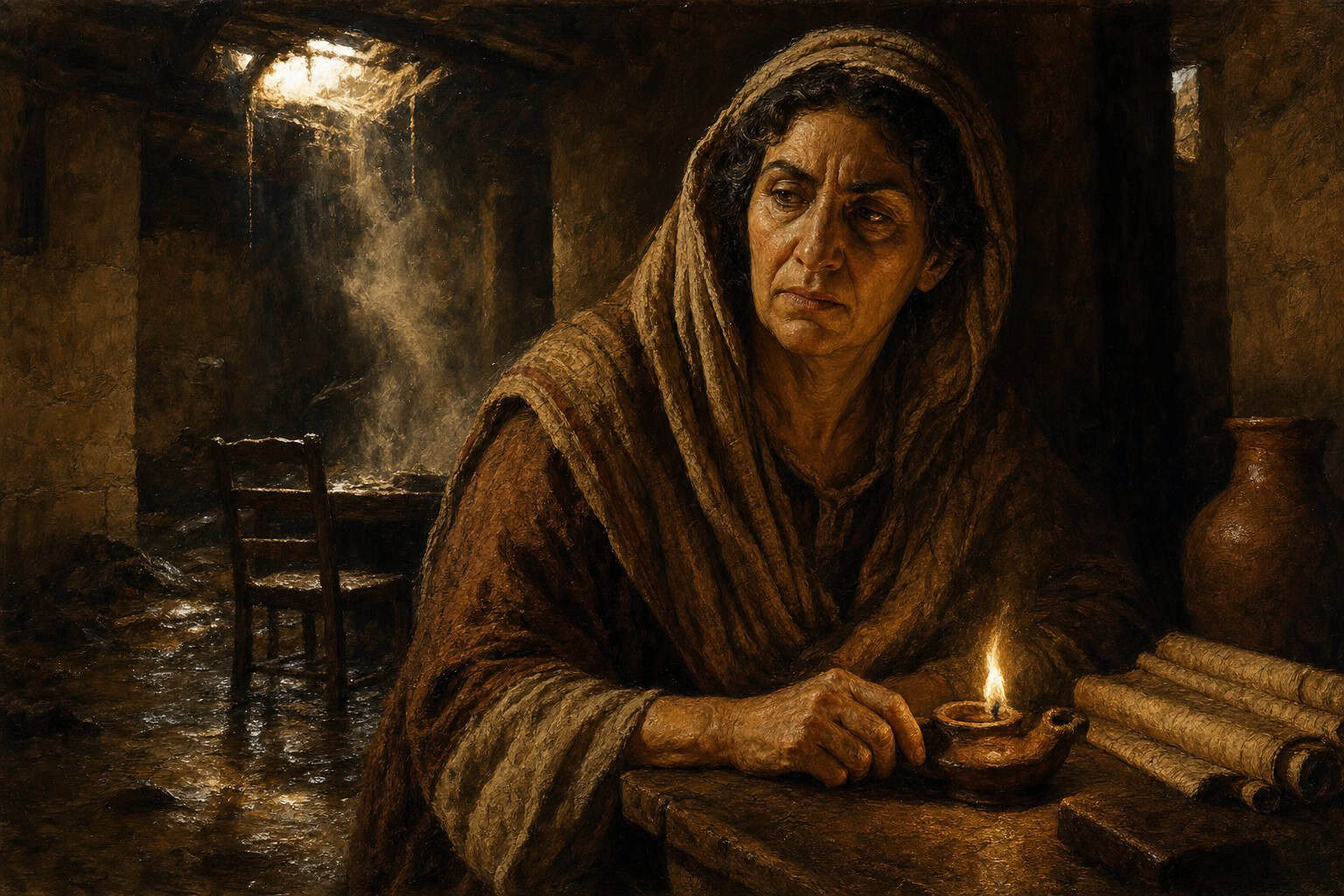
The truth speaks plainest in the wreckage: reason is a needle, emotion is the mountain, and the needle has always known which one is larger. After that recognition the chapter does not rebuild anything. The falling action is not repair; it is a slower kind of seeing. The narrator does not get his lid back. The roof stays torn open to the weather. What changes is that he stops treating the open roof as a defeat. He starts to suspect the flood was never the enemy at all – that his loss of control might be the single honest event in a life spent performing composure for an audience that never asked for it. This is the register the whole memoir keeps returning to, and it does not cheat here. God is not the hand that screws the lid back down. He does not descend to make the boiling stop or to dry the floor. He is found, instead, inside the boiling, close, unhurried, wading through the flooded room without flinching at the mess or the smell of it. The despair keeps its full weight. The narrator is genuinely undone, genuinely frightened that he is too much for any love to hold, genuinely aware that the ideal mate he keeps sketching in the margins is a wish he cannot conjure into being by wanting her hard enough. No rescue arrives to knot the thread and call it finished. But there is accompaniment, and accompaniment turns out to be the harder, stranger grace, the one that costs more to receive than a rescue would. To be met in the exact hour of your worst spillage of feeling – not corrected, not managed, not talked down, only accompanied – undoes the entire logic of the lid from the inside. Because the lid was always about being acceptable. The lid said, I will not show you the mountain, because if you ever saw its true size you would leave me standing here. And the presence that walks the flooded room says the plain opposite: I have already seen the mountain, every ridge of it, and I have not moved. The narrator refuses to announce this as a solution. He is too honest for solutions and too suspicious of his own tidiness. He keeps interrogating his own motives, asking whether even his sublimation – the writing, the sorting, the elegant grief on the page – is one more way of arranging himself so as never to be simply touched, one more polished refusal to be plainly held by anyone. He lets that question stand in the room with the steam still rising off the water. He does not answer it. He lets God stand there in the same room, unbothered by the mess, patient with a man who cannot yet believe he is worth the staying.
Steam Thinning in an Open Room
I came out of this chapter changed in one small, exact way that has never worn off. I stopped believing that keeping a grip on my feelings was the point of anything. The narrator taught me, by refusing to fake his own steadiness, that the man who never loses control is not strong – he is only well-sealed, and the seal is nothing but a slow, silent hoard of everything he could not afford to say out loud. What this chapter dares to do in these pages is treat the eruption not as a shame to be scrubbed away but as evidence worth reading: evidence that the feeling was real, that the loss actually mattered, that a creature made of dust and breath cannot be run by reason alone and does himself violence by trying. There is a tenderness under the severity here that caught me off guard. He is merciless with himself, relentless about his own self-deceptions, and yet he is not contemptuous of his own tears. He grants them their voice at last. He speaks the mountain’s true name instead of pretending it is a hill. And in doing so he discovers that the flood does not erase him – it exposes him, which is a wholly different fate, and being exposed turns out to be the one condition under which a person can finally be accompanied. If you searched for this in the dark tonight because your own control just gave way and the size of what poured out has scared you, this chapter will not hand you a trick for resealing the kettle. It will do something rarer and more unsettling. It will sit down in the steam with you. It will tell you the mountain was always larger than your needle, and that this was never a fault to be ashamed of. And it will hint, without ever pressing, that the room you assumed was empty has held a second presence all along – near, quiet, in no hurry, unbothered by the water underfoot. The book will not solve you. It flatly refuses to. But it stays. And when you have spent an entire life fastening the lid so that no one would ever leave, something that simply stays with you inside the flood is the nearest thing to being kept that you may have ever felt in your body.