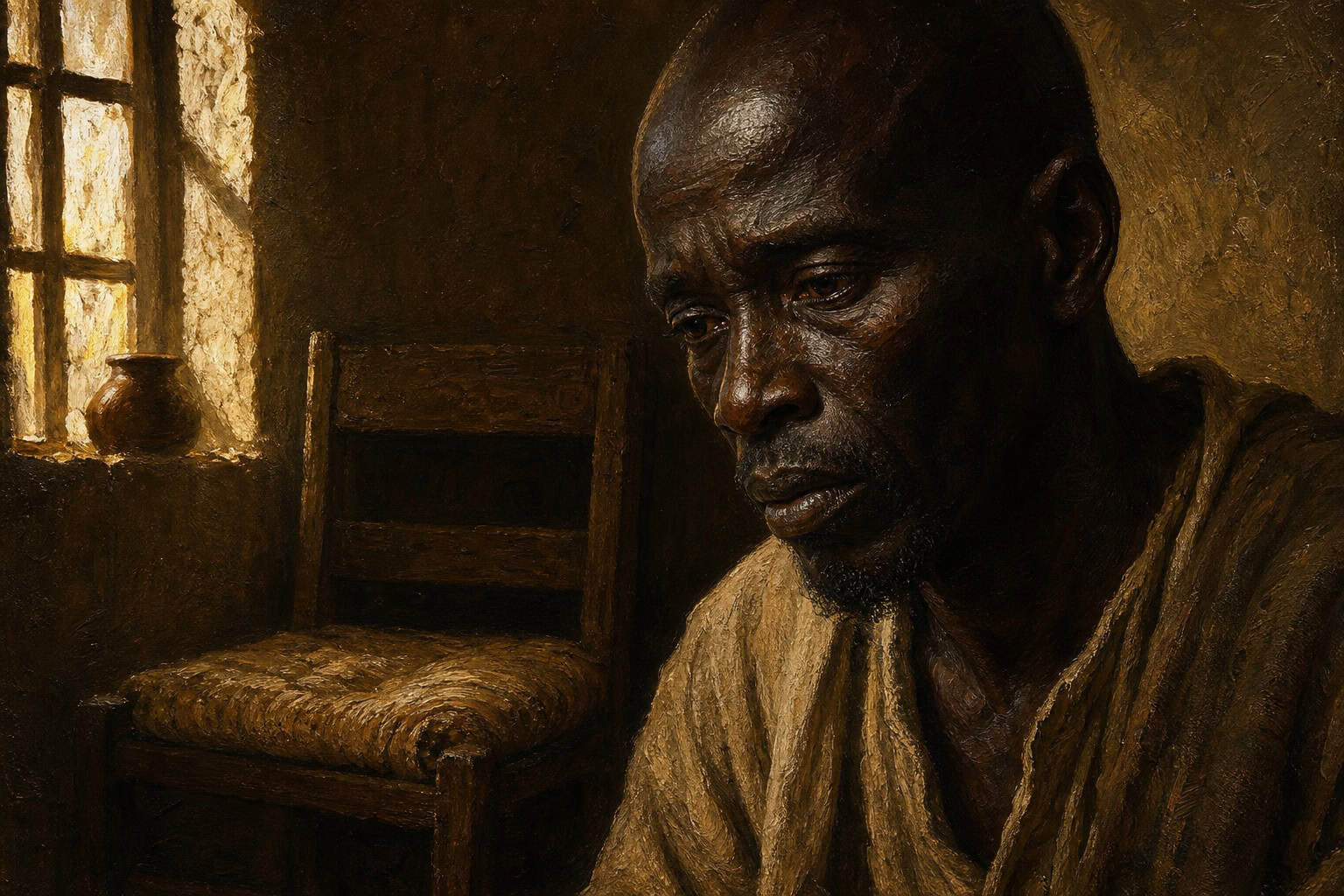
Absent in the body, present with God—how someone you love can be gone from the room and still nearer than your own breath. A reflection on presence.
The Chair Nobody Fills Anymore
You know the exact spot. There is a dent in the cushion, worn into the shape of someone who sat there for years, and your eyes go to it first, before you can stop them, the way your tongue keeps finding the tooth that is missing. The body remembers before the mind agrees to remember. What the body reports back is simple and cruel: they are not here. It is the same room. The light comes through the window the same way in the late afternoon. The dust still turns gold in it and drifts down slow onto the sill. But the person is subtracted from all of it, and the subtraction is the only thing you can feel. You reach for them the old way—with your hands, with your ears cocked for their step on the stair, with your nose half-expecting their smell to be caught in a shirt you have not washed. Nothing answers. The stair stays quiet. The shirt smells like the closet now, like cedar and dust, and not like them. This is the first grief and it is honest: the flesh you loved is gone from the places the flesh used to fill. Do not let anyone hurry you past it. The absence in the body is real and you are not imagining it—not the empty chair, not the cold half of the bed where your foot slides across sheets that stay cold, not the plate you almost set out of a habit your hands have not yet unlearned. Your hands were made to hold. Now they hold nothing, and they ache with the holding of nothing, closing on air and finding no weight to close around. That ache is not weakness and it is not faithlessness. It is love still shaped like the body it used to reach for, still curved to fit a shoulder that is gone. Before you can find them anywhere else, you have to let this be true first: that the eyes of your flesh look out at the world and find a hole in it exactly the size of the one you lost. There is no shortcut through that hole. The gold dust settles. The chair keeps its shape. And you sit down across from it anyway, because that is where you have always sat, and your body does not yet know how to sit anywhere else in this room. Let it not know for a while. Let the ache do its slow work in the muscles and the throat and the chest. Something in you is being taught, in a language older than any word, that the person and the place were never the same thing—but you learn that lesson through the body’s protest, not around it, and the protest has to come first and it has to be allowed to be loud.
Reaching With Hands That Grasp Only Air
The trouble deepens when you notice you are still doing it. Weeks pass, then months, and your body keeps reaching with the old equipment—the equipment that only knows how to grip what has weight, warmth, a pulse under the skin. You want to touch them. You want the plain animal comfort of a shoulder under your palm, a voice in your actual ear, breath you could feel on your face if you leaned close enough. This is not a low want and it is not a shameful one. God Himself came into flesh; He let frightened people press their fingers into the wounds in His hands; He ate cooked fish on a shore so they would stop believing they had only seen a ghost drifting on the water. The hunger to touch is not the enemy of the spirit. But here is where the grinding starts, where the ache turns and begins to feel like failure. You reach, and your hands close on air, and something in you whispers that if you cannot touch them then you have lost them completely—that touch was the whole thing, and without it there is only nothing left over. That whisper is the deepest lie in grief, and it is dangerous because it sounds exactly like the truth. You start to suspect that all your reaching is proof of your own smallness, your refusal to accept what has happened, your animal hunger for what you were wired to want and nothing higher than that. Was it ever more than that, you ask in the dark, lying flat and staring at the ceiling. Was it only two bodies keeping each other warm, two creatures huddled against the cold, and now one is gone and the warmth is gone and that is the whole of the story? The question is honest and it is built to break you. Because if it was only flesh, then the absence of flesh is simply the end, full stop. And your body, reaching and grasping nothing, keeps casting its vote for that verdict. The same hands that once traced a face now cannot find that face, and the wanting will not stop, and the wanting itself seems to prove there is nothing left to want. You lie awake bracing against this thought. Your jaw sets. Your shoulders draw up toward your ears, holding themselves the way a body holds just before a blow lands. And you cannot yet tell whether the resistance in you is destroying you or sharpening you—whether the ache is grinding you down into powder or grinding you toward some edge you do not yet have eyes to see. That not-knowing is its own torment, and you live inside it, night after night, hands empty on the cold sheets, no answer coming from the dark you keep questioning.
The Eyes You Were Never Taught to Use
Then, some ordinary morning, something shifts—not the loss, the loss stays exactly where it was, but the way you find yourself looking at it. You catch yourself doing a thing you would once have called foolish: talking to them. Not to the chair, not to the photograph propped on the shelf, but to them, wherever they have gone, as though they could still hear you across the distance. And the strange part is not that you do it. The strange part is that it does not feel like talking to no one. Some quiet in the room seems to answer back—not in words, not in any sound an ear could catch, but in a nearness that is somehow more solid than the empty cushion, steadier than the cold half of the bed. You realize you have been using the wrong instrument this whole time. You have been trying to find a spirit with the eyes of the flesh, and of course the flesh found only absence, because absence is all the flesh can report about anything that has passed beyond its reach. But those were never the only eyes you were given. There is another way of seeing, and grief is what pries it open, the way a seed casing has to split before the green thing inside can push up toward the light. This is the turn, and it is quiet, and it will not survive being handed to someone who insists on looking with a child’s flat and literal eyes. The person you love does not live in the flesh you can no longer touch—the flesh was only the window it looked out from, and a window is not the light that passes through it. What you loved was a soul, and a soul does not stop because a heart stops beating in a chest.
What you love does not live in the flesh you can touch; the flesh was only the window it looked out from.
Living in the House the Absence Rebuilt
The seeing does not stay steady, and you should be warned of this so it does not undo you when it fades. The nearness comes and then it goes. Some days you sit down across from the worn chair and there is nothing there but the worn chair again, and the whole hard-won knowing looks like a story you told yourself to survive a bad night. The flesh reasserts its claim. Your hands remember what they cannot hold, and the ache floods back at full pressure, as though you had learned nothing at all in all these months. This is not backsliding and it is not a failure of faith. You are a creature made of body and spirit at once, and the body keeps its own long grief that runs on a slower clock than the soul’s sudden understanding. The two are not enemies locked in a war. The friction between them—the pull of the flesh that wants what it has always wanted, the reach of the spirit toward what it now half-sees in the quiet—that friction is not the sign that something in you is broken. It is the very grinding through which you are being changed into something with a sharper edge. You do not become a person who can see the invisible by leaving the body behind like a coat dropped on the floor. You become that person by living inside a body that aches and refusing to let the ache speak the last word. So you keep talking to them. You keep the practice on the days it feels like speaking into a wall, because faithfulness was never a feeling; it is a posture you hold with your whole tired frame when the feeling has drained out of it. And slowly the house you live in gets rebuilt around the absence, room by room. The chair stays empty, but it is not only empty anymore. It becomes a kind of low altar, a place you go to be near what you cannot see with the flesh. You stop demanding that the body hand you what only the spirit can give. You learn to hold two truths in the same breath—that they are gone from the room, and that they are nearer to you now than they ever were when a warm body stood between you. This is the harder faith, the one nobody puts on a card, the one that does not switch off the dark but teaches you that Someone is standing in the dark alongside you, walking in the very hollow the loss carved out. You are not consoled. You are accompanied. And on the days you cannot feel the difference between the two, the accompaniment is enough to keep your spine upright and your feet moving across the floor.
What the Love Was Always Trying to Tell You
You arrive, in the end, at a suspicion that runs deeper than the grief itself. The love you carry for someone the body can no longer reach was never really about the body—or rather, the body was where it began, the doorway, the first grammar you learned it in, but it was always straining toward something past its own skin. Every touch you ever gave or received was reaching for a union that flesh alone can never finish, never quite complete. That is why the loss opens such a strange and unexpected passage. The absence of the body does not empty the love out; it purifies it, burns off everything that was only appetite and habit and the comfort of the familiar, and leaves the thing itself—the naked soul-longing that was underneath the whole time, waiting to be seen for what it was. You loved a spirit and called it a face. Now the face is gone and the spirit remains, and you are learning, clumsily, backward, through more tears than you believed a body could hold and still keep breathing, that this is what the love was always for. It was training your eyes. It was teaching your ears to catch what most people walk straight past without a flicker—the whisper of a presence that has no weight, throws no shadow, and is more real than the plaster walls of your house. If you had never lost anyone, you might have gone your whole life believing flesh was all there is, that touch was the ceiling of love, that when a body dies the whole story simply stops mid-sentence. Grief is a terrible teacher, but it is not a lying one. It shows you, at a cost you would never have agreed to pay, that you are more than meat cooling in a room and that the ones you love are more than meat, and that the God who took flesh Himself did so precisely to prove that flesh and spirit were never meant to stay strangers to each other. There is no cheap comfort anywhere in this. The chair stays empty in this life. Your hands will keep closing on air until the day they too are folded and laid down. But you are not left alone in the dark with your sadness knocking softly at the door of your own heart. You are being remade inside that dark, ground slowly toward an edge you cannot yet see, by a love that does not require a body to find you where you sit. If you want to stay inside this a while longer—the ache and the nearness held in the same hand, the flesh and the spirit grinding toward one harmony—Fractions of the Soul is the well this was drawn from, and it does not flinch from the dark or promise to flip on the light. It only swears, plainly, that you are not alone in the room.