Looking for real intimacy and finding only distance? Why understanding someone is not the same as being close, and how to stop hiding behind your own mind.
The Boy Who Learned to Watch
Long before I knew what I was building, I was a boy learning to survive by watching. Something broke in me young, and the break taught me a trick that felt like wisdom. I learned to step a little outside my own life, to take notes on it, to read the faces around me the way a tired student reads a hard page—slowly, looking for the trap in every line. At the time it had no name. It was only a habit, the way a child in a loud house learns to hold his breath and count the footsteps in the hall. I did not know I was making a self out of distance. When the first true love of my life shattered—when the person I trusted most laid the ground for a new life on the exact spot where my bones had fallen—the watching hardened into armor. I told myself I was understanding. I told myself that if I could name every part of the pain, and turn the betrayal over in my hands until I saw all its angles, I would master it and it would never master me. Here is the confession I want to put down plainly for anyone who is hunting for closeness and finding only more distance: I mistook understanding for intimacy. I believed that to comprehend a person down to the root was the same as being near them. It is not. In Confessions to the Empty Chair I finally trace how those two things tore apart inside me—how the skill that saved the boy went on to cage the man. The scholar’s cool distance kept me from the one thing I wanted most in the world. I could describe love with terrible precision. I could sketch its stages, predict its failures, footnote its griefs. I could not stand inside it. You may recognize the stance even if you have never given it a name—the way you narrate a conversation to yourself while you are still in the middle of having it, the way you feel more like an audience than a guest in the room you are sitting in. It wears the mask of depth. It gives off the calm scent of control. It is, underneath, a wall I built out of my own cleverness, brick by careful brick. The boy who learned to watch grew into a man who could no longer be surprised. And a man who cannot be surprised cannot be reached. That is where the whole search for intimacy begins for me—not in some technique for closeness, but in the slow, embarrassing recognition that my intelligence had quietly become the place where I went to hide.
The Coldness That Called Itself Attention
There is a specific coldness in a certain kind of understanding, and I lived inside it for thirty years without once feeling the chill on my own skin. When you study a person instead of loving them, you hold them at arm’s length while telling yourself you are honoring them with your attention. You listen—yes, you truly listen—but you listen the way a physician listens across a desk: already sorting the symptoms, already forming the diagnosis, already three steps ahead of the person who is still speaking, still trusting you with the raw thing. I did this to nearly everyone I met. I did it to the women I said I loved, tallying their moods like weather. I did it, God forgive me, to God—turning even prayer into a subject I could analyze. The cruelty of it is how noble it felt from the inside. I believed my endless observation was a form of care, and care sits so close to love that I never checked the difference. But there is a wide gap between being seen and being examined, and I handed people the second while calling it the first. To be examined is to be quietly reduced, filed, and shelved. To be seen is to be received whole, unexplained, allowed to simply be present without having to earn it. I could not do the receiving. I could not let another person sit before me without instantly turning them into a knot to untie, and I could not let myself be received without narrating my own performance in a running whisper only I could hear. The wound underneath was old and simple: somewhere in the beginning I had learned that to be known plainly, stripped of my clever framing, was dangerous. So I never stopped framing. I never once let the raw self show its face. When a real nearness came looking for me—when Leigh noticed a steady light in me and reached toward it with an open hand—even that I had to catch, and study, and fit inside my system before I would let it touch me. The fortress does not sleep. That is its particular horror. The mind that keeps you safe will never let you be foolish enough to fall, and falling is exactly what intimacy asks of a body. You cannot be intimate and in command at the same moment; one of them has to lose its footing. For most of my life I chose command and named the loneliness that followed depth. I mistook the emptiness of the watcher for the seriousness of a thinker. The distance was not wisdom. It was fear in a clean white coat, and it kept me untouched, and clean, and alone.
The Fire I Called Black Was Always White
Here is the turn, and it undid me. For years I was certain that the fire I had walked through after that first shattering was a black flame—a fire made of sorrow, of the long grey depression, of the strange self-punishment I clung to as if pain were the only honest thing left standing in the wreckage. I saw it through a blemished lens, and the lens smeared everything into darkness. I was sure the fire was destroying me and that I half deserved the burning. What I could not see then, and see now with the older man’s grief-cleared eyes, is that the flame’s blackness was never the flame’s own color at all. It was only the color of my own state, thrown back at me like a face in dark water. The fire itself was never black. It was bright. It was the refining fire of the very breath that passes between the Father and the Son, and it burned me precisely to the degree that I clung to things I was never made to hold. God did not reach down and yank the fire away from me the way He had once, when I was thirteen, healed me clean and quick. He did something stranger and far harder to bear: He stepped down into the heat and stood there with me, a fourth figure walking in the furnace, present in every single tear, refusing to leave me alone in the flame even in the long stretches when I could feel nothing of Him at all.
Understanding another person is not intimacy; being willing to be undone in front of them is.
That is the secret the watcher can never learn from his safe seat outside the room. Intimacy is not a thing you achieve by comprehension, no matter how total. It is what breaks open when you stop guarding yourself and let the fire have the parts of you that you were hoarding in the dark. I had built my entire life to dodge exactly that surrender. I had made a private religion out of understanding so that I would never once have to be exposed and small before another soul. But the fire did not respect my system. It burned straight through my analysis like paper. It reached the sealed place where my old trauma and my wound had fused into a locked room—a foothold where an older darkness had made its home and paid no rent—and it did not knock politely and wait for my clever explanation to finish. It came in as heat, plain and total. And the astonishing thing, the thing that still stops my breath in the middle of an ordinary afternoon, is that the heat was love. What I had spent decades naming my worst and most shameful self-punishment was the nearest God had ever come to standing beside me. He was not the fire’s enemy. He was the one walking in it.
Understanding another person is not intimacy; being willing to be undone in front of them is.
What the Watching Cost Me
The refining did not hand me a cure, and I need to say that flatly, because the self-help shelves are full of soft lies about this exact point. God’s nearness inside that fire did not delete the machine I had built. I walked out of the furnace carrying a steady light—a real one, the kind another person can catch sight of across a crowded room—but I also carried out the same habit of watching I had carried in, the same trained instinct to stand apart and take my quiet notes. Thirty years later I still have it. It is not a defense I have retired and hung on the wall. I chose to keep it, and I choose it still, some mornings without even meaning to, the observer clicking on before I am fully awake, narrating my grief in a low steady voice instead of simply grieving like a man. That is the honest cost, and it does not flatter me. Grace found me down inside the darkness; it did not spare me from hauling the wound out the far side and living with it. So I put the hard question to myself and I refuse to soften its edge: how much of the closeness I lost across a lifetime was because I would not set the notebook down? How many people reached toward the light they saw in me and closed their fingers on nothing but the cold glass I kept between us? Leigh saw something true and steady. She did not mistake it for the ghost of my first love; she saw the light of a man who had come through fire and lived. But could I let her come all the way near, or did I turn even her tenderness into one more subject for careful study? I am not certain I know the answer. I suspect the answer would shame me. What I do know is that the same structure can serve two very different masters. The habit of watching that kept me isolated is not evil in itself; it is a tool, and a tool takes the shape of whatever hand grips it. Held in fear, it builds a cell. The long falling-out of my whole life has been learning, slowly and against every grain of my nature, that the same fortress can be made into something else entirely. Held under love, the watching becomes a way of tending rather than guarding. The wall can be rebuilt as the wall of a chapel. The cold empty space of the laboratory can become the reverent hush around an altar. But none of that is automatic. It is a daily surrender, small and unglamorous, and I fail at it far more often than I keep it.
Where the Watcher Kneels Instead
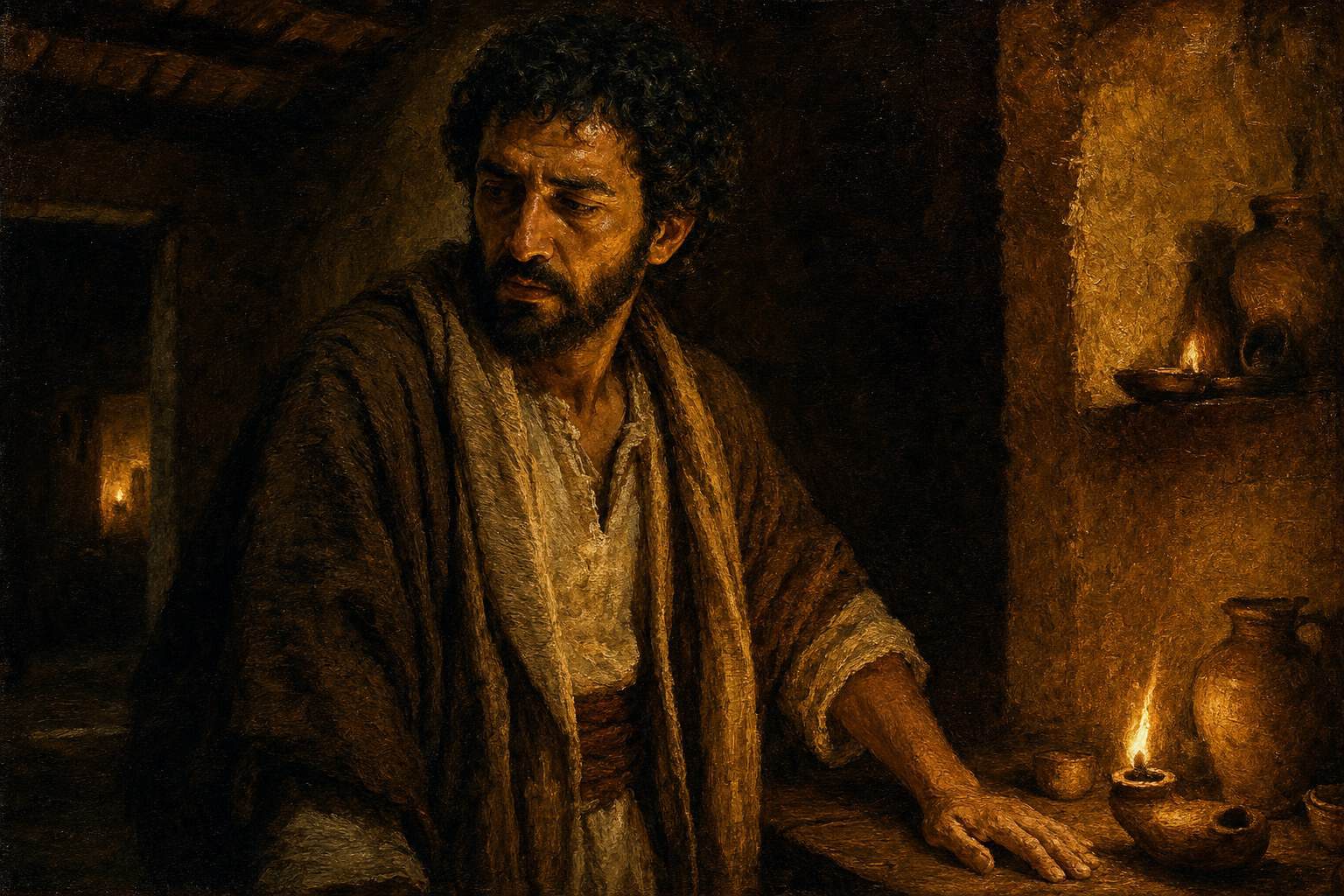
So how do you find intimacy? I will not hand you a technique, because a technique is only another wall—one more clever way to manage the thing that is supposed to overwhelm you and leave you changed. I will tell you instead what the old man in me has come to believe, having wasted most of his youth hiding inside his own intelligence. Intimacy begins in the exact place where control finally lets go. It begins the moment you stop narrating yourself and let another person—and let God—catch you plainly in the act of simply being alive and unguarded. It begins with the smallest bodily things, the ones the mind cannot outrun: your open palm laid flat on a wooden table, feeling the grain under your fingers; your breath drawn slow from the belly and not the tight throat; one true sentence said aloud with no clever frame built around it to keep it safe. The spectral fear that holds you back at a distance is not beaten by more thinking. It is beaten by returning to your own body, to the real room you are standing in, to the actual person breathing across from you. I learned this far too late to spare myself the long years of loneliness, but not too late to set it down on a page. In Fractions of the Soul I could feel the wound clearly enough, but I could not yet name what my own understanding was quietly costing me. It took the later and harder book to diagnose the fortress, to see that the very lens I had trusted with my survival was the thing keeping me from the closeness I most hungered for. That is the strange double gift of writing these things down. The same page that was once a place to observe my life from a safe distance can slowly become an altar, a place where I finally kneel instead of watch. The habit does not die. It converts. Under love’s rule the watcher stops examining the beloved and starts, at last, to adore her. The scholar sets down his pen and receives what he will never be able to fully explain. I am still learning this in the ordinary, uncounted hours, and I still stumble. But I have felt, more than once, the plain difference between studying a soul and being present to one, and I would trade every clever thing I have ever written to stay a little longer in that second, warmer place.