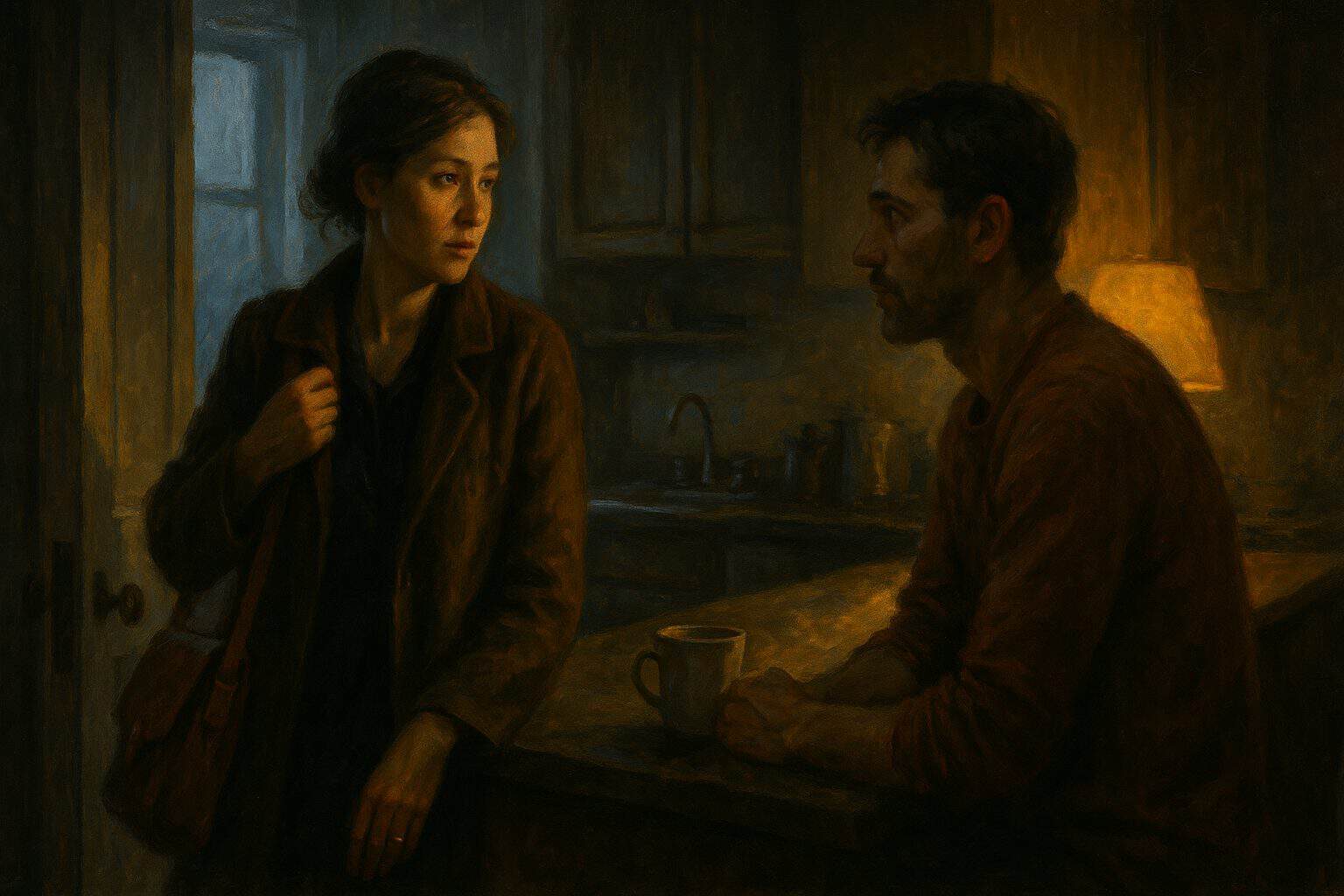
The will that chooses daily what the heart once seized in a moment.
The morning argument begins with a coffee cup left unwashed. She mentions it while rushing past, already late, the irritation sharp in her voice—not about the cup, really, but about what the cup represents: another small forgetting, another tiny proof that her needs don’t register in the automatic flow of his attention. He feels the familiar tightening, the defensive reflex rising: it’s just a cup, for God’s sake. But beneath that surface reaction pulses something else, something that Fromm would recognize as the modern confusion between love’s initial explosion and its sustained practice. The cup sits there between them like a question neither quite knows how to answer: what does it mean to love when the falling is over?
The Tyranny of the Fall
We speak of falling in love as if love were a pit we stumble into, a gravitational event that happens to us rather than something we do. The language itself betrays our confusion—we fall, we are struck, we are swept away. Love arrives as weather arrives, as accident arrives, as grace arrives: unbidden, unearned, uncontrolled. And in this falling, we experience what feels like ultimate meaning. The ordinary world suddenly blazes with significance. Every song on the radio seems written for us. The beloved’s most mundane gestures—how they stir their coffee, how they laugh at something on their phone—become revelations of inexhaustible depth.
“This kind of love requires constant assurance to keep it real and each feels compelled to bind themselves to the other’s presence.”
But here’s what the falling conceals: we are not actually encountering the other person at all. We are encountering our own projection, our own hunger for completion, our own escape from the unbearable separateness that Fromm identifies as the core human predicament. The explosive joy of early love—that sense of barriers collapsing, of two becoming one—is precisely the temporary dissolution of the boundaries that normally protect us from symbiotic fusion. We mistake this dissolution for union, this intensity for depth, this need for love.
Watch how it actually unfolds in lived experience. She texts him constantly throughout the day, not because she has something particular to say, but because the silence between messages feels like abandonment. He cancels plans with friends, not because he prefers her company in some deliberate, chosen way, but because being apart feels like suffocation. They speak of “not being able to live without” each other as if this were the highest expression of love rather than what it actually is: the confession of an addiction. “Any heat created from their sexual delight comes from the friction of using the other’s physical intimacy as a tool for personal masturbation”—not union but parallel isolation, each using the other to fill their own emptiness.
The Market of Personalities
Modern love operates according to market logic, though we desperately pretend otherwise. We speak of “finding” the right person as if they were a lost object waiting to be discovered, but watch what we actually do: we advertise ourselves, we comparison shop, we calculate value. Dating apps make this explicit—the literal swiping through human faces like merchandise—but the phenomenon predates the technology. We have always been in the business of exchanging personality packages.
She spends an hour getting ready for the date, but this isn’t mere vanity. She’s constructing a product: the right balance of availability and mystery, intelligence and approachability, independence and need. He rehearses his stories, selecting those that display the right qualities: successful but not intimidating, sensitive but not weak, funny but not frivolous. Both know, without quite admitting it, that they are not presenting themselves but a curated version, an attractive package designed for market success.
The tragedy isn’t the performance itself—all social interaction involves some degree of self-presentation. The tragedy is that we mistake the exchange of these packages for love. We “fall for” the advertisement and then feel betrayed when the actual person emerges: moody in the mornings, anxious about money, carrying wounds from childhood that no amount of romantic love can heal. The market promises that if we just find the right product—the person who “completes” us—we will solve the problem of existence. But existence is not a problem to be solved.
The Paradox of Union
True love—what Fromm calls mature love—operates according to an entirely different logic. It doesn’t fall; it stands. It doesn’t happen to us; we do it. And most paradoxically, it achieves union not through the collapse of boundaries but through their careful maintenance. “Two beings become one and yet remain two”—this isn’t mystical nonsense but phenomenological precision about how genuine intimacy actually works.
Consider the difference in lived experience. In symbiotic love—whether the masochistic submission of losing oneself in the other or the sadistic domination of absorbing the other into oneself—there is always anxiety. She constantly needs reassurance that he still loves her because she has made his love the ground of her being. He constantly needs to control her movements, her friendships, her thoughts, because he has made her submission the proof of his worth. Both are using the other to solve their own existential problem, and because no other person can actually solve this problem, the using must intensify, the anxiety must increase, the bonds must tighten until they strangle.
But watch a couple practicing mature love—not performing it for others, but actually living it moment by moment. When she tells him about her day, he listens not to gather ammunition or to find opportunities to insert himself, but because her experience interests him as hers, distinct from his own. When he expresses a need, she responds not from obligation or fear of losing him, but from genuine care for his well-being—a care that includes the possibility of saying no when her own integrity requires it. They can be apart without anxiety because their union doesn’t depend on physical proximity. They can disagree without catastrophe because their love doesn’t require the collapse of difference.
“Our love was not a succession of distractions designed for maximum pleasure and minimum discomfort; it was a continual search for deeper meaning.”
The Discipline of Choosing
Love as an art—Fromm’s central metaphor—requires what any art requires: knowledge, effort, discipline, patience, and supreme concern. But we resist this truth. We want love to remain a falling because falling requires nothing of us. We are victims of gravity, helpless against the force that pulls us down. If love is something that happens to us, we bear no responsibility for its presence or absence. We can blame chemistry, compatibility, timing—anything but our own unwillingness to do the work that love requires.
The work begins with the most difficult recognition: the other person is actually other. Not an extension of ourselves, not a solution to our loneliness, not a mirror for our projections, but a genuine separate being with their own irreducible interiority. This recognition feels like loss because it is loss—the loss of the fantasy that we can escape our essential aloneness through another person. But it’s only after accepting this loss that real love becomes possible.
Watch what happens when someone actually makes this shift. He stops interpreting her moods as judgments on his worth and begins to see them as weather patterns in her own internal landscape—sometimes having to do with him, often not. She stops needing him to validate every feeling and begins to trust her own emotional experience as legitimate regardless of his response. They both stop keeping score—who did what, who gave more, who sacrificed what—because love is no longer a transaction but a practice.
The practice has specific disciplines. The discipline of attention: actually seeing the other person rather than our idea of them. The discipline of patience: allowing their growth to unfold at its own pace rather than demanding they change according to our timeline. The discipline of courage: risking the vulnerability of genuine encounter rather than hiding behind the safety of emotional distance or symbiotic fusion. The discipline of faith: trusting in love’s possibility even when its actuality seems absent.
The Freedom to Love
“Love is free—free to accept or reject. It cannot be coerced, manipulated, purchased through compliance, or sustained by obligation.” This freedom terrifies us because it means love can always be withdrawn, always be refused, always end. We prefer the bondage of need, the chains of dependence, the prison of “not being able to live without” because at least these feel secure. But security built on bondage is not security at all—it’s delayed catastrophe.
Real love can only exist between free beings who choose each other not from need but from fullness. This doesn’t mean waiting until we’re perfectly whole—no one ever is. It means taking responsibility for our own emptiness rather than making another person responsible for filling it. It means doing our own spiritual and psychological work rather than expecting romantic love to substitute for growth. It means choosing to love even when—especially when—we don’t feel like falling.
The choice happens in the smallest moments. When he’s irritated by her anxiety about the upcoming family visit, he can withdraw into cold distance or he can choose to stay present, to be curious about what the anxiety is protecting her from. When she’s frustrated by his inability to articulate his emotions, she can attack him for this failure or she can choose patience, recognizing that emotional articulation is a learned skill he may never have been taught. These choices don’t feel romantic. They don’t make the heart race or the world shimmer with meaning. They make love real.
The Productive Orientation
Fromm distinguishes between various orientations toward life—receptive, exploitative, hoarding, marketing—and identifies only one as capable of genuine love: the productive orientation. This isn’t about economic productivity but about the basic stance toward existence. The productive person experiences themselves as the source of their own powers, as capable of giving from abundance rather than taking from need.
In love, this manifests as the difference between giving as deprivation and giving as vitality. When someone stuck in a receptive orientation “gives” to their partner, they experience it as loss, as sacrifice, as something being taken from them. They keep careful account of what they’ve given and expect equivalent return. But when someone in a productive orientation gives, they experience the giving itself as an expression of aliveness. They give attention, care, respect, understanding not to get something back but because the giving itself enhances their own being.
This explains why “falling in love” so often fails to transform into “standing in love.” The fall is passive, receptive—we are overwhelmed by feeling, carried away by emotion. But standing is active, productive—we generate love through our own activity, our own choice, our own disciplined practice. The fall depends on the other person remaining exciting, novel, mysterious. The standing creates its own energy through the very act of loving.
Beyond the Symbiotic
The symbiotic union that masquerades as love in our culture takes two primary forms, both of which Fromm identifies as escapes from freedom rather than expressions of it. In masochistic submission, one person makes themselves nothing so the other can be everything. “Most will choose to surrender autonomy and responsibility in order to find comfort in the familiar.” They dissolve their own boundaries, abandon their own desires, silence their own voice, all in the name of love. But this isn’t love—it’s the avoidance of the terrifying responsibility of being a separate self.
In sadistic domination, one person makes the other nothing so they can be everything. They must control, possess, absorb the other into their own being. Every independent action by the partner feels like betrayal, every separate friendship like abandonment, every private thought like deception. This too isn’t love but the desperate attempt to escape aloneness by consuming another person.
Both forms of symbiosis create the illusion of union while actually preventing it. Real union requires two distinct beings who meet across the bridge of their separateness. It’s the difference between two rivers converging while maintaining their distinct currents and one river being absorbed entirely into the other. The first creates something new while preserving what was; the second destroys one to maintain the other.
The Art of Standing
To stand in love rather than fall into it requires a fundamental reorientation of our entire being. We must give up the romantic fantasy that someone else will complete us and accept the difficult truth that we are responsible for our own completeness. We must stop looking for the “right” person and become the right person—not right in the sense of perfect, but right in the sense of oriented correctly toward reality.
This orientation includes humility: recognizing that we don’t know the other person as well as we think we do, that they remain mysterious despite our intimacy, that love is always larger than our understanding of it. It includes courage: the willingness to risk rejection, to bear disappointment, to stay present even when every instinct screams to flee or merge. It includes faith: not religious faith necessarily, but faith in love’s possibility, in growth’s potential, in the meaningfulness of choosing to love even when we see no immediate result.
The art must be practiced daily, in the most mundane circumstances. When she leaves the coffee cup unwashed again, he has a choice. He can nurse his resentment, building the case for his own suffering. He can attack her forgetfulness as evidence of not caring. Or he can wash the cup himself, not from martyrdom but from love—the simple recognition that sometimes we carry each other’s small failures without keeping score. When he forgets to call when he said he would, she faces the same choice. The love is not in never failing but in how we meet the failures, our own and each other’s.
The Eternal Return
Every long relationship knows this rhythm: the initial fall, the gradual disillusionment, the crisis of reality, and then—if both people do the work—the transformation into something deeper. But it’s not a single transformation. It happens again and again, each cycle deepening the love or revealing its absence. We fall out of love with our projection and, if we’re lucky and brave, learn to stand in love with the actual person.
The standing doesn’t feel like the falling felt. It lacks the intoxication, the obsession, the sense of cosmic significance. It feels instead like coming home—not to a place of rest but to a place of work, the work of building something together that neither could build alone. It feels like choice rather than compulsion, will rather than emotion, commitment rather than need.
“Do not resent the descent; it is where the ascent finds its meaning and purpose.” Each disillusionment with romantic fantasy creates the possibility for real encounter. Each crisis of difference opens the door to genuine acceptance. Each moment of choosing to love when we don’t feel loving builds the capacity for mature love. The descent is not the failure of love but its education.
The Impossible Possibility
Fromm’s vision of mature love seems almost impossible in our current cultural moment. Everything militates against it: the market logic that turns people into products, the therapeutic culture that mistakes feeling good for being good, the romantic mythology that confuses intensity with depth, the technology that promises connection while delivering isolation. We are told simultaneously that love is all we need and that we need nothing but ourselves, that relationships should be effortless and that we should never settle, that love conquers all and that love is just brain chemistry.
But the impossible becomes possible in the particular, in the actual lived moment when someone chooses to love rather than to use, to give rather than to take, to see rather than to project. It happens when someone recognizes that “It is in the tension between intimacy with God and mission in the world, between solace and struggle, that the soul grows strong”—and that the same tension exists in human love, between union and separateness, between comfort and growth, between security and freedom.
The art of loving cannot be mastered because the other person keeps changing, we keep changing, the relationship keeps changing. What worked yesterday may not work today. What brought union last year may create distance this year. The art lies not in finding the final form but in staying responsive to the endless becoming, the continuous creation that real love requires.
This is why love is an art rather than a technique, a practice rather than an achievement, a standing rather than a falling. It requires everything we have and promises nothing except the possibility—never the guarantee—of genuine encounter. It offers not the solution to existence but the courage to bear existence together, each remaining irreducibly alone yet somehow, mysteriously, not alone at all.
The coffee cup sits unwashed in the sink. Such a small thing to carry the weight of so much meaning. But this is where love actually lives—not in the grand gestures or the peak experiences but in the daily choice to see the cup, see the person who left it, see ourselves seeing, and choose what to do next. Not from the fall but from the stand. Not from need but from love.