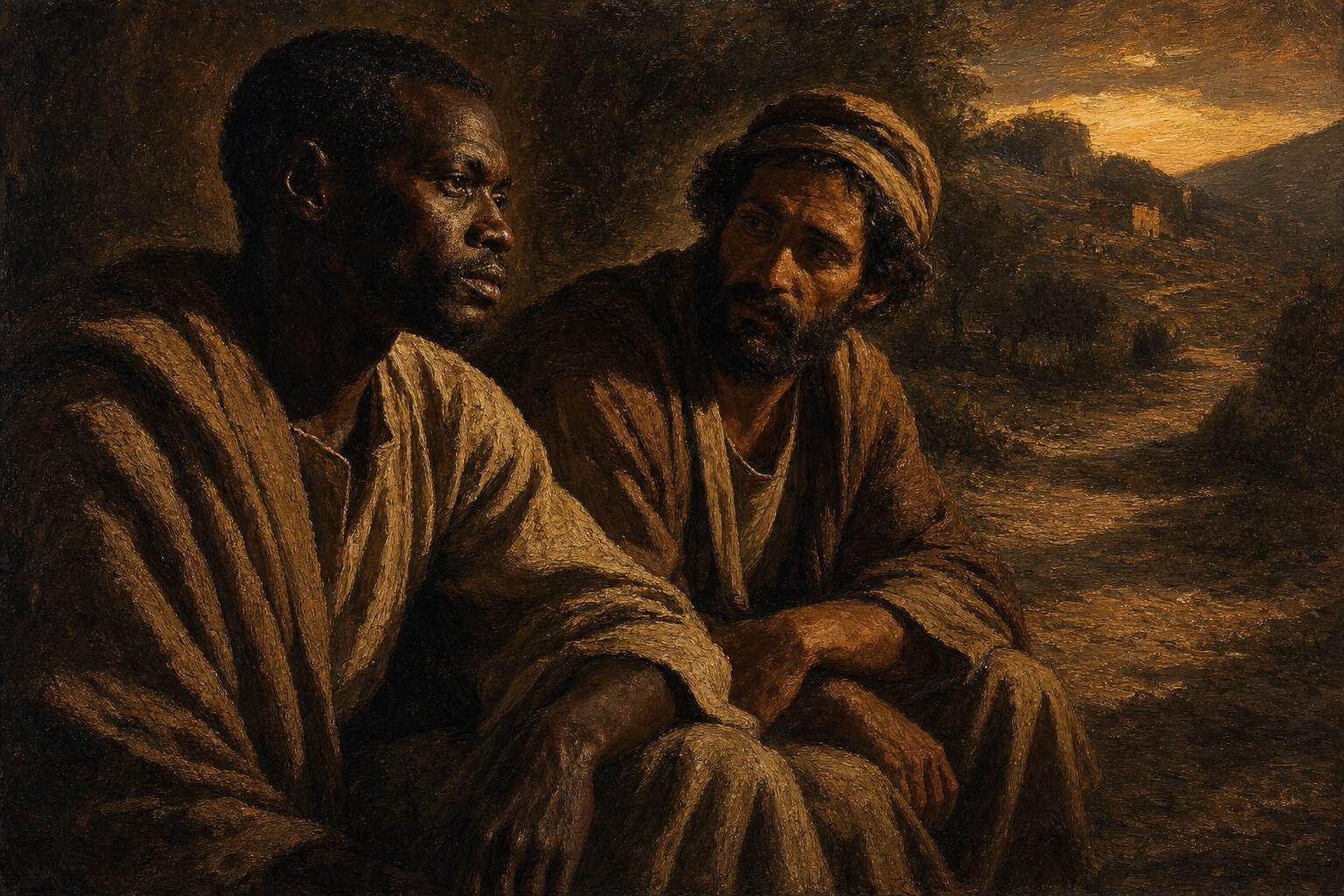
You wanted the scream in the car—the moment of being seen. Here is what it means to be named in your sadness before you can build a defense.
Facing Forward While She Watched My Jaw
I remember the way I used to arrange myself beside certain people—shoulders squared, chin fixed on some point out ahead, the whole body set like a wall that had learned to smile. That was how I sat beside her. In Confessions to the Empty Chair, near the close of one chapter and the opening of the next, the narrator lingers with a young woman at his university, a girl of keen mind and eyes that read the spirit. He tells himself the story he needs. He says he leaves her untouched out of some crooked mercy, that he refuses to spoil her with his evil, that taking her would be selfish and exploitative. It sounds almost noble on the surface. But he peels it back himself, right there on the page, and finds something colder underneath—a wish to dodge the complications, the fallout, the mess that comes with taking innocence, or worse, accepting it when it is freely offered. He names it a new level of dishonesty within, and he is not wrong. This is a man doing accounting on his own soul and disliking the sum. When you type a query about a scream in a car, about the terror of being seen, this is the country you are standing in—the seconds before someone says the true thing, while you still believe your posture holds. He faced forward. He kept his eyes on the road of his own performance, talking, in control, sure of the frame. And she was watching the side of his face the whole time, reading what he thought he had buried. The physical detail is small and exact. Two people. One gazing straight ahead. One turned sideways, studying a jaw, a cheek, the corner of an eye. It is the plain geometry of every defense we build. We aim ourselves away so no one catches us full in the face. We choose our best angle and hold it. But the sideways watcher sees the profile we forgot to guard, the muscle that tightens when we think no one is looking, the sadness that sits in a mouth at rest. That is where the danger lives—not in the frontal confrontation we brace for, but in the quiet angle we never thought to protect. He believed he was managing every variable of the encounter, deciding what she got to know, curating the version she received. He believed the offense was in the taking, and that his restraint made him clean. He was, in fact, already exposed, and had been for some time, without his consent and without his notice. The wall was standing. She had already walked around behind it.
The Ledger of Careful Withholding
Watch how the narrator reasons, because the reasoning is the tension. He decides she would have loved him had he tried. He decides she cannot separate the body from the heart, that her purity makes the very concept foreign to her, maybe even offensive. Each of these decisions is a coordinate he plots, a map he draws of a person he claims to respect. He does not encounter her. He calculates her. He treats her innocence as a fragile object he must handle with gloves, and in the handling he makes her smaller than she is, a variable rather than a soul. This is the trap the book keeps circling—the man who believes he can measure the interior of another human being from the outside, reading her like a spread of data, deciding in advance what she can and cannot bear. It is a misuse of a sharp mind. He mistakes control for kindness. He tells himself that keeping his darkness away from her luminous life is a form of love, and there is a grain of something real in it. The depraved soul does grieve to watch its corruption reach toward what is clean. There is a genuine ache in not wanting to stain what is still whole. But grief is not the same as love, and self-exile can be its own quiet vanity, a way of remaining the interesting wounded figure at the edge of someone else’s brightness. He chooses to be the sad thing she circles rather than the man who risks the plain, ordinary ruin of trying and failing. All the while he is arranging his face, his words, his careful distance, building the armor that lets him feel both noble and safe at once. The complications he fears are not really hers. They are his. He does not trust himself, and he calls that mistrust a concern for her feelings. He calls his fear her fragility. The chapter that follows will open onto Italy—Rome, the Vatican, Florence, the old architecture, the study-abroad application, the churches whose stones have swallowed centuries of prayer and grief. It is as though the whole book is gathering itself to send him toward something older and larger than his self-protection, toward altars where poverty and transcendence once met. But first he has to be caught. First the wall has to be walked around and looked at from the side. He does not know yet that the girl beside him is not a puzzle to solve or a purity to preserve or a coordinate on a map. She is a person with her own terrible, particular sight. And she is about to use it on him, unprompted, in the middle of an ordinary sentence he thought was his to control.
You Remind Me of a Sad Angel
Then she interrupts him. Out of nowhere, mid-sentence, she says he reminds her of a sad angel. And the whole machine stops. He freezes. The word for it in the book is exactly that—frozen. He turns his head, finally, to look at her, and in that turn the geometry collapses. The man who kept his face aimed forward is now caught full, and he knows it. She saw him. Not the curated version, not the managed profile, not the darkness he thought he had hidden behind wit and distance. She saw the sorrow underneath the corruption, the thing that had survived his own contempt for himself. That is the hinge of the moment, and it is why the scene answers the search for the scream in the car, the cry of being seen. To be named in your sadness by someone who was not supposed to have access is a kind of small death. He had spent the whole acquaintance deciding what she could perceive, ranking her, gloving her, keeping her at the safe distance of his pity. She perceived the one thing he had buried deepest, and she named it gently, without accusation, in a handful of quiet words. There is awe in it, if you sit still enough to feel it. A young woman with eyes attuned to the spirit looks at the side of a near-stranger’s face and sees, past all the armor, the angel he still is and the sorrow that has bent him. That sight is enormous. It dwarfs his careful ledger. It makes room for him in the same breath that it strips him bare. And it comes unannounced, the way the deepest intimacies always seem to arrive—not through his plan, not through his negotiation, but as an interruption he could neither schedule nor refuse. The word angel is the sharpest edge of it. He thought himself only depraved, only evil, a man who spoils clean things. She saw something still holy in him, still faintly lit under the rot, and she said so out loud. That is more frightening than any accusation could be, because an accusation he could absorb into the story he already tells. This asks him to believe he might still be good. It asks him to hold both truths at once—the sorrow and the light—and he has no defense prepared for mercy.
To be seen in your sorrow before you can arm yourself is to lose the one war you thought you were winning.
After the Word Lands in the Silence
What does a man do when the wall is gone and there is nothing left to hold up? He sits inside it, and the book does not rush to comfort him. He is exposed, and exposure does not heal on its own. Her word hangs in the closed air between them, and he cannot un-hear it. He had built a whole private theology of self-exile—I am too damaged to touch what is whole, so I will keep my distance and call the distance love. One sentence from her cracked that theology down the middle. Because if he is still an angel, even a sad one, then the story he told about being pure evil was itself a lie, another curated mask, another way of never being fully seen. That is the cruel arithmetic of the moment. His darkness was, in its own way, a costume he wore for cover. Being seen strips both the pride of goodness and the pride of ruin. He is left as neither the noble protector nor the irredeemable villain, only a man with sorrow in his face and something angelic he had tried hard to bury. The fallout is quiet and interior. There is no scene, no argument, no dramatic reversal—only a frozen man and a girl who has, without meaning to, become his judge. Not by any law or tribunal, but by the plain fact of her clear sight. He cannot manage her anymore. He cannot decide in advance what she perceives. And underneath the shame there is something he did not expect and cannot quite name—a kind of relief, terrible and clean, the relief of no longer needing to prop the wall against the wind. Grace does not arrive here as a rescue that lifts him out of his condition. It arrives as company, as one true word spoken into his darkness by someone who saw him inside it and did not flinch or turn away. That is the whole register of this book. God found not floating above the mess but walking straight through it, near in the exact place a man is most sure he is unlovable, present in the tightness of a frozen jaw and a mouth gone dry. The girl’s sight is a small revelation, rare and unearned, the exception that breaks in rather than the rule that comforts. It does not fix him. It names him. And to be named truly, even in sorrow, even against your will, is where being loved for real begins.
Toward the Weathered Stones of Rome
The chapter turns from here toward Italy, toward ancient churches whose stones have drunk centuries of suffering, and there is a rightness to that pivot that only shows itself in hindsight. A man who has just been seen through cannot go back to polishing his own reflection. Something in him has been pried open, and the book carries him toward places where the sacred lives in wounded, weathered rock rather than in clean and comfortable worship. He is mortal, and part of what her word exposed is exactly that—the fragility of a whole life spent guarding a single profile, the ending that waits behind every wall we raise. We do not get forever to keep our faces turned toward the road. There is only so much time to be caught, only so many chances for someone to look sideways and see the sorrow before the light goes. The scene leaves the older narrator turning the hard questions back on himself, and he does not resolve them or tie them off. Who was she, really, to him—a person, or a mirror he polished for his own reflection? What did he refuse to see in her by deciding in advance what she could and could not hold? Did he protect her innocence, or did he protect his own fear of being known and found, somehow, still worth loving? He sits inside those questions and lets them stay open. That refusal to flinch is the reason to read Confessions to the Empty Chair. Not because it hands you a clean answer about being seen, but because it stays inside the terrible, particular moment of it and lets the sad angel remain both sad and an angel, holding both without collapse. If you came here searching for the scream, the moment someone finally sees past the face you keep aimed at the windshield, the book meets you there and tells you the truth about the cost. Being seen is not soft. It is the quiet collapse of the war you thought you were winning by yourself. But it is also the only way out of the loneliness of the mask, and the God of this book waits on the far side of that collapse—not to erase the dark, but to walk into it and stay in it with you. The girl said her few words and slipped back into an ordinary afternoon. The narrator was never quite the same afterward. Neither, I suspect, will you be, once you have felt the side of your own face studied by someone who saw the sorrow you were certain you had hidden well.