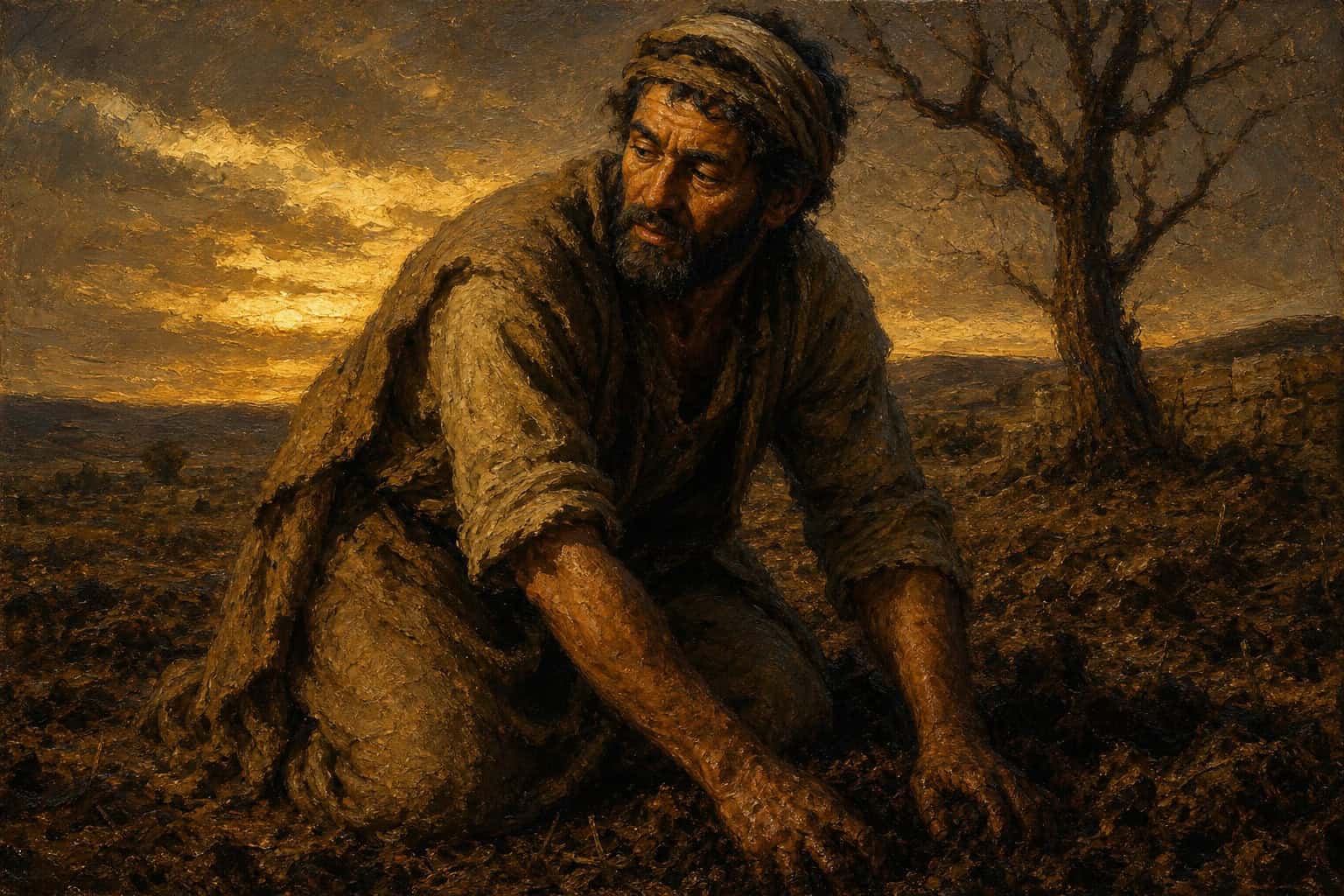
Learning from strangers means reading their fruit, not their claims. What actually grows from a life tells you who is worth following.
The Stranger on the Bus Who Got Off at the Next Stop
You remember the first time a stranger changed you, though you did not know it then. Maybe it was a man on a bus who said one hard, true thing and stood up before you could answer. Maybe it was a woman behind a counter who watched your hands shake and said nothing, only slowed her own hands so you would not feel so alone with your trembling. You did not choose these people. They arrived. They interrupted the ordinary path you were walking, the route you thought was yours, the errand you were running with your head down, and for a moment the ground under your feet shifted a little. This is the strange fact of being alive among others: the ones who teach you most are almost never the ones you selected. You went looking for wisdom in the places wisdom advertises itself — the lit rooms, the confident voices, the people who charge for the answer — and it was oddly silent there. Then some unnamed person, some accidental neighbor with coffee on his breath, said the thing and walked away into the crowd, and you never learned his name. You carried it for years. You still carry it, whatever it was, like a coin worn smooth in a pocket. The mind reaches always for the fruit that hangs just past its grasp, and often it is a stranger who bends the branch down without meaning to. But here is the vertigo underneath the gift, and you feel it in your stomach before you feel it in your head: you cannot know, in the moment they speak, whether the stranger is worth trusting. You have only their face, their tone, the weight of what they said and how it landed. You have no history with them, no track record, no reference to check. You stand in the hollow between their words and your own hunger, and you must decide something you have no ground to decide. That decision is a freedom that frightens you, because it is entirely yours. You could be wrong. You could take the poison for the medicine and swallow it grateful. And yet you cannot refuse to decide, because refusing is also a decision, a colder and quieter one that costs you the meeting entirely. So you sit near the stranger who will not quite meet your eyes, and you feel the whole situation take on a felt tone you never asked for — a mood that colors the light in the window, the salt on your lip, the silence stretched between two people who owe each other nothing. You are learning already. You do not yet know what.
Reading the Breadcrumbs a Life Drops Behind It
So you become an observer, though no one ever taught you the craft of it. You watch what a person actually produces, not what they promise you at the door. You notice the small consequences that trail behind them like breadcrumbs on a floor: how they speak to the waiter when the order is wrong, whether their calm survives being contradicted, what their children flinch at when they raise a hand to scratch their own head, what grows in the soil where they have lived a long time and put down roots. You make assumptions from this, and you are right to. A life leaves a wake, and the wake tells the truth the mouth is too clever to tell. You cannot see a soul directly, cannot pry it open and hold it to the light, but you can see its harvest, and the harvest does not lie the way a sentence lies. This is old work, this reading of loose threads to guess at the whole cloth, this quiet deduction from the tree of what the fruit will taste like before you have bitten it. You do it with strangers because you have no choice; you have nothing else to go on but the evidence they leave scattered around them. And the tension gathers right here, in the gap between how close you stand and how well you can read from that distance. The nearer a person comes, the more their life presses its texture against your skin, the truer your reading grows. From across a room you catch only the outline, the posture, the volume of the laugh. But let a stranger sit close enough that you feel the air change when their breathing changes, and suddenly the breadcrumbs multiply on the floor, the small facts thicken, and the names you were assigning stop mattering — you are no longer labeling the person, you are beginning to know them. That is the danger, too, and you feel the danger arrive with the knowing. Nearness raises the resonance, and resonance can pull you under. You lean toward the stranger to read them more truly and find yourself no longer reading at all but dissolving, losing the edge of your own body, mistaking their particular fruit for the whole destination of your hunger. The observer has to keep his feet under him. He has to stay himself while tuning to the other, adjusting the pitch of his own attention like a hand finding a string, without snapping the one string that is his own soul. And so you dread it a little, this closeness you actually need to survive. You want to be near enough to learn and far enough to walk away whole. You keep making the determination, over and over, seed by seed, face by face: is this good soil under me, or will the birds come down, or will the thorns rise up and choke the small green thing that is trying to grow?
The Teacher Who Showed You the Battle Instead of the Crown
Then one of them does the thing you never expected, and it breaks your whole method. Instead of standing above you — arrived, finished, clean, done with the fight — the stranger who teaches you most opens their own wound and lets you look straight into it. They do not say, I have conquered this; walk behind me and be saved. They say, I am still in the middle of this thing, and here is exactly what it has cost me, and here is the part I have not paid off yet. The mind you assumed was strong turns out to be battle-worn, scarred across the surface, still bleeding a little at the seams where they never fully healed. And this is the turn that undoes all your careful observing, because it reverses everything you believed about where authority comes from. You came hunting for someone who had escaped the struggle and could hand you the exit. What actually feeds you, what actually sinks into the dry ground of you, is someone who confessed they are still in it with you — walking the same dark road, planting the same seeds in the same unpromising dirt, sometimes losing the whole crop to weather they could not predict. Their honesty about the wound is not weakness dressed up in the costume of humility. It is the only honest soil a real word can ever grow in. The teacher who hides behind the crown gives you nothing you can actually use; you cannot eat a crown, cannot plant it, cannot warm your hands on it. The teacher who shows you the battle gives you your own permission to keep fighting yours. This is where the dread turns, strangely, into something like peace — though not the easy peace you had been begging for. You wanted to be lifted clean out of the struggle, set down on the far side of it dry and unbothered. Instead you were accompanied inside it, kept company in the middle of the mud. The stranger did not carry you up out of the dark. They sat down in the dark beside you and named the exact shape of it, and that naming, that willingness to stay in the low place and call it by its true name, was the whole gift you came for without knowing it. What kind of teacher is worth your ear? Not the one polished by having arrived, but the one still muddy from the road you are also on.
You do not learn from the stranger who has arrived; you learn from the one still bleeding and honest about it.
What Grows in the Soil You Actually Became
After that you cannot go back to being fooled by polish, and something in you almost grieves the loss of the easy fooling. You have seen the difference between the fruit a life claims from a stage and the fruit it quietly grows in its own backyard, and the seeing spoils you for lesser teachers forever. But the fallout lands far closer to home than you wanted it to, because now you have to turn the same observing eye back on your own field. If you read strangers by their fruit, honesty demands you read your own life exactly the same way, and the reading is not flattering, not by half. You look at what has actually grown where you have lived all these years, and you count the trampled seed by the edge of the path, the seed that sprouted on rock and withered fast for lack of any depth of water in you, the seed the thorns of your own anxious wanting choked flat before it could ever stand up straight. You cannot blame the sower for this. The seed was good. The soil was you, and you know it. This is the harder confession, and it arrives with a particular vertigo — the groundless hour of your own freedom — because you understand at last that you are the farmer of your own life and no one else chose the field or cleared the stones. You decided where to plant. You decided which strangers to trust and which to wave off, and some of the ones you waved off spoke the truest words you ever refused to swallow. You made the determination again and again, morning after morning, and half the time you got it wrong, and the crop standing in the field this year shows every wrong choice plainly. There is no comfort here that tidies this away into a lesson. The despair over a wasted season is real and it does not lift; you do not get the year back, and pretending otherwise would be a second lie laid over the first. And yet — here is the strange grace that does not haul you up out of anything — even in the counting of what died on you, you are not counting alone. There is a nearness in the dark reckoning, a presence that does not scold you and does not rush to fix the ruined rows, that simply stays there while you turn over the barren ground with your bare hands. You feel it as a kind of light that comes inside the darkness rather than in place of it, a dim and quiet company that never explains itself, that keeps beside you while your will stays dry as chalk and your understanding aches toward something it still cannot name.
The Neighbor Who Was Never Only a Neighbor
Where it settles is quieter than where it began, lower to the ground. You stop demanding that your teachers be flawless, and slowly you stop demanding it of yourself too, and something in your chest that had been clenched for years lets go a fraction, enough to breathe with. You learn from strangers now the way a patient farmer learns from the fields around his own: by walking slowly along the fence line, watching what actually thrives in this weather, kneeling in the dirt to feel the soil crumble between your fingers, refusing the smiling salesman who promises a hundredfold harvest from ground he has never once knelt in. You keep the boundary of yourself even as you lean in close, because you finally understand that losing yourself entirely in another person is neither love nor learning — it is a small death you dress up in the clothes of devotion and call beautiful. The stranger worth your ear is the one who leaves you more yourself when they walk away, not less; more able to plant your own seed, not merely enchanted by theirs. And you carry a new suspicion now, gentler than the old cynicism, less armored: that the ordinary neighbor, the accidental face at the counter, the one who interrupted your path and said the hard true thing and vanished — that person was never only a neighbor. Something met you through their eyes that was larger than the person carrying it, a depth and a height that cracked open your small round of daily tasks and would not let you shrink back into it afterward. You cannot prove this to anyone. You can only report the fruit of it, and the fruit is this: you are alive to the truth in a way you simply were not before, and the aliveness came to you wearing an utterly human, forgettable face. This is the wager you live by now, and you know it is not a safe one. You risk being badly wrong every time you open your ear to a stranger on a bus. You risk the birds and the rock and the choking thorns every planting season. But the alternative is to stay sealed inside your own single view, certain your horizon is the only horizon there is, slowly starving in a field you never once let anyone teach you how to read. So you keep the risk. You lean in, and you keep your feet under you, and you go home changed. If any of this rings the low note you have been carrying without a name for it, Fractions of the Soul is the well this was drawn up from — not to hand you the finished answer, but to kneel with you in the honest dark where the real answers grow slow and late.