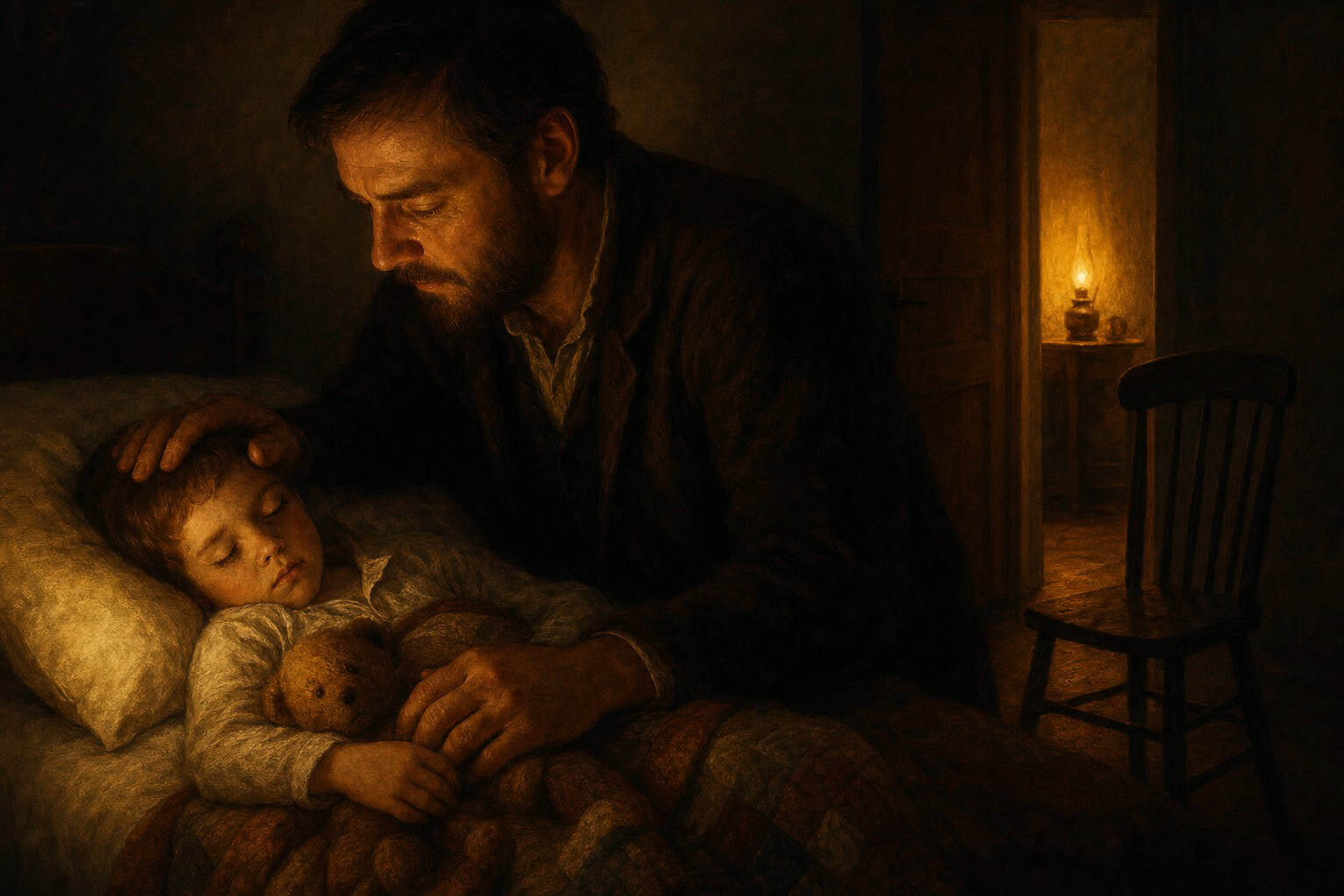
You want to heal your inner child wounds. A hard, honest look at the darkness marked before memory—and how to live with what won’t be erased.
The Cold Air and the Sudden Wetness
You want to reach back and hold the small version of you that got hurt. You want to sit on the edge of that child’s bed, speak low, and undo the damage before it hardened into who you are now. That longing is honest, and it is real, and I will not lie to you about it. But sit with me first, because the book I want to hand you begins somewhere you may recognize in your own bones. The opening of Confessions to the Empty Chair does not begin with strategy or with a plan for repair. It begins with a fragment—almost nothing—the click of a thermostat, cool air moving across skin, a sudden new wetness where there should have been none. A boy is alone in a house at night. A babysitter has done something that will not be named plainly here, something that brands him before he owns the words to hold it. He is far too young to build a memory of it. What survives is not a story but a temperature. The chill. The shock. The wet cold against the small of his back. This is where the search for the wounded child so often walks straight into a wall you did not see coming. The oldest hurts arrive before the mind can catch them. They do not sit in the album of things you remember and can turn over in your hands; they sit in the flesh. They come back as a shiver at the wrong moment, a ringing in the ears in a quiet room, a stiffness that locks the limbs when nothing is happening. You go looking for a scene to heal and you find only that cool air on skin, arriving from nowhere, decades later. The author names this at the very start, not to frighten you but to be true to you. Some marks are inflicted, not chosen. The child did not agree to it. He did not invite it. He did not deserve it. That refusal—the flat refusal of the lie that the small one somehow earned the dark—is the first honest ground under any healing worth the name. Before you can tend the child, you have to admit he was harmed by another, and that the harm went in beneath language, into the body that would carry it long after the mind lost the details. You feel the pull to fix it fast, to skip ahead to the warm room where none of this happened. Hold that feeling. Do not spend it yet. The book will not let you rush past the cold, and neither will I. The first act of care is smaller and harder than a cure: to stop, and to feel the chill that never fully left your skin.
The House Was Quiet While He Burned
Here is the part that sharpens the ache until it draws blood. In the same house, a few feet away, the parents sat or slept, living their ordinary evening. The kitchen light was warm. Dishes dried in the rack. The rooms held that low hum of a family at rest. And down the hall a child was undergoing something that would score the whole rest of his life. That gap—between the warm ordinary rooms and the cold one—is among the cruelest facts the book lays bare early on. The people who loved him most were near enough to hear a cough, and they had no idea. He could not tell them. He may not have had the language yet, or the terror sealed his throat shut, or the shame had already begun its slow work of covering him over, teaching him to fold the thing away where no eye could find it. This is the loneliness so many carry out of childhood and can never quite explain to anyone—the sense of being unseen in the exact moment you most needed to be found and lifted out. You were small. Something happened. And the grown world went on chewing its dinner in the next room. The book calls this out as a real and terrible thing, not a footnote. The child learns, without ever deciding to, that his inner world and the world of the others at the table do not touch, do not even brush against each other. He learns to keep two lives running at once. One is the ordinary boy who passes the salt. The other is the boy who now knows, in his skin, what the dark is capable of. If you are searching for how to heal, this may be the wound you share without naming it: the ache of being not enough to be noticed, not loud enough to be rescued, dissolving quietly into the wallpaper of a normal night while the family laughs somewhere you cannot reach. The intruding images did not stop when the ritual ended, either. They came back uninvited, breaking through the ordinary rhythm of a boy trying to grow up. He would be doing nothing—playing, eating, half-asleep—and the terror would surge up in him again like cold water. This is what a wound does when no one witnessed it happen. It repeats. It plays itself over and over on a loop with no off switch. The author does not dress this up as a phase to outgrow or a stage to pass through on schedule. He shows it as an obsession that broke the natural pace of his becoming a person. To heal, you first have to name that terrible gap between what happened to you and what the rest of the house believed was happening. You have to grieve, out loud, that no one came down the hall. That grief is not weakness dressed as feeling. It is the child at last being seen—by you, decades late, but seen at last, and no longer alone in the room.
The Grotesque Little Mockery
The book moves toward its terrible center, and I will keep the shape of that center hidden from you. But I can tell you the nature of the turn, because it will change how you hold your own wounds. You might expect the height of such an evening to be some grand and towering horror, a great dark thing that speaks in a voice worthy of the damage it does. It is not that. What crowns the visitation is small, childish, absurd—a grotesque little mockery, the kind of taunt a cruel boy makes across a playground, a sneer, a raspberry blown at something holy. Evil, in this scene, does not arrive as a mighty force with a speech and a crown. It arrives petty. It defaces the image of God in a small boy with something cheap and stupid and proud. And that pettiness is exactly what makes it unbearable to sit with. The child braced for the dark to at least be serious, to match in size the harm it was doing. Instead it laughed at him. This is a hard truth about the deepest wounds, and the book refuses to look away from it. The thing that hurt you may have been stupid, cheap, and small. It was not worthy of you or of the ruin it caused. It carried no grand meaning that could ever justify the cost of the damage. Much of the labor of healing is the refusal to accept that our largest wounds sometimes came pouring out of the smallest, ugliest sources. We want the hurt to have weight equal to its cost. We want a reason big enough to hold the pain. Often there is none. The evil was vain and hollow, a sneer and nothing more, and it still marked an entire life. Standing here in the middle of the book, this is where the false hope of erasing the past finally cracks open into something truer and more bearable.
The wound that came before memory cannot be recalled and undone; it can only be carried, named, and offered.
Once you stop demanding that the source be grand, you can stop waiting for a grand cure to match it. The mockery does not deserve your lifelong obedience. Naming it aloud as absurd is itself a kind of freedom—not the freedom of forgetting, which never comes, but the freedom of refusing to let something petty keep dictating your worth to you every morning. The child was defaced by a sneer. The man, decades on, can turn and look straight at that sneer and name it for exactly what it was: cheap, proud, and beaten in the end. That is where the search for healing meets the harder and far better thing the book is offering you. Not the repair of the child as if the cold air had never touched him. The recognition of the child, and the flat refusal of the lie the sneer whispered into him about who he is and what he is worth.
The wound that came before memory cannot be recalled and undone; it can only be carried, named, and offered.
Lacing the Gloves Before Dawn
So what does healing look like, if the mark does not lift and never lifts? Here the book turns from the boy to the man approaching fifty, and it says a thing you may not want to hear when you first read it. He prayed for deliverance. He believed, fully, in a God with the power to reach down and lift the darkness clean off him. And that God did not lift it. Instead, morning after morning, the man laces up the gloves and steps into the same fight he fought the day before, and the day before that, for as long as he can remember. There is no clean before and after here. There is no single session that seals the wound shut and sends you out into daylight made whole and finished. What the book offers instead is a way of endurance, and I feel the heaviness of that word as I set it down for you. The affliction stays. The strength is forged in the wrestling of it, not in being carried away from it. I know how hard that lands when you came here hoping for relief and rest. But listen to what sits underneath the hard news. The refusal to remove the thorn is not abandonment, not a shrug from heaven. It is a strange and severe form of love—one that says you will become who you are meant to be through the very struggle you keep begging to end. The wrestling is the making of you. The man is not being punished by the ongoing fight; he is being shaped by it, muscle by muscle, dawn by dawn, until the fight itself has hands and a spine. And he does not fight it alone. The book is careful and tender right here. He cannot do this by himself, and he never once pretends he can. He endures while God stays in the room with him, close, through every round. That companionship is the whole difference between combat and despair. This reframes the entire search that brought you here. Healing your inner child may not mean the child stops hurting on some appointed day. It may mean you stop leaving him alone in the dark house. You become the one who stays down the hall now. You lace the gloves on his behalf when he cannot. You carry the cold air with him instead of pretending the room was always warm. The fallout of this scene is not a trophy or a triumph—it is a weary, clear-eyed readiness. Rest is for others, the author admits without flinching; for him, war. That sentence could sound bleak read cold. It is not. It is the sound of a man who has stopped lying to himself about the true shape of his one life and has decided to keep showing up inside it anyway—faithful, tired, and, above all, accompanied. That is a form of healing our comfortable, quick-fix words almost never reach.
Learning to See Through the Dark
And yet the book does not leave you standing in unbroken night, and neither will I. There are lights, the author says, and he names them one by one, plainly, like a man counting coins he knows the value of. The consolation of being held by God when the holding can be felt. The memory of specific hours when God made Himself known and unmistakable in a life that had every reason to doubt Him. The making of two children with his wife. The patient, wholly undeserved love of that wife, and of family, and of friends who stayed. These do not erase the dark. He is stubbornly clear about that, and his clarity is the mercy hidden inside the hard news. What the lights do instead is teach the eyes to see through the dark. Sit with what that means for the child you came here to heal. You were told, perhaps, somewhere along the way, that the goal is to make the wound disappear entirely, to arrive at last in a bright room where the cool air never once touches your skin again. This book offers something more durable and more honest than that promised room. The wound remains, yes—but it stops being the only thing your eyes can make out. Love does not delete the darkness; it trains your vision until you can see the shapes of grace moving inside it. Recall the two musics from the old story that opens the book—one deep and sorrowful and beautiful, one loud and vain and endlessly braying. They do not resolve into a single sweet tune at the end. They keep sounding at once, both of them, all the way through. But the loud, mocking one is taken up and woven into the greater pattern, and even its proudest, cruelest notes end up serving the very beauty it set out to drown. That is the real promise here, and it costs everything to earn. Your wound may itself become food for someone. The private groaning of one man, held for decades in empty pews and finally spoken aloud, becomes bread for others who were sure they were the only ones alone in their dark. To confess, it turns out, is to feed someone starving down the hall. If you have carried an inexplicable darkness from your earliest years, searching for a source you cannot name and cannot picture, Confessions to the Empty Chair will not press an easy cure into your hands. It will hand you a companion who knows the cold, who laces the gloves before dawn, who has learned to read grace by the faint light left burning at the end of the hall. Go and read it. Not because it will make the child’s hurt vanish overnight. Because it will teach you, at last, to stop leaving him alone in there.