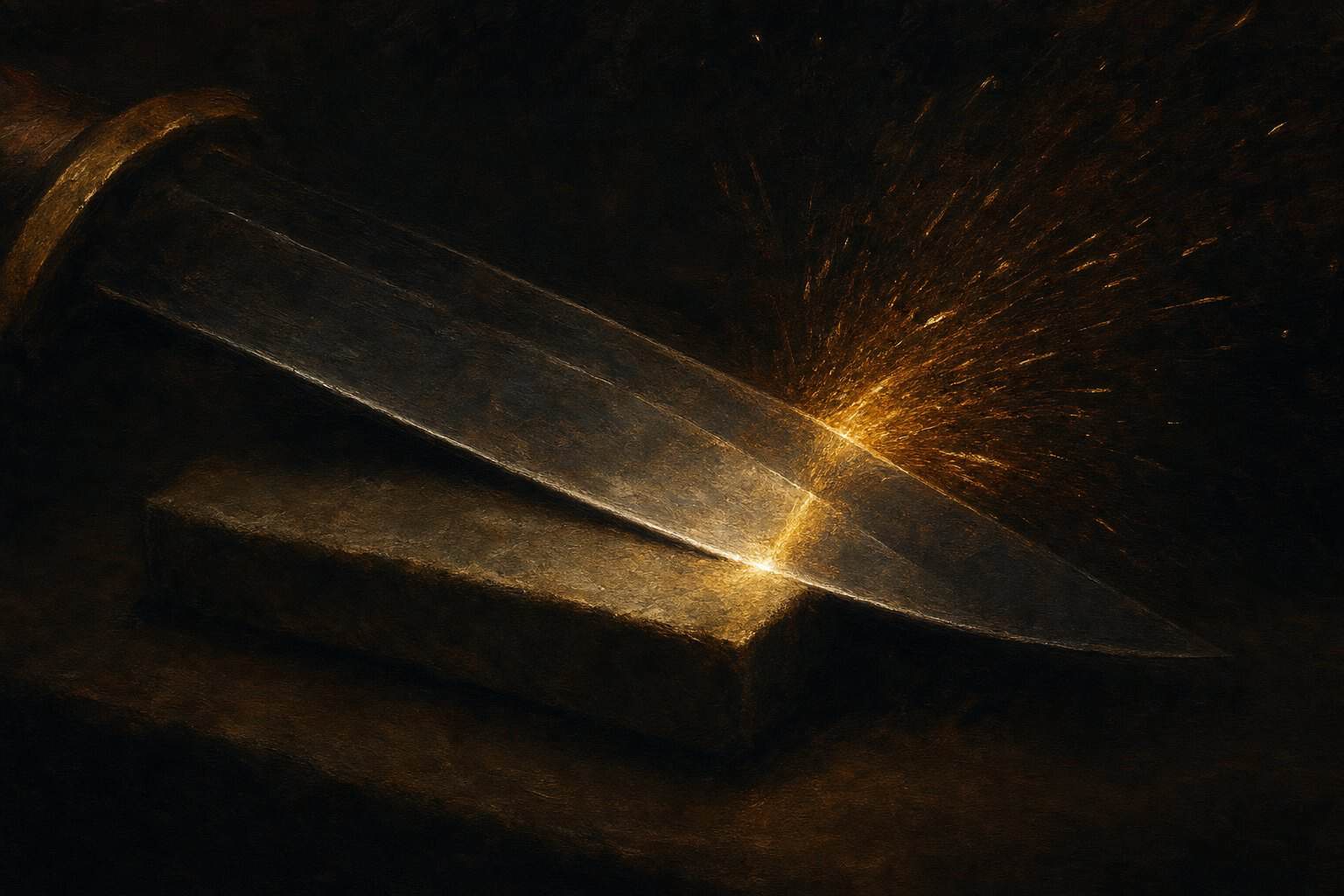
Some souls are honed only by abrasion, and van Kaam teaches us that the friction which wounds may also be the very hand of formation.
The Stone That Was Made to Wound
In Fractions of the Soul you name a terrible thing plainly: that some souls are fashioned by God to be whetstones, sharpening others through abrasive contact. There is no gentleness in the image. A whetstone does not caress the blade; it grinds it. It gives up its own substance so that another edge may be born, and it does so through a friction that both parties feel as loss. To read this vocation through Adrian van Kaam is to refuse the easy consolation that would make the abrasion merely accidental — a personality clash, a wound to be forgiven and forgotten. Van Kaam grounds his whole therapeutic philosophy in the primacy of authentic human encounter as a creative, liberating force that enables persons to discover their unique destiny. The whetstone vocation asks whether encounter can be creative precisely as friction — whether the meeting that abrades is not the failure of care but one of its strangest and costliest forms.
Willing Against Willfulness
Van Kaam draws a distinction that cuts to the marrow of this theme: the difference between authentic willing and willfulness — that tyranny which imposes itself upon reality rather than participating in it. Here is the razor’s edge of the whetstone vocation, for it can be lived either way. There is a friction that is willfulness: the abrasive who grinds another down to remake him in an imagined image, who sharpens not to liberate but to possess, producing not a free blade but a disciple. Van Kaam warns precisely against this — the counselor, the parent, the friend who inadvertently enslaves through suggestion, approval-seeking, or the imposition of his own life project. And there is a friction that is willing: the abrasive who consents to be the resistance against which another discovers his own edge, who gives up substance without demanding gratitude or conformity, who honours the irreducible uniqueness of the one he hones. The whetstone that is willing does not know the shape of the blade it serves. It only knows it must offer resistance, and then let go.
The Reservedness of the Abrasive
It seems a contradiction — that abrasion should require reserve — yet van Kaam insists that genuine care always involves a reservedness that respects the client’s freedom. Apply this to the whetstone and something luminous appears. The soul fashioned to sharpen others must hold a paradoxical restraint at the heart of its friction: it may wound, but it may not determine. It may resist, but it may not conquer. To sharpen a blade you must meet it at an angle and hold your ground; press too hard and you shatter the edge you meant to hone. This is the reserve within the abrasion — the refusal to grind another into your own likeness, the discipline of being difficult without being devouring. In the memoirs the pattern surfaces in those relations where one presence stands athwart another, refusing the comfortable smoothness of agreement. That refusal, van Kaam would say, can be a form of unconditional, unilateral self-giving — the giving of one’s hardness so that another may become sharp, while withholding the last violence that would make the other merely a copy of oneself.
The friend who grinds against you may be the whetstone God has set at your side; the grace is to be honed without being erased, and to hone without devouring.
Consenting to Be Honed
But the vocation runs both ways, and this is where it wounds most. To be the whetstone is costly; to consent to be the blade is a humiliation. Van Kaam speaks of how education, family life, and religious formation so often produce neurosis by forcing people to imitate an external perfection rather than growing from their own depth — and the honed soul feels every abrasion as exactly that threat. The one who sharpens you appears, from within your fear, as the one who would erase you. And so the temptation is to flee the whetstone, to seek only the company of the smooth, to mistake the absence of friction for peace. Yet van Kaam reveals that freedom is the core of human existence that can never be fully eradicated even under the most abrasive patterns. To consent to be honed is not to surrender your uniqueness to the one who grinds you; it is to trust that beneath the friction your own edge is being called forth — that the abrasion is not the imposition of another’s will but the awakening of your own dormant freedom, provided you refuse to let the grinding make you a disciple rather than a self. This is the terror and the hope you address to the empty chair: the plea for someone to be fully with you beyond your symptoms and failures, even when their presence takes the form of resistance.
The Blade and the Empty Chair
In the end the whetstone vocation belongs to the theatre of the empty chair, for it is finally an appeal for therapeutic presence — a cry for someone to be with you in a way that does not smooth you into acceptability but calls forth the unique ‘you’ that cannot be measured or categorized. This is post-edenic ontology rendered as friction: the fallen self is never sharpened without abrasion, never formed without being ground against what resists it. The empty chair is where you learn that the deepest formation may arrive disguised as opposition — that the friend who grates against you, the sorrow that will not yield, the vocation that costs you your smoothness, may be the very hand of the unseen listener fashioning your edge. Van Kaam would have you notice the split at the heart of it: between the real personal inner life and the proliferation of perfect manners assumed to gain acceptance. The whetstone strips those manners away. It is abrasive precisely because it will not let you stay smooth and unformed. And so you kneel before the empty chair not asking for the friction to cease, but asking for the grace to be honed and to hone without either party being consumed — asking that the grinding become, at last, encounter.