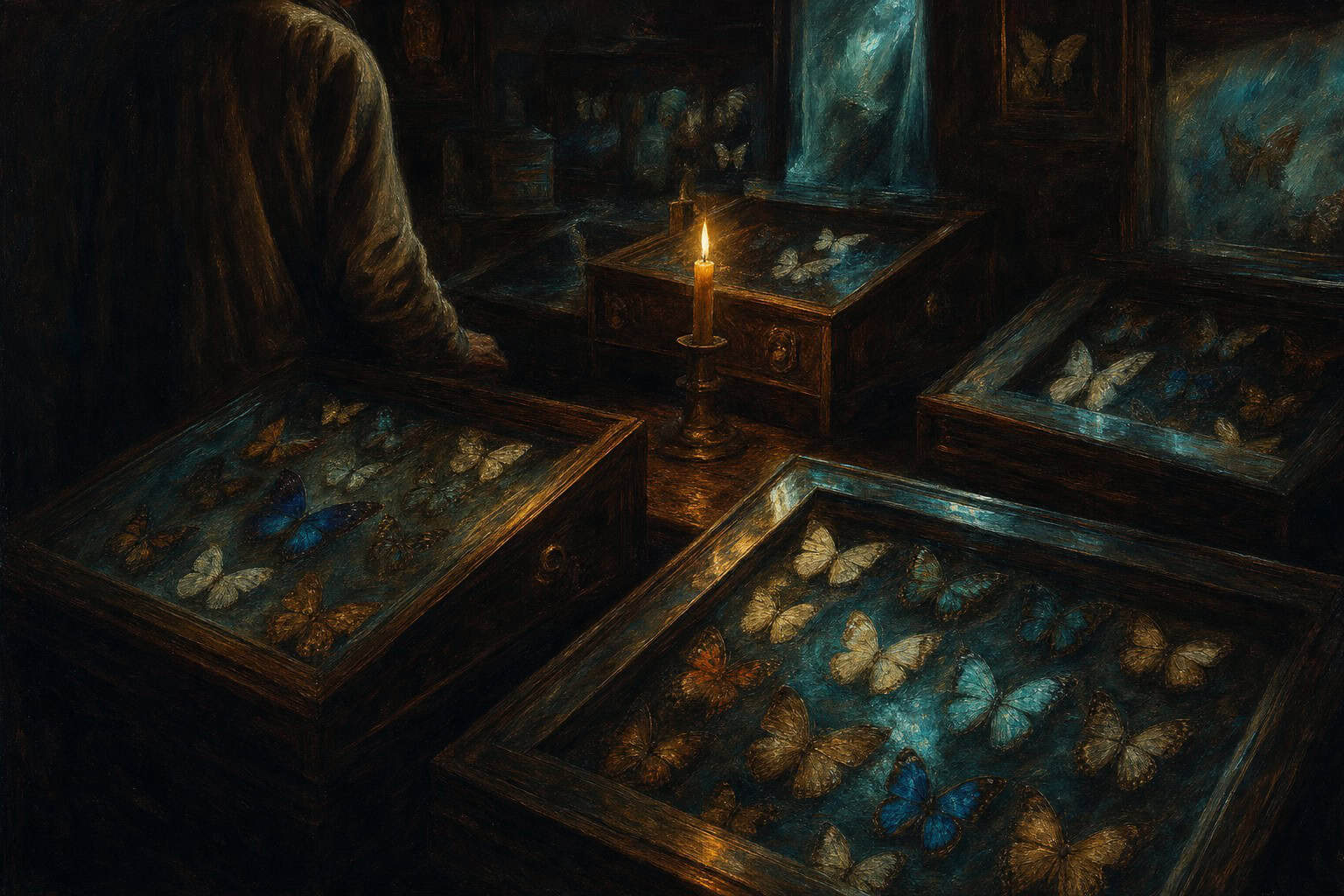
She moves through her life as a curator, not a lover, and the men she keeps hang like butterflies under glass: perfect, spread, and long since dead.
Butterflies Pinned in Morning Light
She moves through her own life like a curator, not a lover. Men hang around her attention the way butterflies hang in glass cases, each one fixed in place, wings spread, color intact, but utterly still. The literal scene is quiet: a phone on the table, screen lighting up in a slow rotation of names, small bursts of affection collected like specimens. She descends into these conversations when she wants the hum of admiration, then retreats back into herself, untouched, unchanged. No single man is allowed to become weather; each remains controlled climate, measured and safe. This passage stays close to that museum feeling: affection preserved, not lived; desire stored, not surrendered. The crystal cases are not metaphorical in her inner world—they feel as real to her as glass against skin, as labels beneath pinned wings. She has built a gallery where every man believes he is the room, never realizing he is only one tag in a long, careful row.
Making Love to a Condemned Exhibit
Alongside the gallery, there is still a bed, still two bodies that know the old choreography. They meet because they know how, because muscles remember what hearts have forgotten. He touches her with the reflex of past tenderness, but what lies between them now is more like an exhibit than a home display: staged, lit from one angle, emptied of private meaning. This moment in the chapter names that coldness without flinching. He keeps returning to this familiar body, confusing its availability with consent of the soul, as if repeated access could resurrect a vanished bond. She lets him, not out of malice, but out of the same numb efficiency with which she tends her collection. Emotional architecture has fallen in on itself, but the skin still behaves. The passage sits in that ache: two people moving through dead motions, mistaking the steady pulse of arousal for proof that anything living remains behind the glass.
Poison Poured into the Display Case
From that deadened intimacy, a darker transaction begins. His hurt curdles into curses, and he stops aiming his words at heaven. Instead, he speaks his rage toward whatever will listen now, wanting her to feel what he feels, wanting visible damage. The text does not soften what happens: he asks for harm, and harm comes, but not cleanly. Every act of spiritual malice he sends toward her leaves a trace in him, like poison splashing back up from the beaker, burning the hand that pours. This is where the image of the collection grows teeth. Her crystal cases are not only for admirers; in his fury, he becomes an object on his own shelf—tagged by the very darkness he unleashed, marked by each curse that finds its mark. The pressure here is brutal and simple: the more he succeeds at vengeance, the more he carries its taste in his own mouth, unable to spit it out.
When we keep our lovers as trophies behind glass, we mistake collection for connection, and every touch leaves a residue we call contamination.
Touching What Lives Inside the Glass
Underneath the surface drama—texts, sex, curses—this passage presses a quieter terror: contact always leaves a mark. Their bodies are not neutral instruments; they are porous, like thin glass that sweats on both sides. Ordinary readers will recognize the pattern even if the specifics differ: staying in a dead bond because the physical still sparks, nursing secret wishes of harm when discarded, feeling yourself change in ways you never chose. The book names this as a real exchange, not just hormones: through every touch, something of each person crosses over. Darkness does not stay politely on its own side of the bed. The one who enters carrying heavier shadows doesn’t have to intend anything; the weight seeps, and the lighter soul finds foreign impulses growing like mold in forgotten corners. This is the stake: intimacy is never just recreation. Every time we press our bodies together, we handle each other’s spirits with the same bare hands.
Cracks Spreading Through the Crystal
By the end of this passage, the gallery she runs and the curses he throws have begun to blur into one shared contamination. He has become one more piece in her careful inventory, yet he carries in his own flesh the backlash of the blades he sharpened for her. Their couplings now feel less like union and more like transfusions gone wrong—her unresolved darkness flowing into him, his wounded rage hardening her further. No one here is cartoon evil; each is simply using the tools they learned too young: collection instead of commitment, hex instead of lament, sex instead of surrender. The narrative pauses on that uneasy balance, refusing to tidy it into a neat moral or sudden conversion. Instead, it lets the image hold: a wall of crystal cases, once flawless, now showing thin fractures where light scatters strangely, as if something inside has begun to push against the glass from within.