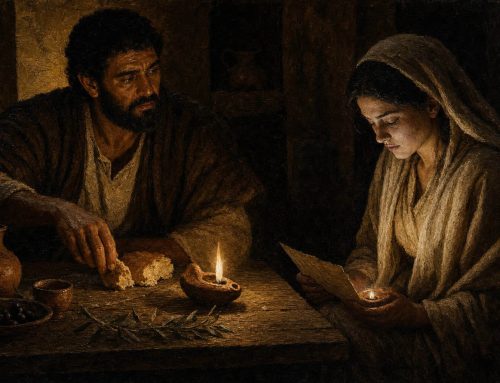
Ink smudges her hand as she bends over a book her father assigned, not knowing the discipline that once saved her has quietly become the wall that keeps love out.
Her Elbows on the Study Table
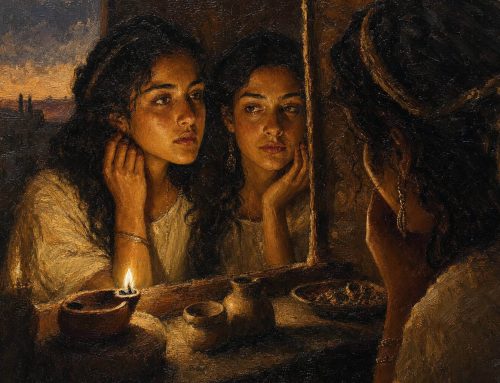
Ink smudges the side of her hand as she bends over a heavy text her father has assigned, elbows planted on the worn study table that once held his own schoolbooks. The lamplight is harsh and yellow, pooling over columns of dense print while the sounds of teenage life—laughter, music, car doors—float in faintly from the street outside. Her mother passes behind her with a stack of papers, pausing just long enough to correct her posture, to urge another chapter, another exercise in precision. Here, affection arrives as syllogisms, as Latin roots, as quizzes slipped under her plate at dinner. She is praised not for charms or beauty but for how sharply she can follow an argument, how neatly she can map a doctrine. Later, when the house quiets and her neck aches, she will feel both held and pinned by this regimen, like a specimen pressed flat under glass for safekeeping.
The Quiet Arithmetic of Unequal Exchanges
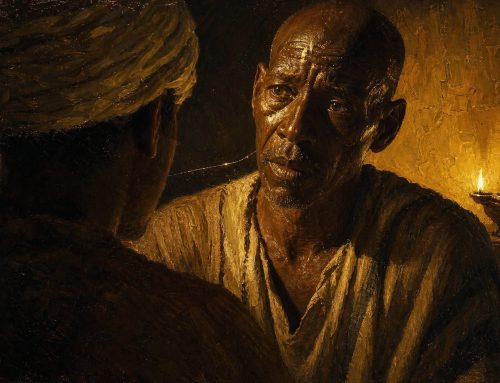
Years later, that same girl, now a woman, sits across from men who seek her counsel at café tables and parish gatherings, notebooks open while their coffee cools. They speak in rushes about confusion, failure, hunger for meaning, and she, almost by reflex, draws from the early training at that study table—stories from the saints, clear distinctions, hard-won insights about love and sacrifice. Their faces brighten as if something in them has been named, straightened, set on firmer ground. She watches them leave more focused than they came, shoulders looser, steps surer. Only when they are gone does she feel the subtraction: nothing of equal weight has come back across the table. Her questions about her own heart, about what to do with the loneliness that clings even in crowds, remain unasked, because they would require someone whose formation could bear their full heaviness.
Stacked Volumes Beside an Unwrinkled Pillow
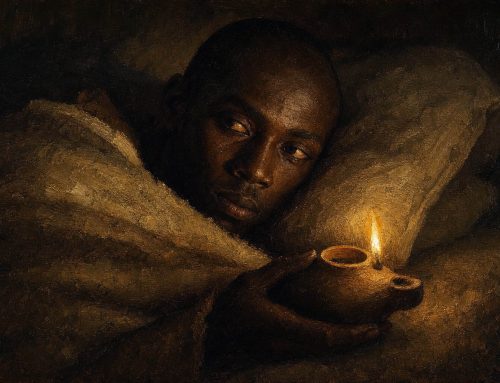
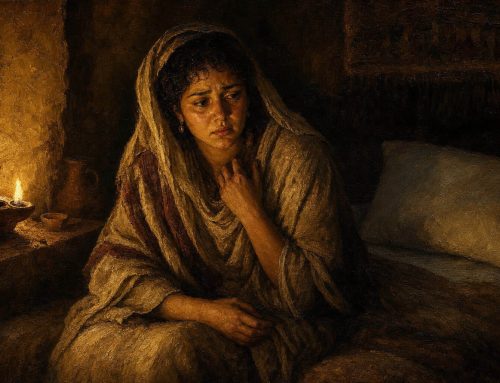
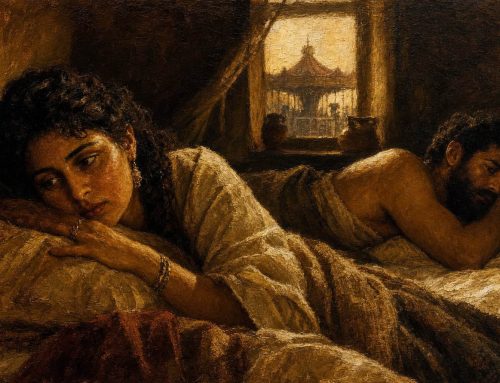
Night gathers around her bed like a second blanket, the lamp on the nightstand the only stubborn light left in the room. Volumes lean in an unstable tower beside an unwrinkled pillow, titles she has underlined to the point of tearing the page: treatises on charity, marriage, suffering, all the things her body knows more as theories than as touch. She turns the pages with a practised hand, yet a small resentment grows under her ribs each time she closes another chapter still physically untouched, still mentally alone. The same discipline that once felt like shield now feels like a weight strapped to her chest, preventing her from sinking into ordinary, mutual foolishness with another person. Her eyes burn from reading, but she keeps going, as if somewhere in the next paragraph there might finally be a voice that does not need her to translate, a mind that walks beside hers instead of being gently pulled along behind.
Some souls are armored by libraries long before love can reach them, and the discipline that saved them becomes the very wall that keeps love out.
The Reader Who Can’t Find Her Match on the Shelf
Anyone whose parents armed them with books before the world could bruise them may feel the sting of this scene under their own skin. Perhaps your childhood also smelled more of paper and highlighters than of perfume or sweat on a gym floor, your worth measured in how early you grasped arguments, not how easily you were held. That shaping spared you from much: from obvious predators, from reckless romances that leave permanent scars, from mistaking attention for love. Yet now there is this quieter cost: conversations that rarely move past admiration into genuine exchange, relationships where you are the steady compass but rarely the one guided. The world praises your insight then offers you companions who find you impressive, not equal. You turn again to the shelves that raised you, not out of snobbery but because they still feel like the only place where your full complexity is not too much.
A Bookmark Waiting Between Two Unread Pages
This passage does not resolve her hunger; it refuses to tidy the paradox of a life both graced and constrained by early mental rigor. It leaves her with a stack of books that have kept her safe and an empty space at her side that those same volumes seem to guard too fiercely. She has enriched so many stories without finding someone who can enter hers without shrinking it, someone who hears her references not as tests but as shared language. The memoir simply lets her stand there, between the lamp and the shadowed hallway, holding a book half open, feeling the ache of wanting both protection and exposure. The last image is not of her choosing one or the other, but of a thin cardboard marker resting between two unread pages, a small, silent pledge that this is not yet the final chapter of her mind’s strange solitude.