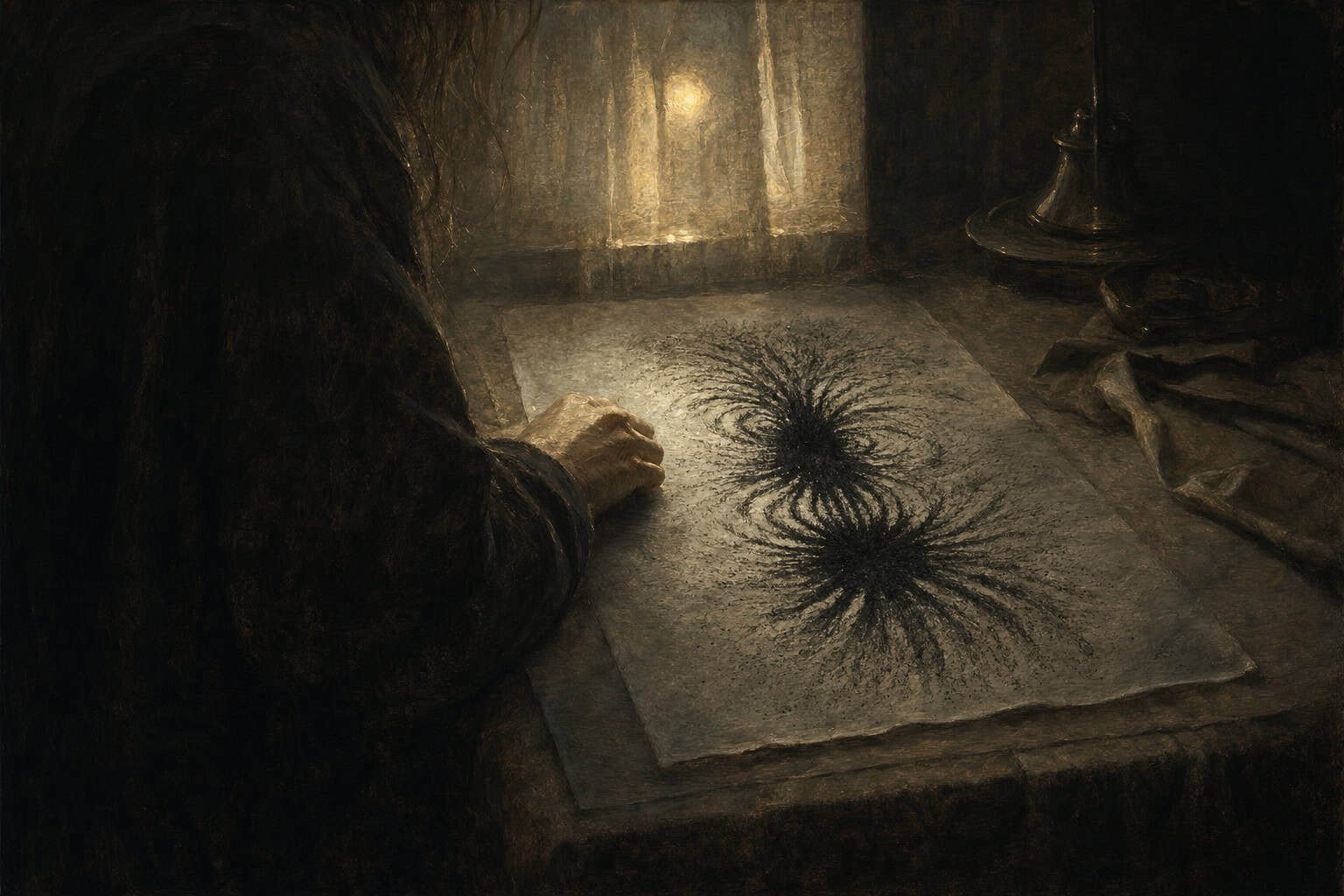
A single mood settles into the chest and the air goes thick and metallic, one small disappointment calling out to every older one, until he feels how many selves he has become and how the body breaks from being all of them at once.
Sadness Gathering Like Iron Filings
A single mood settles in the chest and the air changes, thick and metallic, as if someone has dragged a magnet across the floor of memory. One small disappointment from today calls out to an old humiliation, then another, until the mind is crowded with scenes that feel eerily the same: the missed call, the turned back, the empty chair at a table that was supposed to be full. They do not arrive in order. They swarm, pulled into the orbit of this present grief, aligning themselves around it in a dark ring. The body reacts as though every event is happening now: jaw tightens, stomach hollows, shoulders curl in. Time loses its ordinary spread; yesterday’s wound, last year’s loss, and a feared future collapse onto the same point in the ribs. In this passage, the heart discovers that mood is not color but gravity, and once it thickens, every loose shard of sorrow finds its way to the same invisible pull.
Faces Overwritten by Old Scars
Across the table, a stranger lifts their cup, and the hand looks familiar in a way that makes the throat tighten. Before they finish the first sentence, the mind has already laid a thin film of old faces over theirs: the parent who did not stay, the lover who lied, the friend who stopped returning calls. These images do not arrive as gentle comparisons; they slam down like carbon paper, pressing a faded outline onto the fresh page of this encounter. Every twitch, every pause, gets filed under an old category—unreliable, distant, hungry, dangerous. The passage names this for what it is: not second sight, not romantic instinct, but the masturbation of desire, where the ego touches itself with its own past and mistakes that friction for intimacy. The other is there, breathing, shifting in their chair, but the gaze keeps sliding off their actual face and clinging to ghosts. A living person becomes a projection screen for wounds that refuse to stay buried.
One Body Pulled by Invisible Leashes
The same body that sits at this table is already owned by a dozen invisible contracts. A phone buzzes with a work email, tugging the spine toward deference and efficiency. A text from family lands, and with it comes the demand to be soft, or obedient, or endlessly available. Later, a friend will expect lightness, a child will need tenderness, a spouse will seek presence. Each role has trained its own posture into the muscles: shoulders squared for authority, head bowed for apology, face arranged for reassurance. The passage lingers on the quiet violence of translating all these expectations into one set of nerves and bones. There is no backstage where a single, unbroken self rests between acts; there is only this flesh, always mid-transition, always slightly wrong for the next scene it is being hauled into. The strain is not metaphorical. It lives in tension headaches, shallow breaths, a chest that never quite expands all the way without guilt.
We are not one self but a legion, each mask demanding its own performance, until the body breaks under the weight of being everyone at once.
Living Under a Sky of Misfired Signals
Here the scene widens just enough to show how fragile any true meeting between two such burdened bodies really is. Every sentence spoken at the table has had to squeeze through a narrow throat of past meanings, family phrases, private taboos. A simple “I’m tired” might mean “I’m leaving” to one nervous system and “Hold me” to another. The passage names how each person’s words are chipped down as they move from raw feeling to thought, from thought to sound, then further carved away as they enter another skull already crowded with its own definitions. Misunderstanding is not an accident; it is almost guaranteed. And yet, sometimes, something breaks through—a glance that lands, a phrase that arrives carrying more weight than syllables should hold. For an ordinary life, the stakes are brutal: if communication is mostly loss, then every rare moment of real understanding becomes a kind of sacrament, and its absence feels like suffocation under a sky flickering with static instead of stars.
Choosing the Old Fire Over the Cold Unknown
The passage tightens around one final, bitter recognition: given all this fragmentation, most hearts will still crawl back to the first warmth they knew, even if it blistered them. The boy who was only noticed when he excelled grows into a man who cannot rest unless he is exhausted; the girl who learned that love comes with shouting will later flinch in the quiet arms of someone gentle. This is not nostalgia. It is a survival reflex formed in the bones. Familiar pain feels more bearable than foreign peace, because at least the rules of familiar pain are clear. To step outside those rules—to trust that there could be a different kind of embrace, a different way of being one person in one body—feels like walking naked into winter with no promise of spring. The chapter does not resolve this; it only holds the shivering figure at the edge of that field, breath ghosting in the air, watching their old fire still burning behind them.