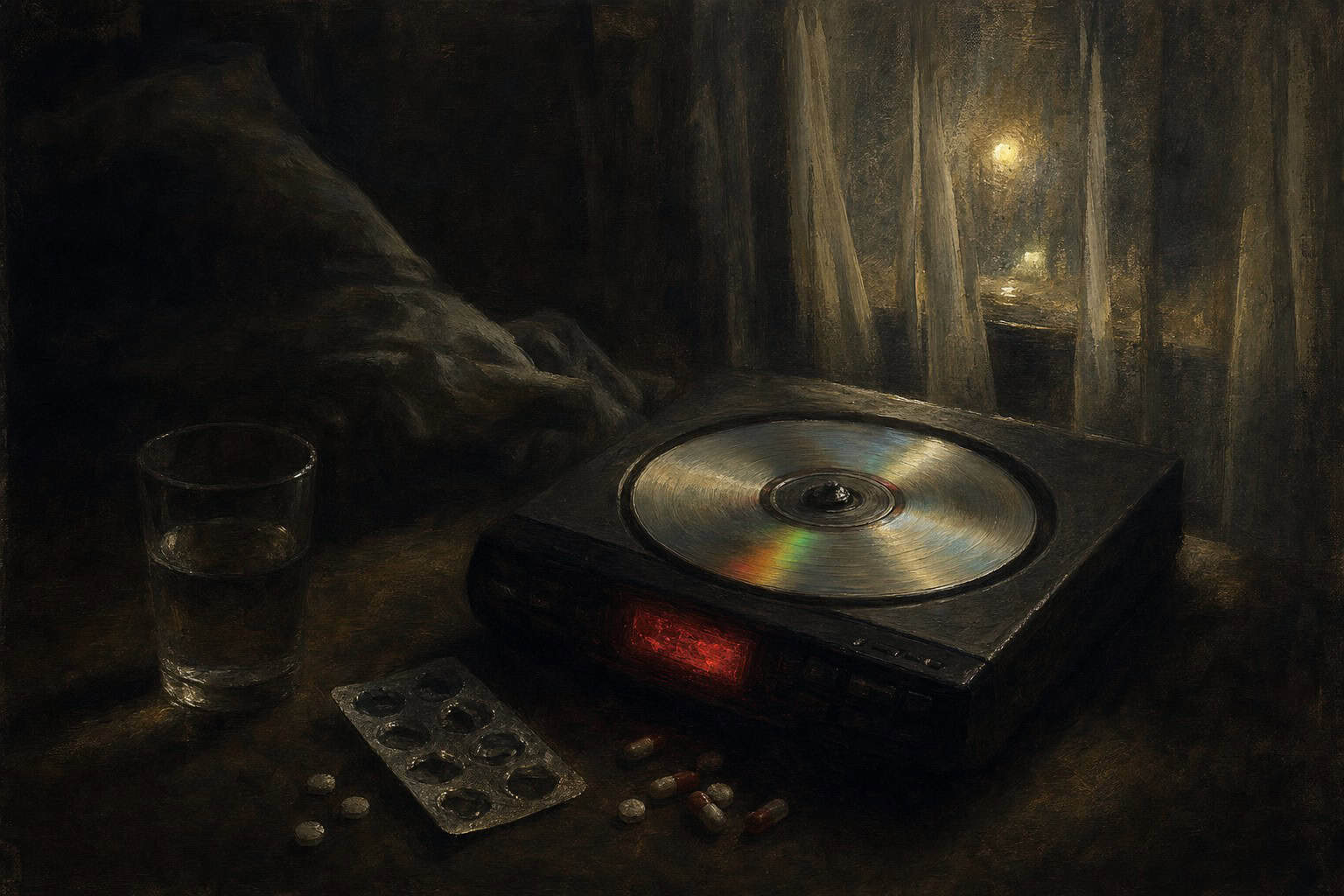
In a darkened room a single disc turns like a censer, and the boy with no psalm left learns to pray in bass and static.
A Spinning Disc in a Darkened Room
The disc tray slides shut with that small mechanical sigh, and the whole night organizes itself around one spinning circle of plastic. The younger self lies near-motionless while the album cycles again, the red display numbers the only clock he bothers to read. Pills gleam dull on the nightstand, half-forgotten, while the sub-bass trembles through the mattress and up his ribs, doing the work his soul refuses to attempt. This is not background noise; it is the only structure left, a tracklist standing in for a rule of life. Each synthetic beat presses into the chest like a thumb, marking out a rhythm so he doesn’t have to. He has chosen this album without fully knowing why, drawn to its industrial density the way a drowning man grabs anything that will sink with him. The speakers crackle at the loudest parts, and that distortion becomes permission: here, at least, something outside him is allowed to break.
Breath Measured in Bass Lines
In this passage, collapse is not a metaphor but a bodily fact measured in the narrow width of each breath. The younger self’s lungs labor while the older narrator counts, not the inhales, but the years between then and now. Heartbeat and kick drum fight for the same space in his chest, and the math of time turns cruel. He is already grieving a woman whose name he does not know, aching toward a future scene he’s scripted but never lived. Above him, unseen, the older self feels another grief: the knowledge that those imagined futures have already outrun him, that whole seasons of possibility have fallen off the map. Two versions of the same man sit inside one soundtrack, both aware—at different depths—that time is moving and they are not. The hourglass here is not on a shelf; it is in his bloodstream, thinning with every swallowed pill, every skipped meal, every song he lets run instead of standing up.
Static Cutting Through the Chorus
Then, without ceremony, the pattern stutters. The passage does not dress grace in soft colors; it threads it through the very circuitry he has trusted to hold his ruin. It lands like interference, an inner static that will not sync with the track, a presence he did not invite crowding his narrow chest. His body protests first: muscles tense, stomach turns, the familiar grooves of numbness suddenly feel too tight. He has spent months, maybe years, tuning himself to this industrial liturgy, every self-destructive ritual calibrated to keep him just this side of disappearing. Now something interrupts the setlist. It does not mute the darkness; it jostles it, knocks the needle sideways across the groove of his favorite despair. The passage lingers right here, at the point where rescue feels like misalignment, where what is breaking in is not yet welcome, not yet named as mercy, only known as the unwelcome fact that he cannot keep spiraling the way he planned.
When darkness becomes your only prayer and the beat replaces the psalm, grace does not give up; it simply finds its way in through the speakers.
When Your Playlist Remembers What You Survived
For an ordinary reader, the scene may call up that one album, that single song, welded forever to a season when you were not sure you wanted to keep living. The book names what many never say aloud: we curate our own liturgies of collapse, choosing sounds strong enough to contain what would otherwise rip us open. The younger self uses Ultra this way; the older self narrates with the hindsight of someone who has outlived that room yet still feels its bass under his skin. This is where the passage presses: on the quiet fear that if the music changes, we will lose not only our coping but also something essential about who we are. It suggests, without resolving, that grace often reaches us by entering the very structures we built to stay far from God. For the one who reads with earbuds in, whose history is organized by albums instead of feast days, the question is not theoretical. What would it mean if the track that held your worst nights became the place God keeps returning to find you?
A Beat That Refuses to Disappear
By the end of this passage, nothing is neatly sorted; the disc still spins, the body still aches, and time still moves in only one direction. What has shifted is more subtle and more dangerous: a new rhythm has entered the mix, and it will not leave, even when the track ends. The older narrator does not offer an easy trade—dark songs swapped for bright hymns, sorrow exchanged for tidy joy. Instead, he hints at a stranger possibility: that the very dissonance which scored his near-destruction might be taken up, not erased, by a love that does not flinch from industrial noise. The question of consent hangs over the scene like smoke: can he allow this love to touch the part of him that only ever trusted distortion? The passage stops short of an answer, leaving us with the pulse of the sub-bass still thudding in the chest, and a second, quieter rhythm beginning to insist on being heard alongside it.