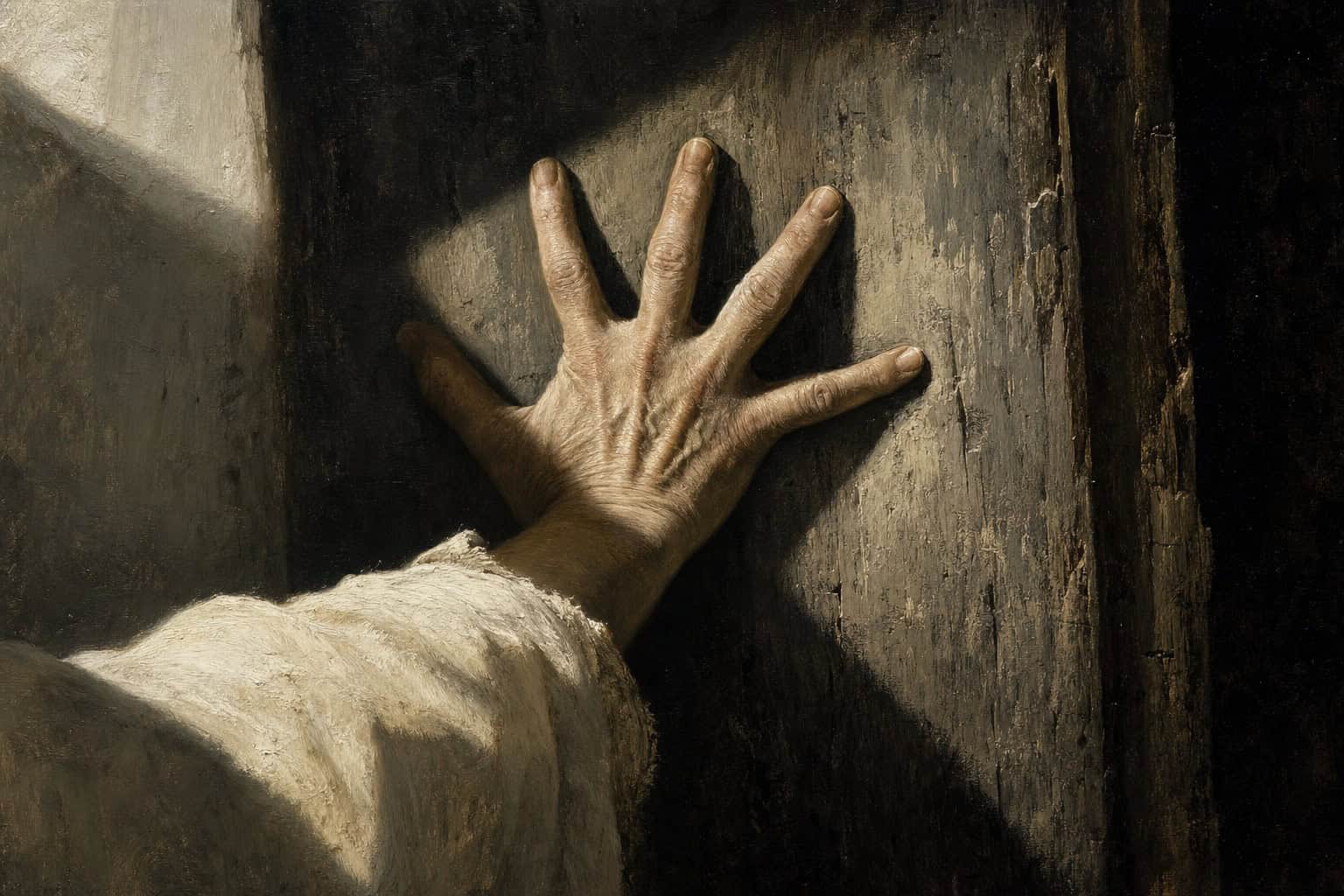
He spreads his hand flat on the desk to feel the grain hold him, and learns that even ruin must knock — that nothing crosses into a soul without its quiet yes.
Hand Flattened on the Desk
Skin meets wood with a small, almost inaudible scrape. The young man spreads his fingers until the tendons pull, as if widening his reach could anchor him more firmly in the room. Grain presses back against his palm, ridged, indifferent, solid in a way his own thoughts are not. He has learned, by painful experiment, that this simple act can cut through the layered voices and visions that crowd his inner world. No Latin, no special formula—just breath drawn from the belly and pushed out slowly, feeling ribs expand against fabric. He names one small fact aloud about this desk under his hand. The word feels clumsy at first, but the sound of his own voice tethered to a physical object begins to steady him. Here, in this narrow gesture, spiritual warfare refuses to stay abstract. Wood, flesh, breath: this is his first line of defense.
The Lock No Spirit Can Pick
As his palm rests on the desk, another truth comes into focus with the same hard clarity as the wood grain: nothing enters the soul’s inner chambers without some kind of yes. Heaven itself waits on that yes, never forcing its way past the threshold of freedom. Hell, with all its rage, is bound by the same law, so it learns to twist exhaustion, fear, and confusion into something that looks like agreement. The young man remembers how, as a child, terror was turned into a kind of nod—how violation dressed itself as attention, as love, as secret power. That resemblance to consent became a tiny crack where darker presence could settle. Now, hand on the desk, he recognizes that every spiritual encounter—holy or unholy—leans on this same lock. His will is not a polite accessory to faith; it is the gate itself, and it can be worn down until no feels impossible to say.
When Fire Feels Like the Same Heat
There are nights when the pressure inside his chest feels like something clawing to get out, and other nights when it feels like a furnace turned up past safe. The body cannot tell the difference; sweat is sweat, trembling is trembling. In this passage, he sits with that ambiguity while his hand stays welded to the desk, trying to decide whose fire he is enduring. The sorrow that rises has a flavor he has always labeled as demonic—heavy, thrilling, almost sweet in its cruelty toward himself. Yet something in it also strips him, refuses his old lies, drives him back to that single touch of wood as if to say: stay here, do not disappear. He cannot sort which voice is pushing him toward destruction and which is dragging him toward purification. Both tear. Both demand surrender. And in the middle, his will flickers between them like a candle in a crosswind.
Even hell respects the soul’s consent; the terrible freedom we can never surrender is that nothing enters us, for ruin or for grace, without our yes.
Splinters Where Therapy Cannot Reach
An ordinary life can carry wounds that feel strangely resistant to every tool on offer. You can unpack memories, name patterns, understand why you flinch the way you do—and still find certain hours of the night ruled by a presence that feels foreign, like something squatting in the hollow your trauma carved. This passage names that hollow as real territory, not just metaphor, and refuses to pretend that one kind of help will be enough. Some of what lives there needs a human listener and years of patient work. Some of it needs priestly hands and words of absolution. And some of it, the part that feels like a bruise behind the eyes, needs exactly what the young man is doing: a return to the body, to creation, to wood under skin and breath counted in fours. For a reader, this scene quietly suggests that healing may require multiple languages—clinical, sacramental, physical—spoken over the same old scar.
Grain Lines Running Under the Skin
The passage leaves him where it began: palm pressed flat, fingers aching now from the constant pressure. He has not solved which sorrow is which, has not mapped every demonic foothold or traced every holy fire back to its source. What he has, in this moment, is the stubborn reality of the desk answering his nerves with its own mute pattern. Breath moves in and out without consultation. The one true sentence he spoke a few minutes ago still hangs faintly in the air, not as magic, but as a marker that he chose to stand inside his own body instead of drifting into the currents that pull at his mind. Consent, for now, looks as small as refusing to lift his hand, as steady as letting the wood’s grain run its quiet lines beneath his skin.