Smoke curls over the old impossible question — how to guard the small chapel of the self and still feed the world — while grace prepares to come in, uninvited, through the wine.
Cigarette Smoke Curling Over a Question
Cigarette smoke rises over a problem that will not leave him alone: how to guard the small chapel of his own soul and still obey the command to feed others. In this chapter, that conflict is not argued in a church or a therapist’s office but in places that smell of wine, tobacco, and old paper. A professor in corduroy asks about Augustine at a Roman mixer; years later, psychology faculty invite seniors into their private home. In both settings, rank loosens, candles and track lighting replace fluorescent bulbs, and conversation slips from lecture to shared confession. Yet beneath the warmth, he carries suspicion like a second spine, convinced most people arrive only to take and leave him emptied. The terrain of the chapter is this: a man trained by betrayal standing among people who call him “peer,” trying to decide if opening his mouth—or his heart—will once again turn his love into something trampled underfoot.
A Glass of Wine in One Hand, a Mandate in the Other
The reckoning that orders the whole chapter rests inside a very specific tension: his body knows how to withdraw; the Gospel demands he step forward. He has learned the language of predators in polite clothing, of hunger that smiles while it feeds. So when Scripture tells him to love this world as himself, he hears it as an almost impossible command. In Rome, a simple social with professors and students exposes a crack in that conclusion. Wine in plastic cups, talk of theology under a softer sky, and the strange relief of not playing the brilliant cynic begin to unsettle him. Years later, at a Dallas faculty gathering, that inner argument returns with sharper teeth. He believes he has finally mastered the discipline of keeping his inner room untouched while navigating human need. This evening will test whether that balance is wisdom or fear wearing a pious mask.
A Pontiac Parked Among Mercedes
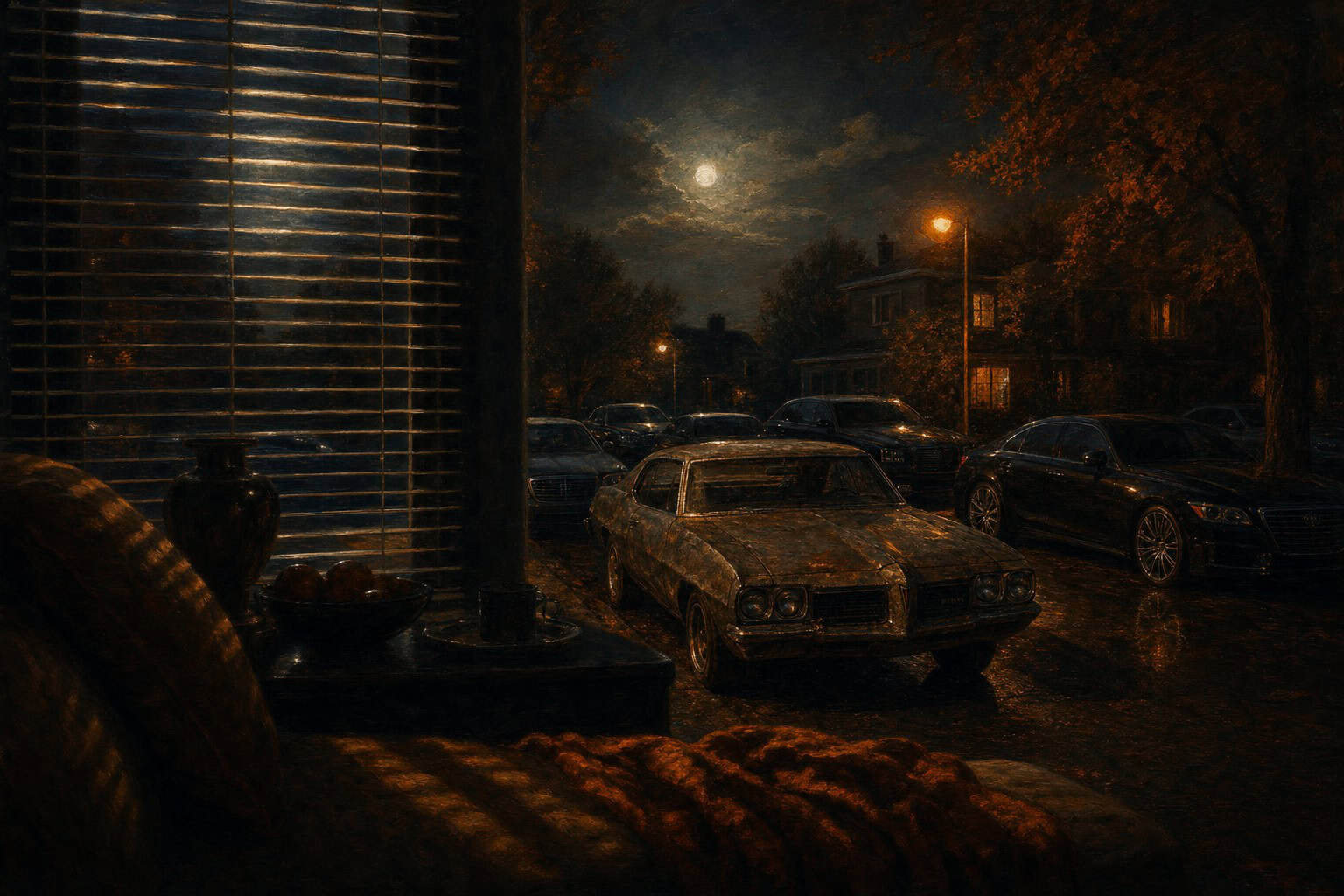
The chapter’s feeling unfolds through a series of jolts, each one practical, physical. His aging 1973 Pontiac noses between polished German sedans in a wealthy Dallas enclave, and envy joins him in the front seat. Inside the professor’s home, every object radiates stability he has never known: curated art, careful lighting, food arranged on real platters instead of paper plates. He hangs his black trench coat, adds his CD to a stack of safer choices, and steps outside with Marlboro Lights and wine to do what he always does—fade to the edge of things. As conversations thicken into smaller clusters, his body remembers Rome’s strategy of survival: become still, let others overlook you, wait out the noise. The pressure grows not from drama but from this contrast: his practiced solitude against a room organized to draw people together. The air hums with low music, glass on glass, soft laughter—and the sense that his old pattern will not be allowed to repeat unchanged.
Grace rarely knocks; more often it dissolves the fortress from within, arriving through wine and music and a stranger bold enough to reach for you.
Track Five as Confession
His choice of music becomes the chapter’s hinge. Asked to bring something to play, he selects The Crystal Method’s “Comin’ Back,” a song more at home in Deep Ellum than among polished wood and inherited silver. That track is not random; it carries the part of him that loves noise, bass, and reckless nights, the side that rarely appears in academic spaces. Dropping the CD onto the pile, he tries to control the risk: let the song speak, while he stays half-invisible at the wall. But one woman watches closely. A visiting physician with red hair and a German accent notes which disc is his, tracks him through the dim room, and names his contribution without flinching. When she walks over, takes his glass, and begins to slide his jacket off his shoulders, the music’s title gains weight. His hidden confession is no longer only in sound; it is being drawn, piece by piece, from his actual body.
Red Hair in the Mood Light
By the time her hands find his sleeves, the chapter has made a promise it refuses to cash in quickly. It promises that uninvited grace does not always arrive wearing linen albs or with gentle phrases; sometimes it has green eyes, a medical degree, and the nerve to undress a stranger at a colleague’s party. For a man formed by early violation, this is not a simple flirtation. It is a live wire thrown across his oldest dread: that what feels like attention may again be consumption, that what looks like favor might be another way of being used. Yet the story refuses to sort her into saint or wolf. Instead, it holds the moment right where it hurts, where desire, power, class, and calling collide under soft, flattering light. The reward for entering this chapter is not a neat lesson but the uncomfortable nearness of that collision, as track five thumps through speakers and her red hair briefly burns brighter than the art on the walls.