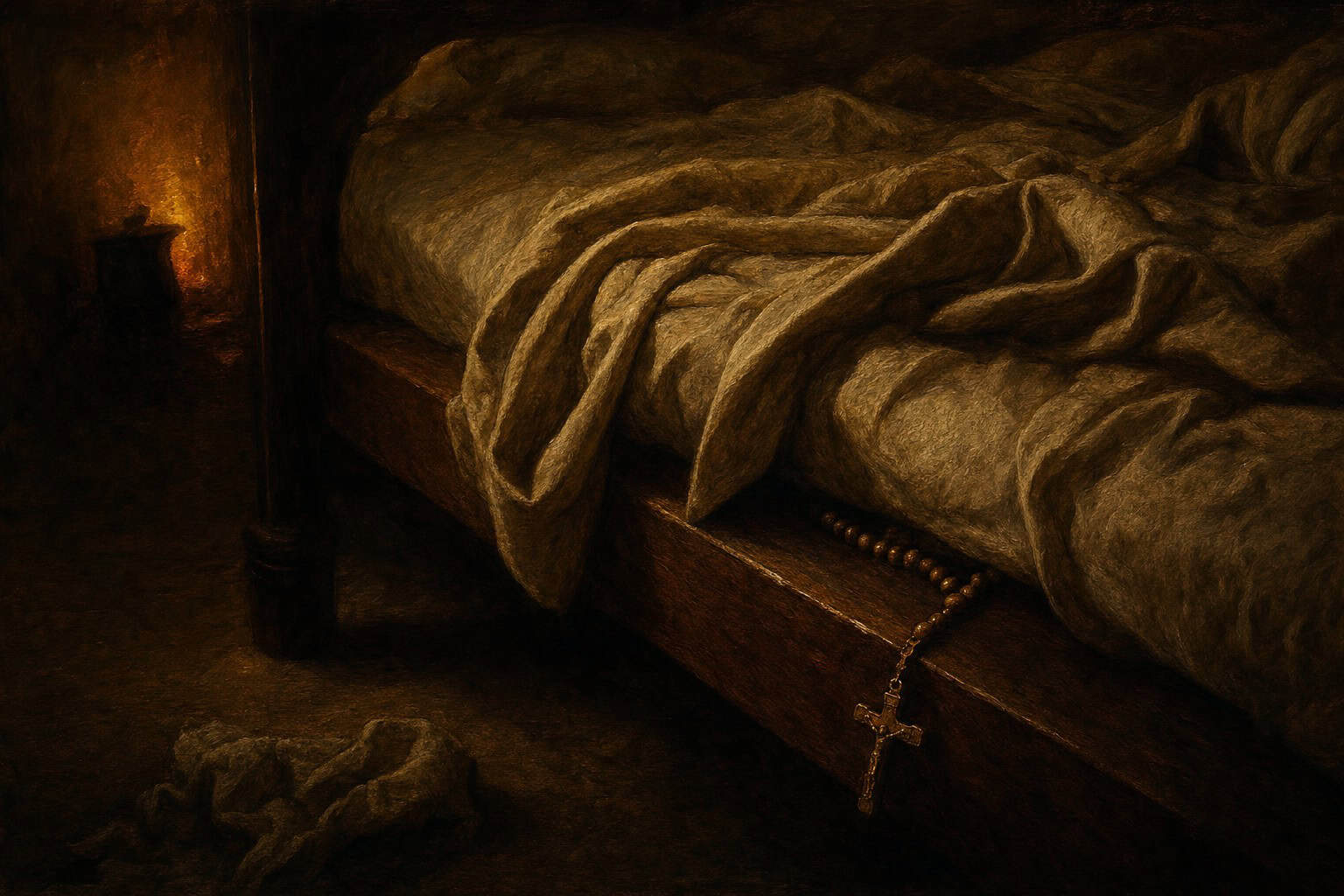
The sheets are twisted from a contest, not from tenderness, and he reaches past her toward the residue of every man who bent her into this readiness before him.
The Bed As a Poor Man’s Chalkboard
Sheets are twisted, not from tenderness, but from a silent contest he has already lost in every spoken sentence. Her mind moves three steps ahead in conversation—sharp, quick, almost careless in its ease—and he feels it in his chest like a slow bruise. In the dim light, with clothes on the floor and wine still sour on his tongue, he chooses the only field where he believes he can win. The dominant grip, the insistent rhythm, the way he arranges her body—these become symbols, not of shared pleasure, but of reclaimed rank. His hands write what his tongue cannot argue: that here, at least, he is not the slower one. The bed turns into a chalkboard for a failing student, every thrust a frantic correction of the red marks he imagines across his intellect. The tragedy is not that the act happens, but that it must carry the weight of a report card.
Drunk Words with Another Man’s Aftertaste
Later, when her head sinks into the pillow and the room tilts with alcohol, she says she is not beautiful. The verdict comes out flat, practiced, like something she has told herself a hundred times and never once believed into healing. He hears his name nowhere inside that sentence. The tone is too old, too settled, like a stain that has soaked through several layers of fabric. Somewhere behind her slurred confession stands another man, or several, whose rejections hardened into this steady contempt for her own body. As he listens, he realizes the insult she lives under did not begin with him and will not end with his protests. Her face is inches from his, breath warm, eyes glassy, yet the judgment she repeats belongs to a court that dismissed him before he ever entered. He holds her, knowing this is not his trial, but he is still sentenced to its fallout.
The Placeholder Sitting in a Reserved Chair
This passage turns, almost without warning, from the weight of her old wounds to the weight of his quiet suspicion: that all his faithfulness has been practiced in a chair reserved for someone else. The years line up in his memory—birthdays remembered, messages answered, invitations refused out of loyalty—and they start to look less like vows and more like unpaid invoices. He has believed, almost religiously, that constancy will ripen into desire, that sacrifice has a due date. Yet her longing keeps drifting toward an outline he does not fill, a silhouette drawn by a man who left or never arrived. The sense of displacement grows: he is present in the photo, but cropped out of the fantasy. Hypergamy here is not a theory but a taste in his mouth, metallic and humiliating, as if he has been polishing a ring for a hand that will never wear it. The bed, once his battlefield, feels suddenly like a waiting room.
We rarely touch a person alone; we touch the residue of everyone who damaged them first, and our own inadequacy looking for someone to blame.
Loving Someone Who Arrives Already Bruised
An ordinary reader does not need the same names or streets to recognize this terrain. You may know the moment when your lover’s flinch makes no sense in the scene you’re actually living, when a casual phrase hits a landmine planted years before you spoke. You discover that your faithfulness cannot rewind her history, that his betrayal still shadows your embrace. This is where the passage presses hardest: on the temptation to take those inherited wounds personally, to answer another man’s verdict with frantic proofs of your own goodness. But love, if it is to be clean before God, must tell the truth about limits. You can hold her when she calls herself ugly, but you cannot erase the first voice that taught her that word. You can offer your real desire, but you cannot force her desire to change its direction. The soul here learns that charity includes accepting you are not the original sculptor of the scars you touch.
Learning to Pray Over Bruised Flesh Without Rewriting It
By the end of this scene, the bed has exposed more than bodies; it has uncovered the strange economy of love and damage. He sees how his own insecurity twists touch into proof, how her old rejection seeps into every new compliment, how fidelity can be offered to a heart still turned toward another horizon. For a soul marked early by darkness, this recognition is not the end of tenderness but its hard schooling. Divine love does not ask him to become less lucid about this dissonance; it asks whether he will let the ache drive him toward possession or intercession. Can he bear to love a woman whose story he cannot rewrite, and in the same breath let God love the parts of him that still grasp for control? The passage does not settle that question. It leaves us in a room where sweat is drying, words hang heavy in the air, and somewhere beneath the mattress springs, a rosary waits like a forgotten chord.