Twenty-eight years lie bracketed in a merciless column of dates — no incense, no glass, only the arithmetic of a man who would rather stay away than come to the altar as a lie.
A Calendar Marked by Absences
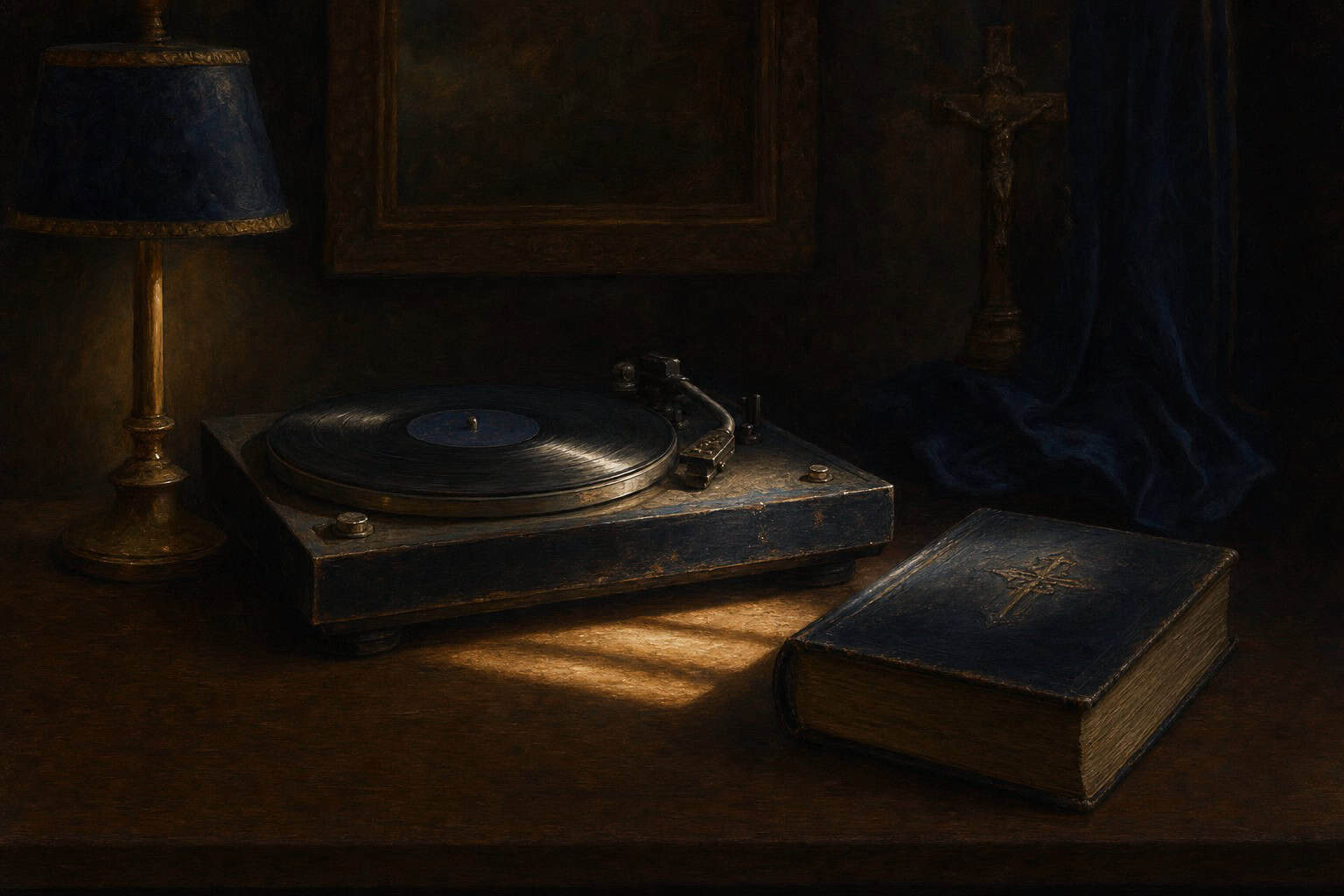
Numbers lie still on the page: 1995, 2023, twenty-eight years bracketed in a quiet, merciless line. No incense, no stained glass, just a column of dates that notes when the Body of Christ stopped touching his tongue and never returned. The same grid that records club nights and record releases, marriages and births, also carries this long blank stretch where Sundays pass without bread. It reads like a bank ledger, one entry missing for almost three decades, the white space doing the speaking. You can almost feel his pen hesitate before writing those years, the way a hand might hover over a light switch it will not flip. The body is older now, but the arithmetic is exact: one boy steps away from the altar, one man measures the distance with the same care he once gave to drum patterns and tempo. Time moves forward; his reception of the Eucharist does not. The gap itself becomes its own hard object, as present as any vinyl sleeve stacked on a shelf.
Bread Refused as a Kind of Reverence
To stand in line for communion while knowing your own rot too clearly would be, for him, a kind of assault. So the dates in the appendix do not just record neglect; they bear witness to a choice: to keep his darkness from brushing against the chalice at all. He reads his history as contamination risk, not in theory but in the felt sense of a body that has done damage and could do more. Better to sit in the back or stay away entirely than to walk forward with a mouth he believes would desecrate what it receives. This is not theater. It’s a bruised, unsentimental honesty that counts every missed liturgy as the only clean offering he can still make. The same precision that catalogs school transitions and job shifts now keeps tally on this refusal. Twenty-eight years are not an accident; they are a long, deliberate bowing-out, a way of saying to God: I know what I am, and I will not pretend otherwise with my hands outstretched for bread.
Basslines, Birth Years, and a Prayer for Immunity
On the same spread where the gap from the altar sits, there’s a different counting: record labels and BPMs fading into wedding dates, tiny initials for newborns, grade changes scrawled in the margins. The beat from the nineties clubs hums faintly under it all, that old physical rush where bodies dissolved into sound and nameless crowds. Now the bodies are specific: one wife, these children, each arrival given a year and, sometimes, a note. Yet under the neat rows, another math grinds on—how much poison has accumulated in him, how certain he is that love cannot change its composition. He has learned to pray not for his own cleansing, but for someone resilient enough to stand near the spill without absorbing it. Marriage becomes, in this accounting, a test chamber. Parenthood, a terrifying experiment in inheritance. The timeline holds it together with tidy lines, but the pressure leaks through: numbers straining like speakers pushed beyond what the cones can handle, everything vibrating at the edge of rupture.
Some souls choose honest darkness over false light, exiling themselves for decades rather than approach the altar as a lie.
When Your Own Ledger Terrifies You
Anyone who has ever counted years since confession, since Mass, since they last told the truth about themselves will recognize this cold bookkeeping. You know what it is to watch your age climb while the sacramental column stays at zero, and to feel that zero as something earned, not merely slipped into. You may have your own chart in your head: the year you left, the relationships began and ended, the job promotions, the children’s birthdays—all marching forward while one line of return remains stubbornly blank. There’s a grim relief in saying, I won’t mock the holy by pretending I’m fit for it, even as that decision hardens around you like a shell. You might even have whispered your own version of his prayer: not fix me, but send someone who won’t be wrecked by the wreck that I am. This passage does not comfort. It names the way certain wounds create their own logic, their own moral code, where staying away from grace feels like the last decent act a ruined person can perform.
The Father Who Hears Only the Metronome of Loss
As the years stack—2016, 2018, 2021—the image that lingers is not a sanctuary but a turntable or a digital counter, ticking in even intervals while life rearranges itself around the beat. Children arrive, each one a shock of new flesh carried home in tired arms, and somewhere in the background the same internal metronome keeps time since that final communion. School transfers, grade shifts, institutional labels slot his kids into ordered spaces, while his own soul remains unsorted, filed under a long unresolved absence. He can record their milestones with clinical clarity, yet when it comes to himself, the only measure that feels true is distance—from the altar, from trust, from a love he now treats as structurally unreachable. The passage ends without any neat correction of the count. The numbers sit where he placed them, steady as a kick drum, waiting to see whether they will keep marking only loss, or whether another kind of rhythm can ever cut in on the dance floor of his days.