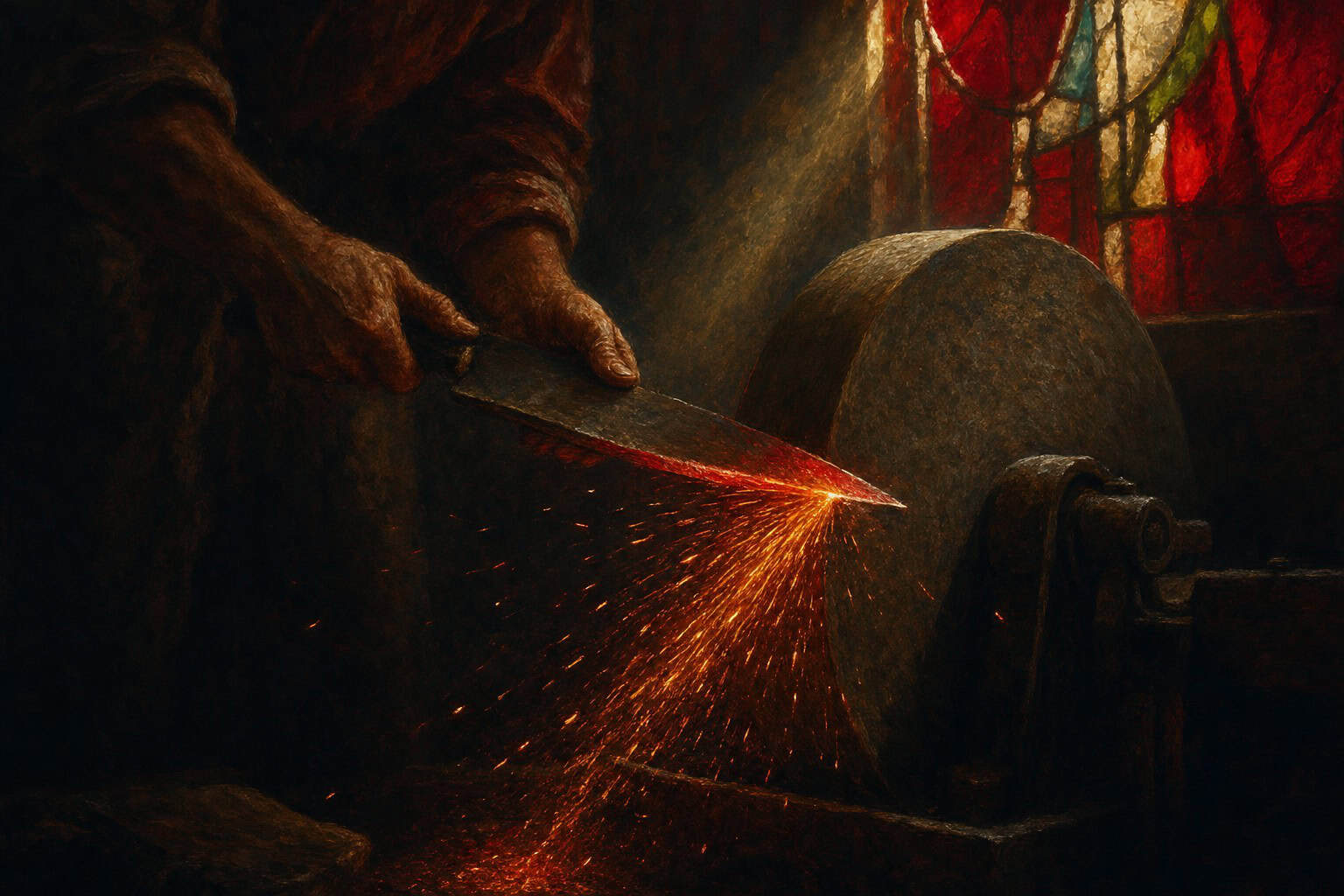
Across a small table one man’s words land with a bright hard edge, and the scraping between them is not cruelty but a craft neither of them asked to be shaped by.
Sparks Between Two Faces at the Table
A small table, two men, and between them a tension you can almost hear, like steel kissing stone. One leans forward and lets his words land with a hard, bright edge. They are not shouted. They do not need to be. Each sentence hits a buried place in the other man’s life, places he has learned to glide past with charm, with noise, with the easy polish of social talk. Now there is no polish, only the raw scrape of truth against habit. His chest tightens; his jaw wants to clench. He can feel the heat rise behind his eyes, not from insult, but from the shock of being known this exactly. It feels less like advice and more like being taken to a grinding wheel. He wants to pull back from the table, yet something in him stays pinned, like metal held firm while the stone begins its work.
When the Stone Refuses to Turn Soft
In this moment the listener confronts a harsh mercy: the other man will not play the usual game. No flattery, no shared complaint, no quick exit into jokes. The abrasive friend seems almost bound to his role, as if softening his speech would be a lie about why he was placed in this life at all. That realization hurts more than the words themselves. It means the sting is not an accident of mood but a calling. For the one being scraped, this raises a brutal reckoning: is love allowed to feel like this? If care arrives as pressure instead of comfort, will he receive it or brand it as cruelty and walk away? The table becomes a test site, not of who is right, but of whether he will permit his armor to shriek against the stone a little longer instead of grabbing it back into safe dullness.
The Restless Blade That Keeps Volunteering
Underneath the sharp talk, another rhythm beats: that familiar restlessness that once drove him from face to face, body to body, searching for relief. He remembers how easily he mistook pursuit for desire, how often he used romance as a hiding place from this very kind of exposure. Yet here, without seduction or charm to distract him, the same hunger stands naked. It is not craving for touch but a gnawing desire to be less false, less split, less scattered. Every time the other man’s words grind against him, old patterns scream for escape—find someone who will soothe, not scrape. Still, some deeper instinct keeps him seated, keeps the blade extended. He begins to sense that all those fevered encounters, all that chasing and being chased, carried this same secret script: find the one sharp enough to break you where you most need breaking, then decide whether to stay on the wheel.
Some souls exist to sharpen others, and the painful scraping they endure is not cruelty but a craftsmanship they did not choose and cannot refuse.
The People Whose Voices Feel Like Sand in Your Teeth
Anyone turning these pages can name their own version of that table: the friend whose tone cuts too close, the mentor whose feedback never flatters, the spouse or sibling whose honesty lands like grit between molars. Most of us spend years arranging our days to avoid this texture, surrounding ourselves with those who mirror back what we already agree to be. Yet the passage suggests another reading of these difficult bonds. It hints that some of the most uncomfortable voices in our lives may have been assigned as whetstones, not enemies. This does not bless every harm or excuse real abuse; wickedness is never baptized here. But it does call for a second look at the relationships that both draw and unsettle us, at the strange gravity that pulls us toward people who do not let our pretense rest. The question sharpens: where do you keep fleeing the scrape, and what edge in you stays blunt because of it?
Steel Held Over Unfinished Fire
By the end of the scene, nothing neat has resolved between the two men at the table. There is no sudden embrace, no tidy speech about gratitude. One still smarts from the grinding; the other still bears the quiet burden of being the stone. Around them, life goes on—the clink of dishes, a chair slid back, traffic humming past an unseen window. Yet the air between their faces has changed temperature, like steel just lifted from heat, glowing faintly beneath a film of scale. The passage leaves that glowing metal in midair. Will it return to the fire, meet the stone again, be drawn out straighter, truer? Or will it cool crooked, edge half-formed, because the next time the wheel spins he chooses comfort over contact? The answer waits not in an ending on the page, but in the next time his restlessness reaches for company and his hand, almost against his will, offers itself back to the spark.