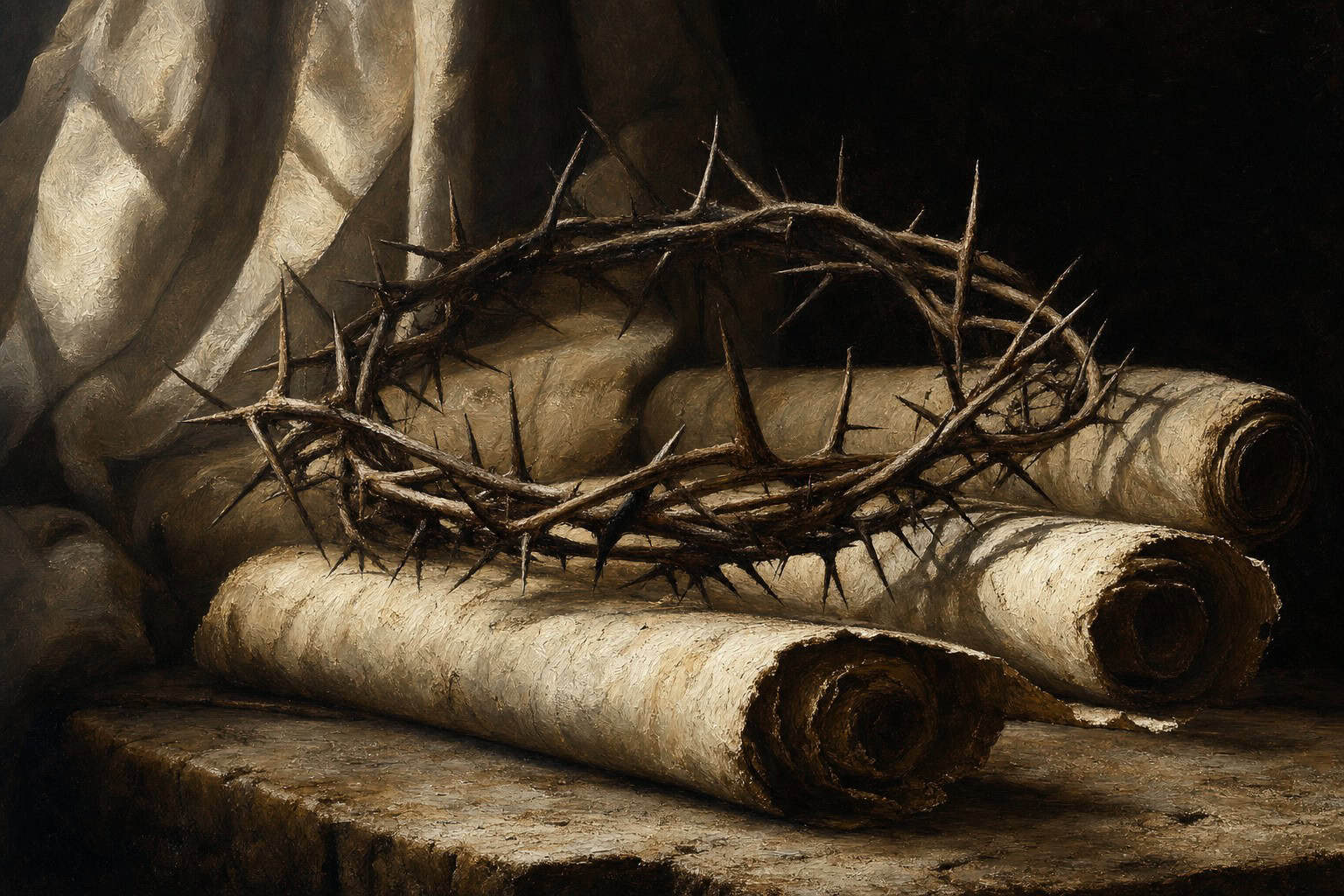
He wears no diadem but carries himself as if one weighed on his head, heavy with old promises, standing in his own mind like a throne room, mistaking a crown for armor.
Fingers Tightening Around an Invisible Crown
He does not hold a literal diadem, but he speaks as if one sits on his head, heavy with old promises and male names. In this passage he stands inside his own mind like a throne room, rehearsing lineage, wisdom, sacred history, until the air grows thick. He tells himself he is descended from a king who asked rightly once, and from that story he fashions a barrier: I am not like the others. That claim hardens into stone between him and the woman before him, between him and the ordinary give-and-take of human warmth. His spiritual learning becomes a mesh that lets through only those who ache for what he aches for, and everyone else falls away as common dust. Yet the more he presses this invisible crown against his skull, the more it feels less like honor and more like a tourniquet, cutting off the blood that might have reached his heart.
Counting Flaws Like Loose Jewels on the Floor
In the same breath that he enthrones himself, he begins to count. Every sentence from the other is weighed, turned, pressed for weakness like a gem held to the light. Conversation is no longer the warmth of two bodies sharing air; it is an X-ray he performs without consent. He searches for the smallest hint of flattery, calculation, hidden appetite, anything that would confirm his dread that affection is just another word for use. Old betrayals stand beside him, whispering interpretations as he listens. He will not be blindsided again, so he builds a test inside every exchange, a secret math of loyalty and risk that no one else knows is being graded. What he calls discernment begins to look less like wisdom and more like a man crouched over scattered stones, so intent on spotting a crack that he forgets the whole crown was already broken on his own head.
When the Crown Becomes a Helm Against Touch
The pressure inside this passage gathers when desire dares to step forward. There is a woman, a possible yes, and with her comes the threat of being wanted and then despised. He imagines how quickly spoken tenderness can curdle into boredom once his need is laid bare. That imagined scene presses against his chest like metal. Rather than risk that humiliation, he sharpens his refusal into a kind of royal decree: he will not be handled, traded up, made into a rung on someone’s ladder. Sex, small talk, shared plans—all of it is scanned for signs that he is being reduced to an object. So he pulls the invisible crown low, turning it into a helm. It keeps out the gaze he fears, but it also muffles the sound of her voice, the possibility that she is not playing the game he has already decided she must be playing.
Intellectual pride makes a fine crown and a poor shield; not even the wisdom of kings can protect a soul from its need to be known.
Wearing Our Own Brilliance Like a Too-Tight Band
Anyone who has ever hid behind their sharpness will feel the pinch here. Many of us have learned to use faith, insight, or wit the way he uses his lineage: as proof we are above being fooled, above needing simple kindness. We replay old hurts until kindness looks suspicious, then congratulate ourselves for seeing what others miss. We call this caution, principle, standards. Underneath, there is usually a quieter truth: we are terrified of finding out that our worst story about ourselves—that we are boring, excessive, unlovable when weak—is the one another person secretly believes. So we keep the crown tight and keep watch from a distance. This passage drags that pose into the light without soft excuses. It shows how easily intelligence and spiritual hunger can become a band around the skull, a self-made circlet that keeps us from ever daring to bow our heads into another person’s hands.
Letting the Broken Crown Drop in the Dark
Near the end of this scene, a different thought flickers: perhaps the only honest thing he owns is not the crown at all, but the ache it hides. The melancholy that clings to his mornings, the corrosive self-suspicion, the ruins of connections he helped shatter—these begin to look less like shameful waste and more like the small coins of a poor widow. He senses that God may care more for those bits of bent metal than for his polished arguments or purified refusals. Yet to offer that poverty would mean loosening his grip on the crown, admitting he was both the builder and the prisoner of his high walls. The text does not show him doing it. It leaves him at that raw edge, fingers still around the unseen circlet, feeling the weight of it and the strange pull in his palm toward letting it finally slip to the ground like a thing that has outlived its use.