Old wood creaks back and forth while colored Christmas bulbs bleed small halos into the December dark, and a heart makes the kind of vow — never again to open — that loneliness keeps longest.
Rocking Wood and Colored Bulbs
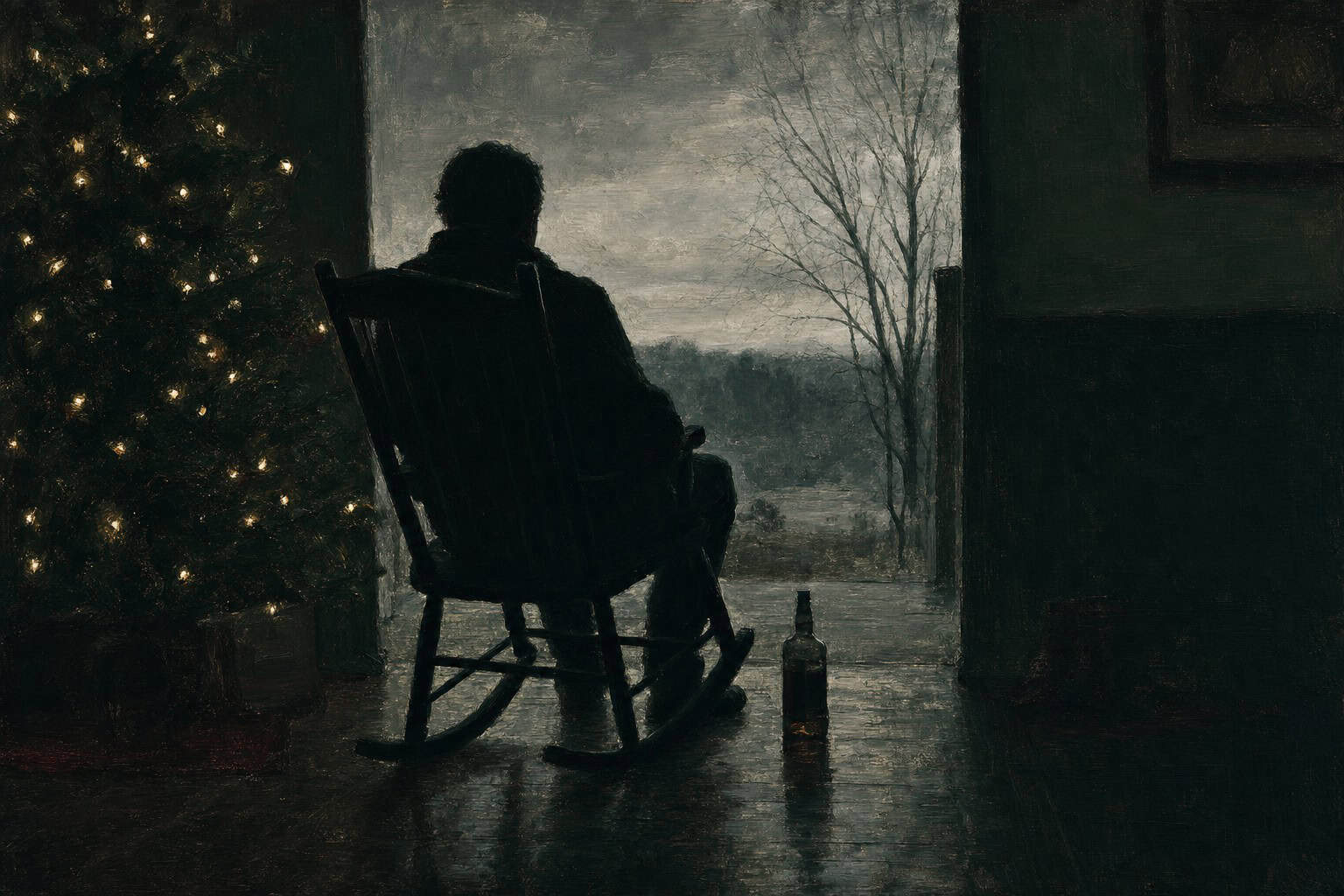
Old wood answers its own weight with that slow, familiar creak as the rocking chair moves back and forth, back and forth. Colored Christmas lights throw small, bleeding halos on the December glass, turning the dark outside into a blur of red, green, and blue. Crown Royal burns a steady line from tongue to stomach, a small fire that seems to prove the body is still here, still animal, even while the soul paces. The car scene replays without mercy: her face behind glass, the bored exhale, the way your name slid into the same tone used for spam calls and traffic lights. Each swing of the chair carves that moment deeper, as if the room were a cutting table and your memory the organ under the knife. Nothing is happening here but drinking and rocking, yet everything is happening here, because this is the hour when rejection stops being just a story and begins to become doctrine.
Imagined Laughter in Someone Else’s Hands
The real wound is not tonight’s silence but tomorrow’s pictures that your mind paints with sick skill. You see her in some other living room, lit not by your cheap string of bulbs but by someone else’s lamps, laughing the way she used to laugh here. A man you’ve never met leans in, says something low near her ear, and your own body reacts as if punched, though nothing touches you in this room but air. Your imagination studies every angle: the way her wrist might turn when he reaches for her, the way her shoulder might relax under a hand that isn’t yours. Whiskey sharpens these images instead of dulling them; the more you drink, the clearer his features become. Underneath the jealousy lives a harsher verdict: if she can laugh like that with him, then whatever happened with you was not sacred, not singular, not anchored anywhere but in your own foolish hope.
The Quiet Signing of a Private Contract
At some hour when clocks feel useless, somewhere between another swallow and another slow push of your heels against the floor, a sentence solidifies without needing words. The rocking chair no longer just rocks; it engraves. You feel it in your chest more than hear it: no one will ever be allowed this close again. Not the next girl or the one after that, not even God, who is already suspected of sharing her indifference. The vow does not arrive as rage or drama but as a cold, almost professional decision, the way a surgeon might decide which limb cannot be saved. Colored lights blink on and off, on and off, like signals at a bedside monitor marking the end of something vital. You do not stand up, do not speak it aloud, yet the air in the room grows denser with this new law. The chair moves, and with each arc you understand: from now on, every tenderness will be a performance, never again a surrender.
The vows we make in our loneliest hours are the ones we keep longest; a heart can promise never to open again and mean it for years.
When Your Own December Still Walks Beside You
You might not have had Crown Royal or blinking bulbs, but you know this posture: body folded into itself, hand around a glass or a phone or a steering wheel, replaying a scene until it brands you. Maybe it was a text left on read, a spouse turning away in bed, a parent shrugging off your small disaster. Somewhere, there was a night when you decided, even if you’ve never named it, that it was safer to simulate closeness than to risk being discarded again. You kept going to work, kept going to Mass, kept letting people think they knew you, but the true center stepped back and watched from behind glass. This passage names that move for what it is: not just heartbreak, but a theological break, where a human dismissal is quietly stapled to the face of God. The danger is not that you hurt—that part is honest. The danger is that you begin to treat your own guardedness as wisdom instead of as the scar of a particular December.
Colored Wires Boxed for Next Year
Morning does not crash in with epiphany; it seeps in around the curtains, gray and indifferent. The Christmas lights hang loose now, colors dulled without electricity, thin wires already thinking of the cardboard box where they’ll be shoved until someone feels festive again. The bottle is not quite empty, but the decision it witnessed is complete, settled deeper than the ache in your head or the sourness in your stomach. Life will resume its usual chores soon enough—dishes, emails, jokes with friends who will never know what just got buried in that rocking chair. Yet the contract made in the dark does not vanish with the hangover. It moves into your shoulders, your tone, your future refusals that will sound reasonable and mature. Somewhere in storage, those tangled lights will wait to be pulled out again, and the same chair will still be there, quiet, holding the shape your body left in its worn wood.