Under humming fluorescent light he stacks his reasons like sandbags — timelines, doctrine, promises — against a love that has already chosen to die, and the silence that answers is the loudest grief he knows.
Knees on Concrete, Words Hanging in the Air
Fluorescent light hums overhead while his voice works through its polished script. He stacks reasons like sandbags: timelines, shared history, doctrine, promises, all laid out with courtroom clarity. Every sentence is built to prove that what they had cannot, should not, be ending. Yet even as he speaks, his knees edge toward the concrete, body inching down while his mind tries to stay upright. Her face stays composed, the small social smile that signals listening without participation, as if watching a stranger defend a thesis she already failed in her own head. This is where the passage drops us: inside the absurd spectacle of a man trying to persuade love not to die, still standing in his arguments while his body has already started to sink.
When a Brilliant Mind Becomes Dead Weight
Here the reckoning is not just with her withdrawal but with the betrayal of his own best gift. His intellect, once the sharp tool that won debates and charmed professors, now drags behind him like a broken sword. He builds moral frameworks, cites Scripture, organizes the collapse into clean categories of fault and remedy. None of it lands. Her indifference is not ignorant; it is settled. The scene forces him to see that he has used goodness itself as a negotiation tactic, performing the perfect “nice man” as if heaven and women alike owed him a return on investment. This is the idolatry exposed in the parking-lot catechism: not that he reasoned, but that he believed reason could bargain with a free heart and with God. What shatters here is the fantasy that being impressive, careful, and harmless is the same as being truly given.
Concrete Admits the Death His Prayers Deny
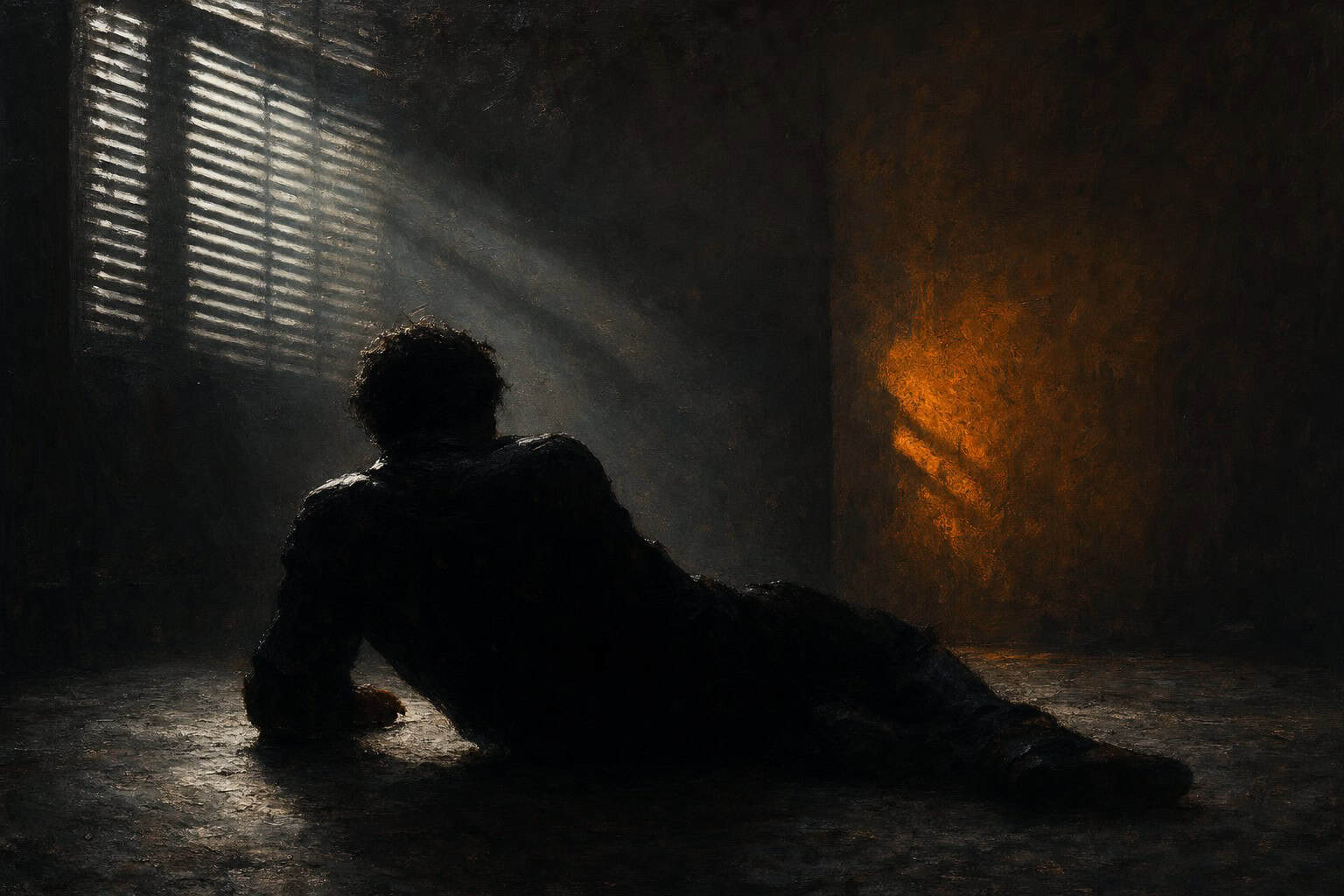
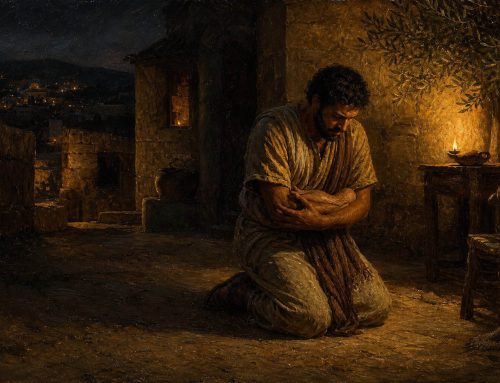
Pressure builds where body, mind, and heaven refuse to sync. His legs finally fold and hit the stained floor; the impact rattles up his spine. Tears come without his consent, hot and messy, cutting through whatever dignity the carefully crafted arguments tried to protect. Yet even as his chest heaves, the interior monologue keeps calculating: one more appeal to shared memories, one more promise to improve, one more theological angle that might move her, or God, or both. The passage lingers on this split screen—flesh already surrendered to loss while the mind still submits petitions to a locked office. Overhead, the silence from heaven is not dramatic; it is flat, like bad acoustics. No inner warmth, no sudden verse applied like a bandage, just the steady awareness that nothing on either side—hers or God’s—will be engineered by his need. The prayer tightens into a single aching plea that finds no echo, only the grit of concrete under his palms.
There is no equation that resurrects a love that has chosen to die, and the silence that answers our arguments is the loudest grief of all.
When Your Own Fantasy Becomes Your Widowing
For any ordinary soul, this is where the passage cuts closest: the slow horror of realizing you are grieving a person you partly invented. The narrative shows how, under the strain of abandonment, his cherished image of her begins to crack. Traits he once wove into a single luminous figure now lie around him like dropped props—kindness here, charm there, a few flashes of shared piety, none of it forming the coherent woman he preached about to himself. The pain deepens when he sees his own hand in the assembly. He loved not only her, but the story of her, a story that covered over warning signs, divided loyalties, and his own complicity in keeping things shallow as long as they felt good. The text presses us to admit how easily we canonize the beloved, then accuse God of injustice when the idol falls. It is not the affair of specialists; it is the daily temptation of anyone whose loneliness is strong enough to sculpt another person into salvation.
Equations Running in the Dark After the Lights Go Out
When the scene releases us, nothing has resolved; it has only stripped away illusions. He walks out of that concrete hollow without an answer, but the inner calculus refuses to shut down. At night, scenarios loop: a different sentence here, a firmer boundary there, a braver desire in some lost afternoon. The mind keeps solving for x as if the past could reconfigure itself under enough pressure. Yet under this compulsive revision lies the harder question the passage leaves untouched but throbbing: how does a man who has worshiped performance and projection learn to let God love the real, dissonant thing he is? No romance resurrected, no tidy closure, only a soul pacing its own interior, formulas flickering like failing neon. The last image is not of a reconciled heart, but of a body that still remembers the feel of concrete, carrying that memory into a night where the math keeps running and the sky gives no reply.