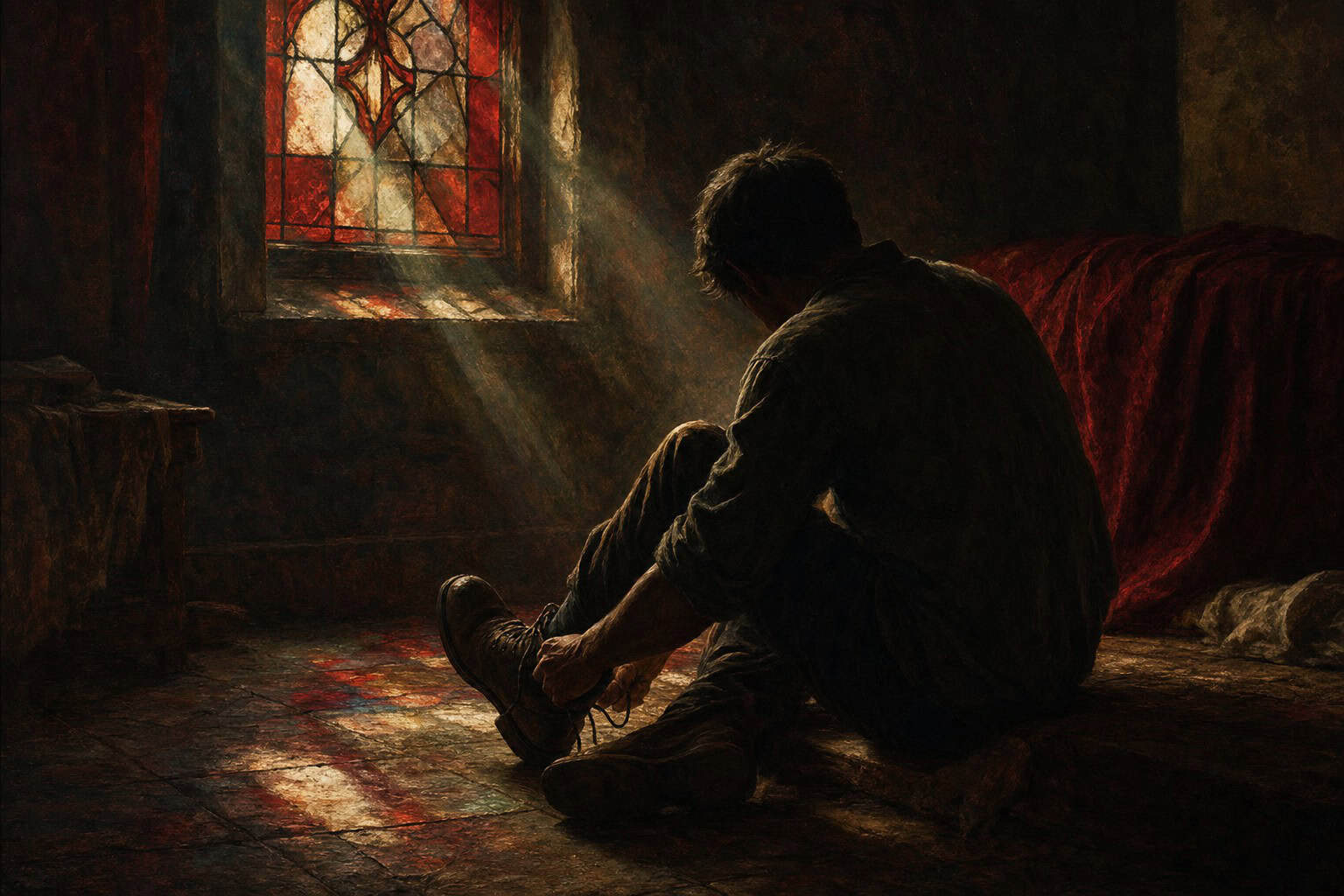
He swings his legs out of bed onto a floor that might as well be a trench, the war renewed in the night, too tired to know that being held still can be its own strange mercy.
Boots on a Floor That Feels Like Mud
He swings his legs out of bed and the ground might as well be a trench. The first weight is not his body but the knowledge that the war has renewed its contract overnight. Before coffee, before prayer, fatigue spreads through his muscles like damp cold, a warning that today’s skirmishes will not be symbolic but carried in flesh and blood. He pulls on clothes with the muscle memory of a soldier dressing by rote, knowing where the day will drag him even if he does not know how he will stand. Temptation and despair wait like seasoned opponents, unhurried, certain he will show up because there is nowhere else to report. This is not the shining march of a volunteer but the slow, resigned rise of one taken again by draft, discovering that faith feels less like escape and more like being kept on a field from which there is no discharge.
Ropes Around the Ring, Not a Way Out
What tears at him is not only the presence of the fight but the shape of the protection. He reaches for certain disasters—numbers he should not dial, sites he should not visit, words he should not send—and finds the paths snarled, blocked, strangely tangled. The catastrophe he secretly wants is denied him, yet the smaller, daily blows remain wide open. It feels like someone has reinforced the ropes around the ring while refusing to unlock the exit. He tastes this mercy as a kind of custody: God will not let him destroy himself, but neither will God let him walk away from the contest. Like a bruised fighter whose corner steadies him between rounds and still pushes him back toward the bell, he is held just upright enough to keep stepping into impact. The prevention is real, but so is the feeling of being detained for yet another round.
The Eye as a Hungry Mouth
The real arena tightens to the span between his brow and his cheekbone. On a bus, in a hallway, across a screen, shapes of soft skin pass before him and the eye opens like a mouth. He is not touching anyone, yet his gaze starts to handle, to arrange, to bend bodies into a private script where he alone directs what they will give. Heat moves through his chest and lower, but behind the heat stands something colder: a decision to treat another’s flesh as material for his inner altar. The battle is not first about what his hands might do later, but about what his eyes are doing now—staring as if they could eat. He begins to see how quickly looking becomes serving, how a lingering glance can kneel before an idol carved in living tissue. The sin is already alive in the feast of his pupils long before his body ever leaves the chair.
Sometimes being held still is its own kind of protection, and the exhaustion of a battle you never chose becomes a prayer you never meant to pray.
When Your Own Eyes Start to Devour
You may know this strange hunger that starts not in the stomach but behind the face. A scroll at midnight, a passing figure in the grocery aisle, an image burned into memory from years ago—the eye reaches, clamps, chews. You tell yourself it is only looking, only curiosity, yet you feel that small internal bend, the way the other person shrinks into a tool for your private weather. The shame that follows is not only about sex; it is about worship, about realizing you have just bowed, however briefly, to a god made of skin and fantasy. In that moment, the command against lust stops sounding like a rule about where to put your hands and starts sounding like a warning about what you feed your soul. The war in this passage is the same war in your late-night screen glow: whether your eyes will remain windows or keep living like starving mouths.
Learning to Walk While the Wound Still Leaks
So he moves through the day like a man with a slow bleed under his shirt. The prayer on his lips is not elegant; it is the raw plea not to cave in to the next image, the next fantasy, the next wave of self-hatred when he fails. Rescue does not arrive as airlift but as a grip under the elbow, a sense—faint, sometimes infuriating—that he is being steadied just enough to keep moving rather than collapsing in the dirt. The path does not shorten, the enemies do not vanish, and yet he is not abandoned to their full appetite. Step by step, he learns that survival here is less about heroic victory than about consenting to be held in the middle of a fight he cannot end. The passage does not promise him triumph; it leaves him walking forward, breath rough, boots heavy, carrying a heart that has not yet decided whether this strange companionship is mercy or cruelty.