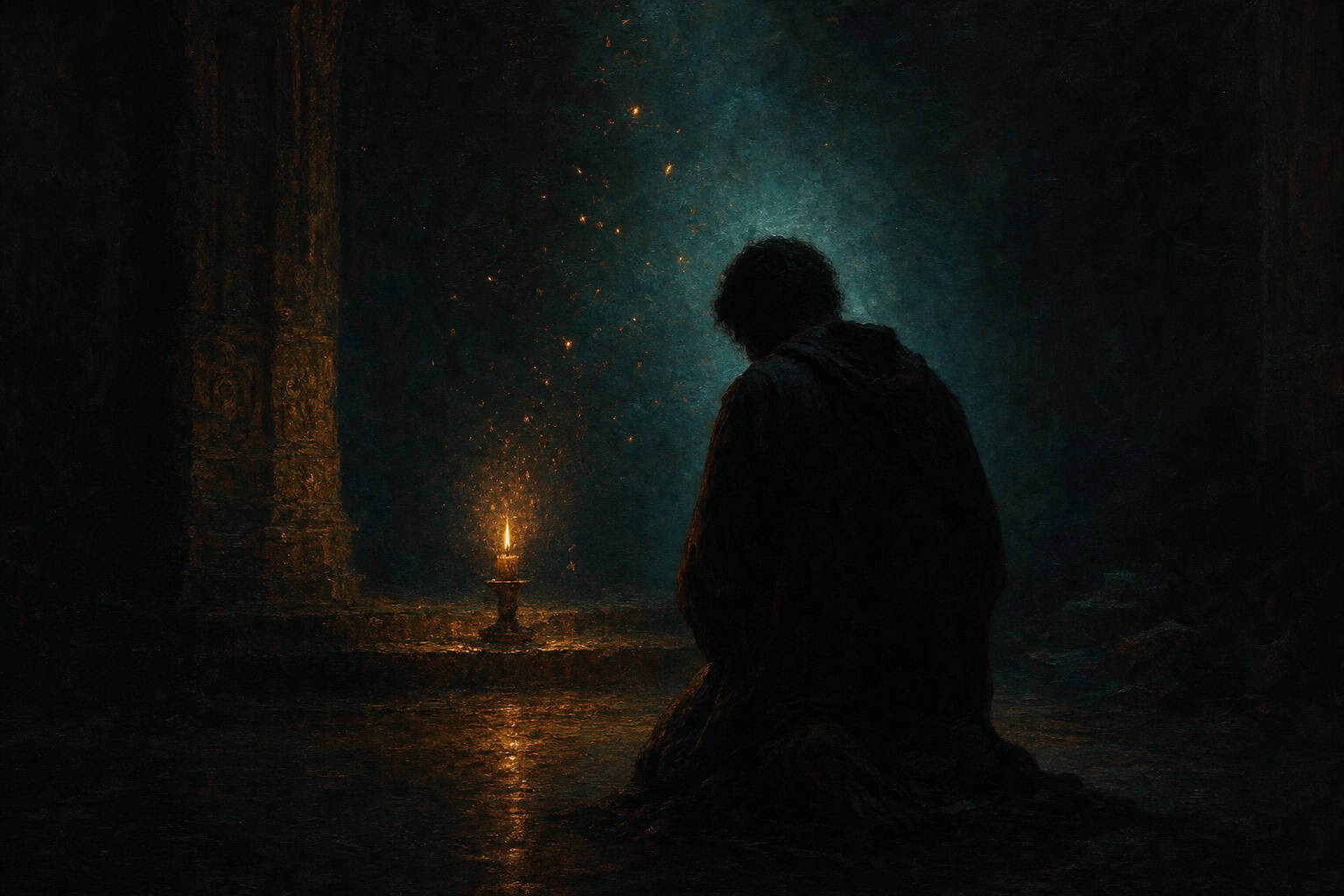
For years he mistook the fire in his marrow for damnation, never guessing the burner that would not go out was hollowing him for something he could not yet name.
A Boy Held Over a Black Flame
He remembers his youth as if someone held him over a burner that never turned off. The black flame of depression licked at bone and nerve until every breath tasted of ash. He named that presence Stickman, gave it contours and cruelty, because it felt easier to fight a figure than to drown in formless dread. Years later, in this passage, the man looks back and dares to call that same blaze holy. Not kind, not gentle—holy. What felt like needless torment now appears as a rough surgery, the Spirit using heat to hollow out hidden chambers no ordinary life would ever need. He does not dress it up as a lesson learned or a triumph won. The scars still throb; the boy’s terror remains intact. Yet the man cannot deny that the very emptiness carved by that darkness has become a strange capacity: room for a fire that does not devour, a love that needs that hollow to echo.
Ashes Pressed Into Someone Else’s Freedom
The reckoning turns crueler when he admits his burning did not stop with him. Out of that same blackened interior, he loved someone who would one day walk away. Their departure shattered him, but in the shards he sees an awful mercy: his breaking gave them the courage to claim a life they could not have claimed intact beside him. Their freedom rose, in part, from his ruins. The image is not pretty—more like bones laid down as scaffolding while another climbs out of a pit. He does not dress this up as noble sacrifice; he knows how much of it felt like simple abandonment. Still, the thought will not leave him: sometimes grace spends one life to open another. In that light, his pain is not redeemed so much as repurposed, his ashes pressed quietly into a path he will never walk, a road only their feet will know.
Living Behind Glass Forged in the Fire
To survive the black flame, the boy learned to step sideways inside his own skin. He watched himself think, hurt, plan escape, all from a cool distance that felt almost scientific. That stance became his shield, the one trick that kept despair from swallowing him whole. Now, decades on, he discovers the shield has hardened into glass. People see their reflection in his calm and assume he feels nothing; he watches them from the other side, feeling too much and showing almost none of it. In this passage, the tension sharpens: the very clarity that once saved him now freezes his face, his voice, even his gestures. Friends, parishioners, casual neighbors encounter a man composed, articulate, oddly unreachable. The pressure builds in that gap between how he is seen and what he carries. He can map another’s sorrow in exact detail, but cannot seem to cross the small distance between observation and embrace without that old glass fogging over.
Sometimes the black flame that burns through our youth is the Spirit’s own fire, hollowing us out for a purpose we could not yet comprehend.
Midnight Kneeling Before an Unburnable Presence
So he waits for the house to dim and the last light under the children’s door to vanish, and then he goes to his real appointment. No crowd, no incense, only a man, a chair, perhaps a crucifix catching the faint glow of a streetlamp. This is his tent of meeting—an ordinary corner turned fierce because of what he dares to bring there. The fraction of soul he holds back from every human being is set before God like a live coal. He believes, with a kind of desperation, that only God can sit this close to it without blistering. His body knows the rhythm now: the slight ache in his knees, the slowing of his breath, the way his chest tightens before words even form. Here his strange detachment falls away, not because he tries harder, but because there is finally a Presence that cannot be harmed by the full temperature of his interior fire.
The Coal No Human Hand Can Carry
What he exposes in those hours is not tidy confession but something closer to a smoldering ember he dares not place in any human palm. The passage circles this coal without naming its full content. It hints at a blend of rage, sorrow, and desire so condensed that to open it fully in a marriage bed or a counseling chair would feel like detonating the room. He is not proud of this; it is not his special depth, only his particular damage. Yet in that damage he discovers a strange liturgy: bringing the same uncooled fragment night after night to the only altar that will not burn or buckle. For an ordinary reader, the question seeps in: what part of me have I decided no one can survive knowing? The scene does not answer how such a coal is finally transformed. It leaves us with a man and his ember, held between trembling fingers, as the first hint of morning begins to thin the dark.