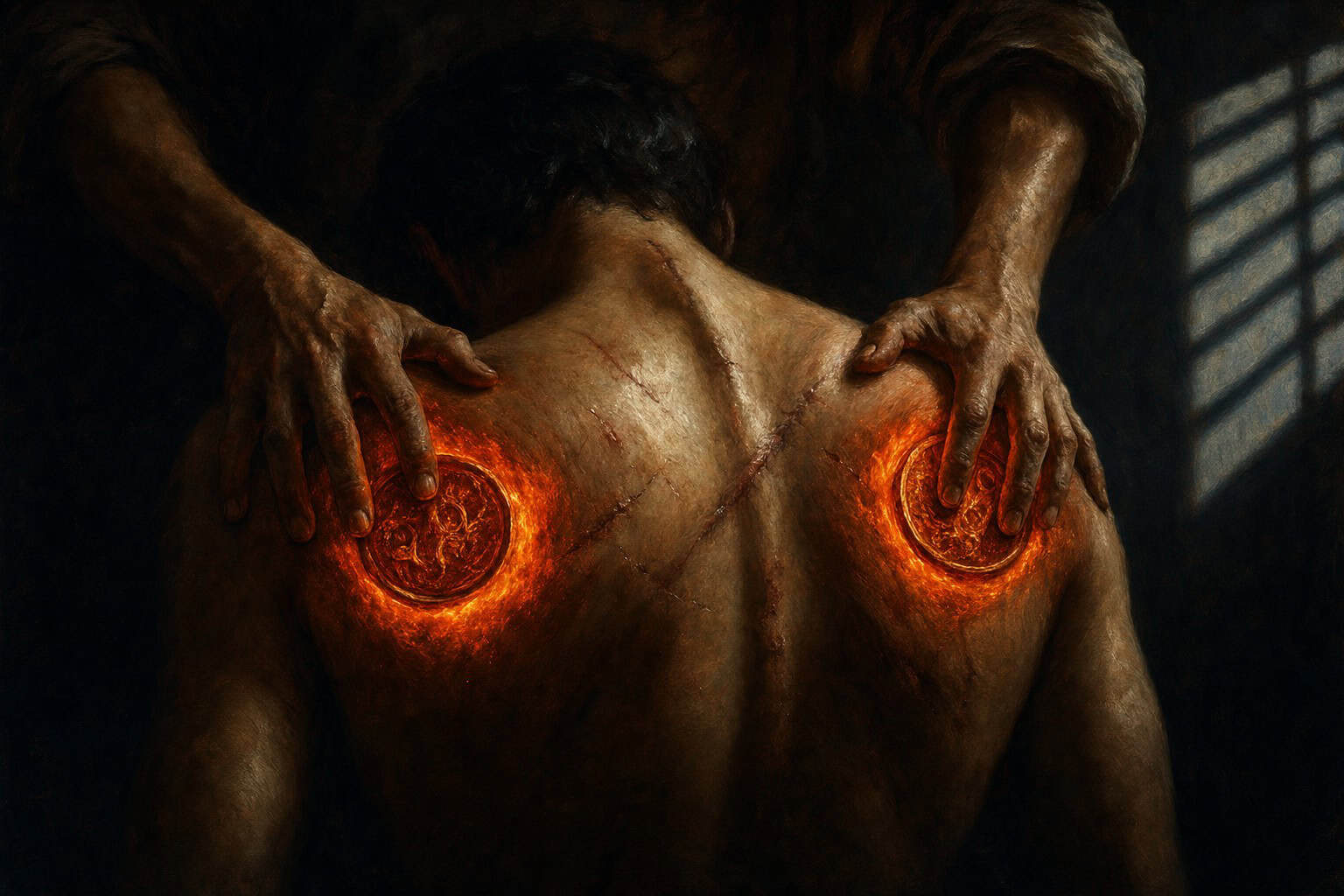
For years a dull ache has nested beneath his shoulder blades, unnamed by any scan, less an injury than a pressure from within — as if the body were keeping a prophecy the mind has never learned to read.
Two Small Suns Pressed Into Bone
Pain has nested for years beneath his shoulder blades, a dull, stubborn ache that no scan, no specialist, can name. It feels less like injury and more like pressure from the inside, as if something were trying to push through the cage of muscle and skin. One night he drops the pious language and speaks to God as one speaks in the bathroom mirror after a failure—flat, stripped, out of patience. No formulas, no holy tone, just the truth of his own darkness. In that raw confession, something answers him without sound. Two circles of heat appear, exact and symmetrical, sinking into the spots that have always burned cold. They are the size and weight of coins, but hotter than any fever, steady and deliberate as fingers that know where to press. The warmth does not hover in the air or in his imagination; it bites through flesh and meets the oldest bruise he carries, as if an unseen thumb has finally found the knot.
An Invisible Hand Unscrewing the Heart
Then the focus drops from his back to his chest with terrifying clarity. A grip closes around his heart—not around his feelings, around the actual beating organ—tight, sure, and foreign. It begins to turn, slowly, counterclockwise, like a lid being eased off a jar that has been sealed wrong for years. The sensation is not poetic. It is mechanical, specific, and violent enough that he could map the motion with a pen on paper. There is no space here for daydream or suggestion; his body has been seized by something that is not him and not neutral. This is not the gentle brush of inspiration he was trained to expect, but a procedure. The presence working on him seems to know exactly how far to twist without snapping something vital. He lies there, pinned between the coins of heat in his back and the rotating ache in his chest, as if caught in a vice between what he has been and what is being forced into place.
Begging for Chains Before the Escape
While his heart is being turned, his mouth fills with words he did not script. They come out half-whispered, half-choked, addressed to the One whose hand he can feel and whose face he cannot see. He tells God, with no drama, that he will not stay. He admits he will explain this away later, dilute it, bury it under clever phrases and heavy books. He says he will run, and he will choose again the safer gods that leave his body untouched. And so he does the only honest thing left: he asks to be hunted. He asks that this hand, which now holds his heart, refuse to obey him when he tries to pull away. It is a plea for shackles before the escape, for pursuit stronger than his future disgust with himself. There is no heroism in it, only a man watching himself from the inside, naming his weakness even as divine fingers grind against his ribs.
The body keeps prophecies the mind cannot read; sometimes grace arrives as a pain that no explanation can dissolve.
When Your Own Pain Starts to Feel Like a Summons
Anyone who has carried unexplained pain—the knot in the neck, the stone in the gut, the fire under the shoulder blades—knows the quiet fear that the body is keeping secrets. We spend years numbing, stretching, medicating, or spiritualizing it away, afraid that if we listen too closely we will hear a sentence, not a sentence of healing but of exposure. This passage dares to claim that sometimes the ache is not accusation or random cruelty, but an unanswered letter from God written in muscle and nerve. That the place you most dread being touched may be the very spot heaven intends to press. This is not comforting. It means our most private soreness could be less about defect and more about unfinished work. It says that the God of the cross does not stay in the sanctuary or in ideas but reaches for the cramped places we hide from doctors and from prayer. To entertain that possibility is to look at one’s own recurring pain and feel it tug, not just as nuisance, but as a strange, waiting appointment.
Living With the Phantom Grip
After the night ends, there is no swelling, no scar to point to, no medical chart to update. But his body will not fully return to how it was. The spots where the heat sank in remember their visitor; at odd hours they flare with a faint, echoing warmth, like metal that was once branded and still tingles in the cold. His chest carries a new awareness of its own machinery, as if the heart now knows it can be turned from the outside. These are not decorations to show off; they are private residues that make lying to himself more difficult. In later seasons of doubt or rebellion, he will have to drag that stubborn muscle memory along with him—the recollection that his flesh has been handled by something he cannot dismiss as fantasy. No one can see this, but it sits in him like a weight and like a question. Every ordinary morning, as he lifts his shoulders and feels the faint pull between blade and spine, he has to decide again what that touch was and what kind of story his own bones are telling.