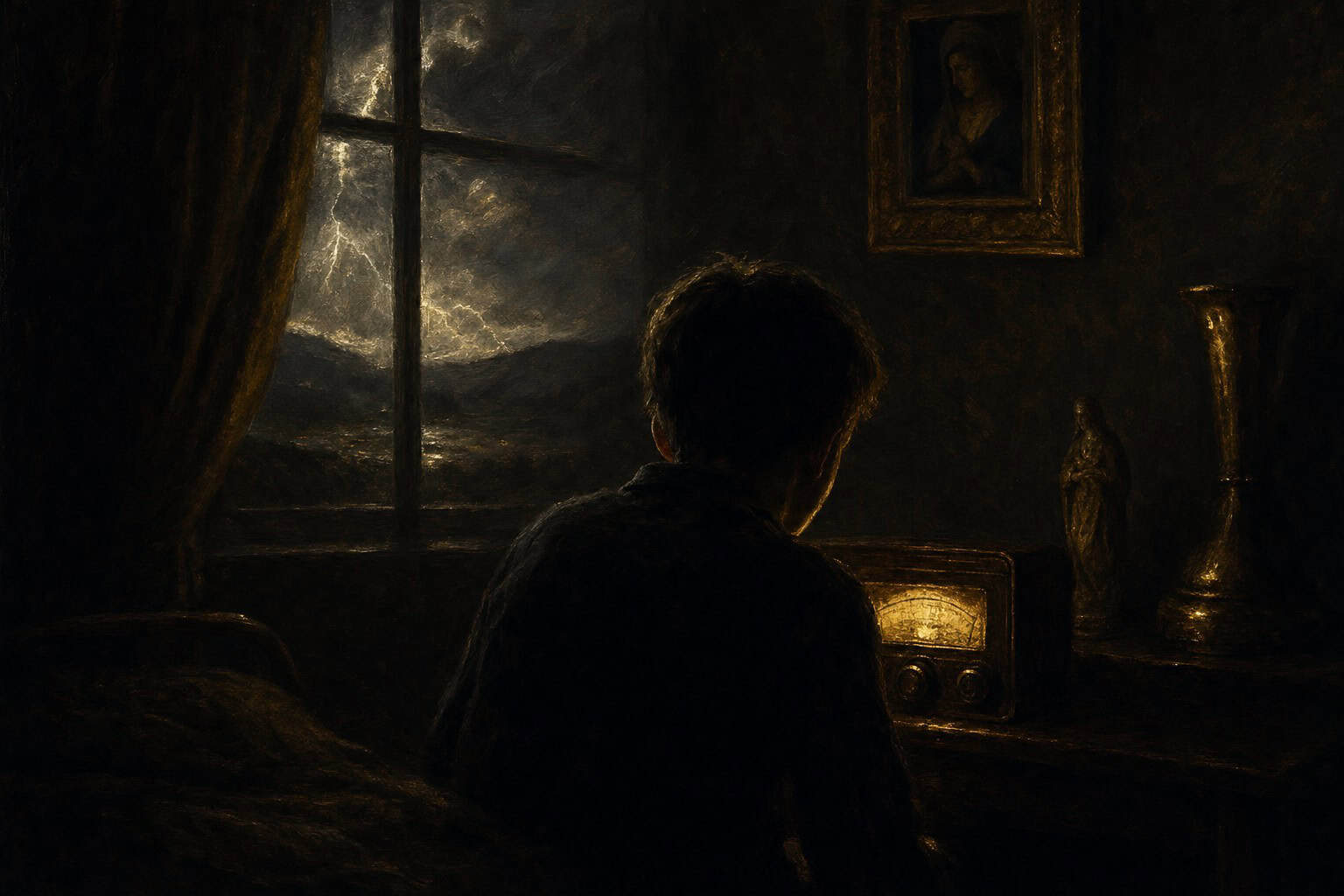
Long after the house goes quiet, the small green dial is the only light on the boy’s bedroom floor, and he sits close to its warmth learning the weight of griefs not yet his from strangers dedicating songs to the broken.
A Green Dial in the Dark
Long after the house goes quiet, the only light comes from the small green dial of the radio, a fragile halo on the boy’s bedroom floor. He sits close enough to feel its plastic warmth against his knee, careful not to bump the knob and lose the station. On this frequency, adults call into the night to hand their heartbreaks to a faceless host and a three-minute song. A woman asks for the ballad from the first dance at a wedding that fell apart; a man dedicates a soft rock anthem to the daughter who won’t answer his number anymore. The DJ’s voice moves between them like a steady hand passing the microphone, not fixing anything, just making space for it to be said out loud. The boy listens as if he has been let into a sanctuary he did not know existed, learning from the tremor in each request that love can snap bones you never see on an X-ray.
Carrying Voices That Never Knew His Name
He has never kissed anyone, yet his chest aches as if he has already survived three divorces and a funeral. A caller’s voice tightens over the title of the song that played when their newborn came home from the hospital; now the child is gone, and the same melody is all that remains. Another caller names the track that used to make his wife laugh in the kitchen, and the way he says the word “used” lands in the boy’s sternum like a small hammer. These sorrows do not belong to him, but his body reacts as if drafted into their wars, shoulders heavy, throat thick, ribs braced. While his classmates are still trading jokes about crushes, he is learning that some people carry one failed love like a stone, while others drag a whole quarry behind them. Each dedication settles into him as a warning label printed not in ink but in a slow, spreading tightness under the skin.
Static as the Cost of Knowing Too Much
Between callers, there is always that thin hiss of static, a soft grinding just beneath the music, as if the sky itself is clearing its throat. In that gap, the boy’s thoughts rush in: if this is what love does to grown men and women, what would it do to someone as unarmored as him? He begins to map out defenses in his head, tracing invisible lines between certain songs and the disasters they now carry. A power ballad is no longer just a chorus; it is a man sleeping alone in a bed he bought for two. A tender country song now means a woman gripping the steering wheel outside the house she once shared. The more he listens, the more love starts to look like a machine that grinds everyone down in time, and the static grows louder than the melodies. Yet he cannot turn it off. His hand hovers near the dial, trembling, suspended between hunger and fear.
Sometimes we learn the weight of a grief that isn’t ours yet from strangers in the dark, dedicating songs to lives already broken.
Learning to Read Hearts Before Faces
What takes place in this dim circle of radio light is its own kind of schooling, one no teacher could assign on a worksheet. The boy is not seeing tears, only hearing what they do to a voice—the swallowed breath before a title, the way someone rushes the name of the song as if afraid it will hurt more if spoken slowly. He discovers that people reveal themselves most when they think no one important is listening, when they are just another anonymous caller on hold. This trains a certain gaze in him, long before he has many real faces to study: an attention for small hesitations, for the crack that enters a sentence at the mention of a certain month or place. An ordinary reader might recognize this training ground in their own life—late-night texts, long emails, quiet conversations in parked cars—moments where bodies are almost absent and words must carry everything. In those spaces, the work is the same: to hear the wound without grabbing for it.
Dawn, and a Chest Full of Unfinished Songs
As the first hint of morning seeps around the curtains, the programming shifts. The requests for lost lovers and dead children give way to traffic reports and chipper voices announcing the weather. The green dial looks duller now, no longer a beacon but just a piece of plastic on cheap circuitry. The boy’s knees complain when he stands, stiff from hours on the hard floor, his body reminding him that he has been keeping watch over sorrows that do not know he exist. He moves through the next day with those voices echoing under his ribs, watching couples at school lean against lockers and share headphones, wondering which of their songs will one day be played into the dark as a farewell. The radio has not taught him how to love, only how deeply people break when they do. He carries that unfinished lesson forward like a melody cut off mid-verse, waiting for the moment when his own voice might tremble on the line.