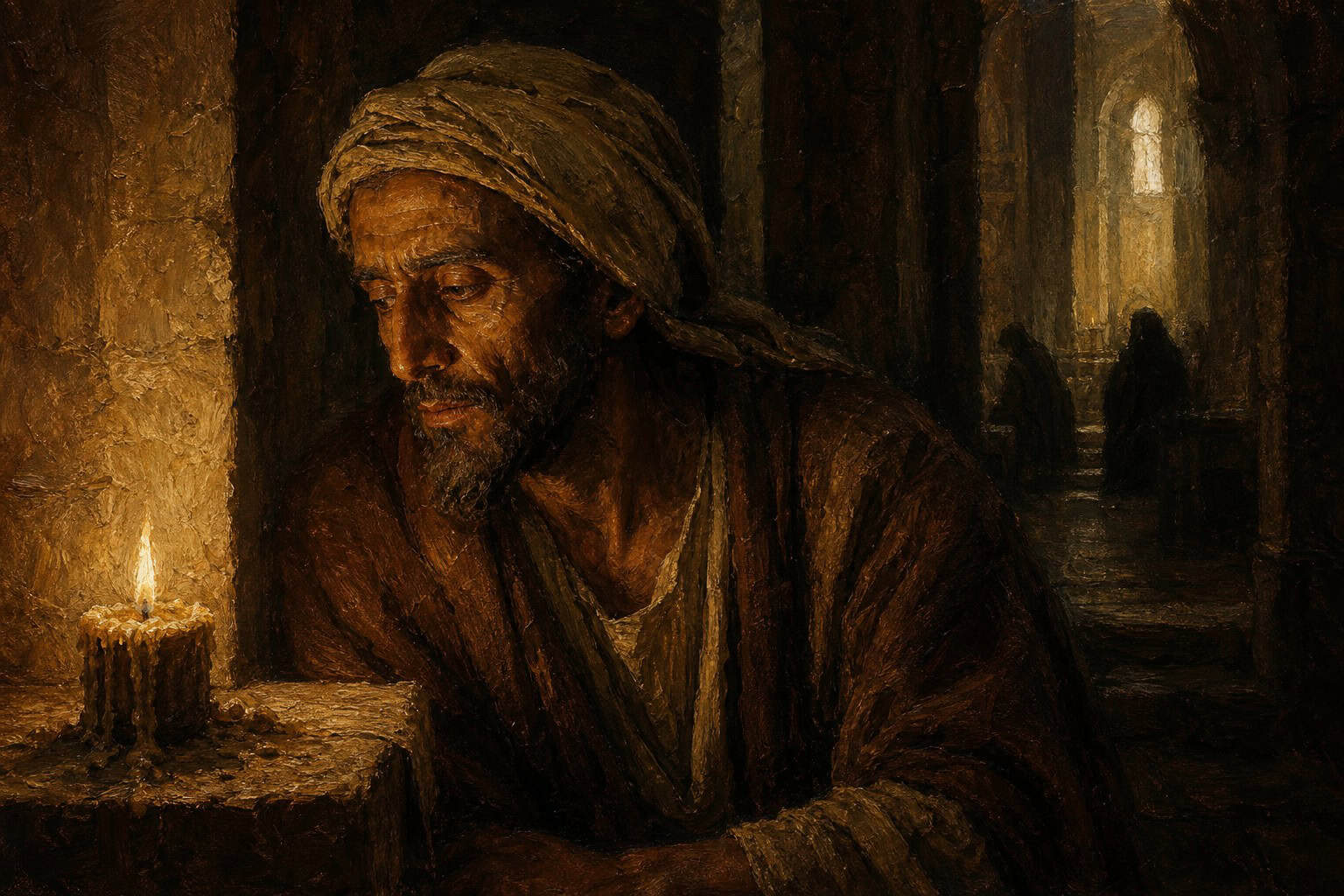
Why does God make us suffer? A raw, honest meditation on grief, desire, and finding God inside the dark rather than being rescued from it.
The Warning He Kept Repeating Like a Vow
It started with a sentence he said out loud, and then said again, and then again. He told her the truth about himself the way a man reads the small print on a bottle of poison—slowly, so there could be no mistake. Do not let this grow. Stop the hugs. Stop the kisses. Pull back before the roots reach down and something snaps. He called this transparency, and he leaned on the word like it made him clean. That is where the question begins, long before anyone mentioned a train to a far cathedral. A man decides he is dangerous. He announces it. He watches the woman take the warning into her hands. Then he waits to see what she does with it. This is the ground beneath the question a person types into a search bar near midnight, hollow and half-ashamed—why does God make us suffer—because the suffering in this scene did not blow in from the sky. It was built. It was chosen. In Confessions to the Empty Chair, the narrator sits with his own honesty and turns it over like a cold stone in his palm, and on the underside he finds something that is not honesty at all. The warning was real. It was also a hook. He told her he could not love her, and the telling made him more wanted, not less. There is a bitter thing in how the human heart works: the man who swears he cannot be had becomes the one the other reaches for hardest. His refusal was not a fence around a field. It was bait laid on the path. He knew this, or half-knew it, the way we half-know the thing we most need to hide from ourselves, and he let it happen anyway. So the scene does not begin with God dropping pain from above. It begins with a man arranging it, guarding his distance the way a sacristy guards the reserved host—locked, adored, untouched. Shinyi was closer to him than nearly anyone alive. He did not want to break her. He said so, and I believe he meant it. But meaning it and permitting it lived side by side in the same chest, breathing the same air, and that split is the first way into the whole punishing question. When suffering comes, how much of it did we raise with our own hands and then charge to heaven’s account? He would ask himself that in the years after. The reader can feel him asking it now, the way a man presses a bruise to be sure it still hurts, half hoping it does, because the ache is proof he was ever there at all.
Tears Poured Out Like Water Turned to Ice
There is a moment in the book where a miracle runs backward. At a wedding, Christ turned water into wine—an ordinary thing multiplied into joy. The narrator says he does the opposite. He turns tears into ice. He says it against himself, not as a boast, though somewhere under the confession there is the cold satisfaction of a man who has learned how to win a game he despises. Every woman who ignored his warning wept, and every wet-faced weeping he gathered up and carried and laid down at the feet of a dead woman’s memory. Jeannètte. The name he still keeps behind glass. Here the reading has to slow its breath, because it would be lazy to draw him as the hunter and her as the caught thing. That is one layer only, and a person is never only one layer. Yes, there is strategy in him—the man who cannot be fully possessed keeps his worth high, keeps his back to the wall so no one can leave him first. He blows up closeness before closeness can cut. That is true, and the book does not look away from it. But another thing sits right against it, touching skin to skin, and it is not strategy at all. It is grief with nowhere to land. His arms had learned one shape and could not unlearn it. His hands kept closing on a warmth that had gone out of the world. Every new embrace got read wrong by his own muscles, translated into someone missing, so that holding a living woman became a way of pressing on an absence. He was not simply cold. He was frozen mid-reach, an arm stretched out and stiffening in the air. Here the question about God grows teeth and bites down. Why would God let a man burn the living to keep a dead flame lit? Why permit grief to curdle into a private shrine where real women are used like incense, their smoke rising to a ghost? The book gives no soft answer. It sits inside the wrongness and lets it be wrong. And Shinyi is not a fool or a corpse laid at his altar. She was a friend, close as anyone, a whole person with her own longing and her own free will—she heard the warning clearly and kept coming, and we are forbidden to flatten her into victim or dupe. She had her own hunger, her own reasons, an interior he could never fully walk into. That is the honest floor of it. Two people met at the crossing where desire runs, and both were carrying something they could not name aloud. His pain was self-made. Hers was chosen with open eyes. And God, if He was in that space at all, was not throwing His body between them to stop it. He was somewhere near the two of them while the ice thickened, quiet, present, and not intervening—which is its own terrible kind of nearness.
A Poem Slid Across the Table Like a Confession
Then she handed him a poem, and everything shifts, quiet as a page lying down. Shinyi wrote her way through all five senses—she heard, she saw, she smelled, she touched, she tasted—and she bent every one of them not toward seduction but toward the war going on inside her own soul. She heard something approaching in the dark and named the feeling fear. She smelled a nearness coming close to the bed. She touched and tasted what she called sweet flesh, and in the very next breath she called it pretend, a lust that only felt like it would go on forever. Here is what cracks the whole cold machine down the middle: she does not stay in the pleasure. Her own conscience wakes at the sound of her name being spoken. She writes that she knows better, that weakness gives in and takes what it should not, that the scent of old lilies dies on the earth without leaving seed. She writes that she must reach and climb higher until she learns to bleed. This is not the poem of a woman being spent like currency. This is the poem of a soul climbing toward grace through the very doorway of desire, refusing to let the flesh be nothing but flesh. She wanted to stand in grace once more. She wanted the purity she had lost and knew she had lost it and meant to repent and grow again, because she believed there is no end. Something interfered with his transaction. Something he did not schedule and could not freeze solid. God did not come down through the ceiling and repair anyone. He did not lift away the temptation or thaw the man where he stood or mend the grief. What happened was smaller, stranger, harder to hold: a young woman’s plain honesty about her own sin became a light the narrator was forced to look into. Her weakness was more awake than his control. Her trembling knew more about God than his iron discipline did. That is the mercy that breaks in through a human hand—uninvited, unwelcome, disrupting the order he had built. Not a rescue that lifts him out. A companion who kneels down in the dark beside him and shows him he is not the only one bleeding there, and that the bleeding itself might be the whole point. He would look back on her poem, I think, and understand it accused him more gently than he deserved. She was the one being honest about the wound. He was the one calling his frozenness a virtue. The reader watches the two of them sit across from each other, one soul openly bleeding and one soul sealed in frost, and the book lets the difference hang in the air without softening it.
Grief that hardens into worship of the dead is not fidelity; it is the slow work of turning your own heart to ice, and calling the cold a prayer.
Grief that hardens into worship of the dead is not fidelity; it is the slow work of turning your own heart to ice, and calling the cold a prayer.
Köln, Where a Third Body Was a Wall
After the poem, they made a plan. He and his friend Ian would travel to see the great cathedral in Köln, and Shinyi asked to come along, joking that she would not be a pest. They laughed and said yes. Watch closely what the narrator does with the arrangement, because it lays his soul bare. He worked out, in the private arithmetic of the itinerary, that Ian’s presence would keep anything from escalating between himself and Shinyi. He shaped the whole trip so that a third body would serve as a chaperone he never had to admit he needed. Sit with that. He is traveling toward one of the tallest houses of prayer ever raised by human hands, and he is using the geometry of who sleeps in which bed to protect his private shrine to a ghost. The cathedral and the maneuver live in the same breath, and the book lets the irony ache without explaining it away. Here the hard question about suffering deepens again. He suffers because he will not let himself be loved. She suffers because she loves in the exact place she was warned not to step. And the two of them are walking toward a building raised precisely to hold this kind of ache—the longing of the body that has not yet understood it is really longing for God. Because that is what desire is underneath, and the book knows it in its bones. The reaching of the flesh toward another is a rehearsal for the reaching of the soul toward the One who made it. Shinyi felt this in her body. Her poem said the scent dies without seed, said she must climb higher until she learns to bleed. She understood, inside her weakness, what the controlled man in all his strength refused to see: that the body’s hunger is holy ground, dangerous and real, not a threat to be neutralized by parking a friend in the next bed. Looking back, the narrator seems half-aware that he mistook management for holiness. He held everyone at the precise distance he had once been taught was safe, long ago, before Jeannètte, and he named that distance faithfulness. But faithful to whom? To the dead woman. To the fear of being left again. Never to the living woman writing poems in the dark, and never to the God who was already waiting inside the stone he was about to walk into. He arranged the beds like a man solving a problem, and the problem was his own heart, and no arrangement of furniture has ever solved that.
Lighting a Candle to Your Own Shadow
So why does God make us suffer. The answer this scene presses into your hands is unsettling and refuses to fold itself neatly. Most of the suffering here God did not make at all. The narrator laid it brick by brick, out of a grief he would not put down and a dread of being abandoned that he dressed in the robes of loyalty. Shinyi built hers with her own free choice, walking toward a man who told her the plain truth and coming anyway, hungry for a thing she could not have. Two consciousnesses, each one lived from the inside, each carrying a private wound, each reaching out in the dark and finding another reaching hand. And God? God was not in the trade of removing any of it. He did not stop the tears or thaw the ice or rewrite who slept where on the road to Köln. What He did was quieter and much harder to swallow: He stayed present inside it. He was in Shinyi’s poem, in her conscience jolting awake at the sound of her name, in her stubborn refusal to let lust stay only lust. He was in the cathedral they were traveling toward, waiting the way a father waits, unwilling to force the latch. The book’s deepest suggestion is that faith sometimes means lighting a candle not to the bright altar but to your own shadow—your past, your present, your unabsolved future—and choosing to stand in God’s darkness rather than in a false and easy brightness. We are often more at home in His shadow than in His noon. The suffering is not a sentence handed down from a bench. It is the very ground where He walks beside us—in the sin, in the frozen reaching, in the wrongheaded pilgrimage arranged around a chaperone. That is not comfort. It is something stranger and better than comfort. Whoever asks why God makes us suffer may find, inside Confessions to the Empty Chair, no answer that stitches the wound shut—only the discovery that the wound is exactly where He stands nearest. The small flame gutters. The wax slides down and pools. And in that low, honest burning, the dead woman is grieved, the living woman is at last truly seen, and a man begins, slowly, against his will, to suspect that his ice was never fidelity. It was fear wearing the vestments of love. Whether he ever thaws, the book will not tell you here. That withheld answer is the true invitation, and it will not let go of you.