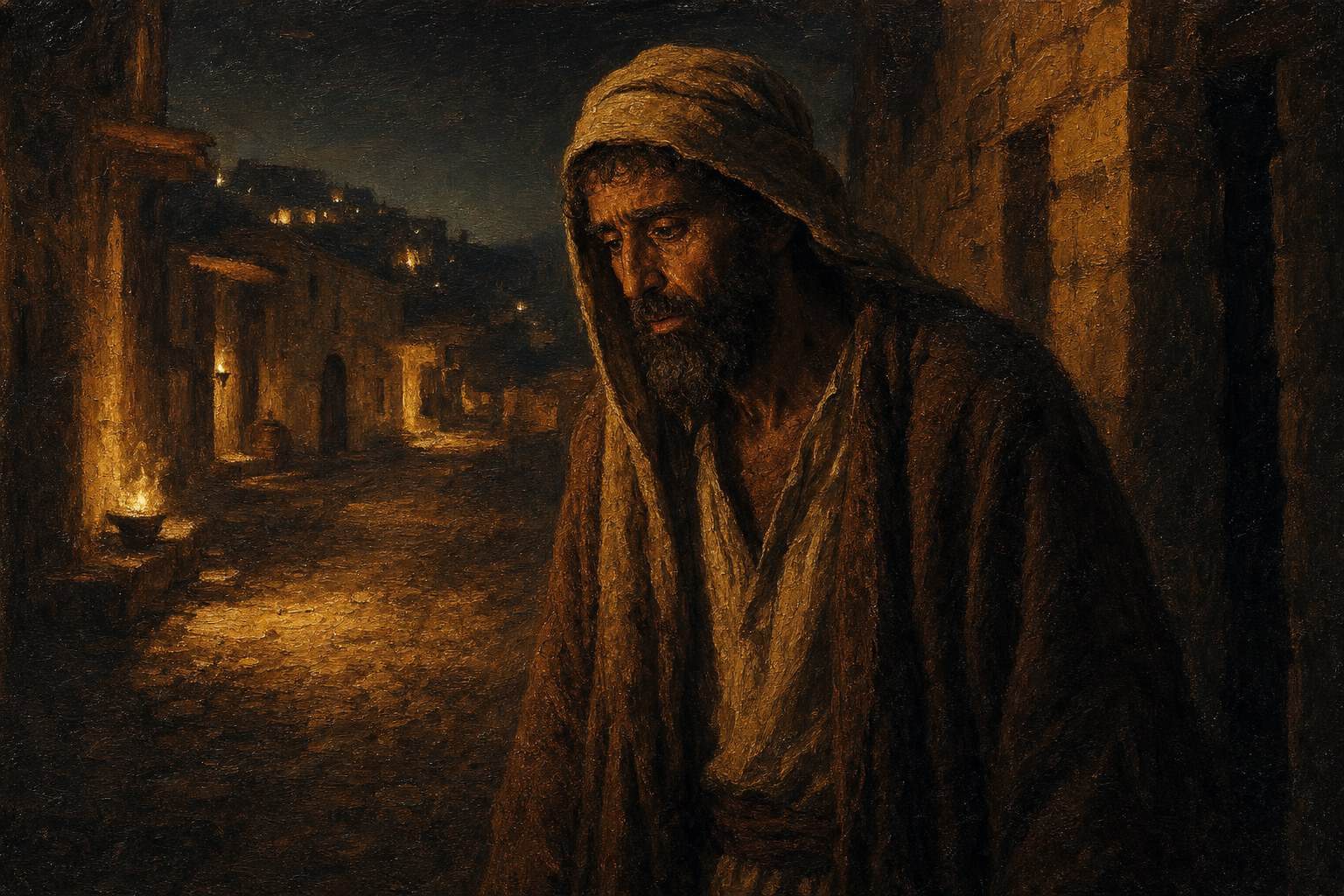
Walking late at night with a wounded heart? A reflection on the prayers that come in the dark, and the future you cannot yet see.
The Pavement That Held Your Weight
You went out because the walls had begun to breathe your own stale air back at you, and you could not stand it another minute. I remember you there, younger self, laced into your shoes, stepping down off the curb under a sky that asked nothing of you. The streets were empty and the cold was clean and it went into your lungs like something honest. Something in your chest that had stayed clenched all day loosened a fraction with each step, the way a fist loosens when the anger finally has nowhere left to go. You had been a man who drank to punish the body, who lifted iron until the muscles screamed and shook, who called himself stupid under his breath and made the flesh pay the fine. That fever was cooling now. The roar in your heart had burned down to a low red smolder, and you noticed, walking, that you no longer reached for the bottle the way you had, no longer needed to break yourself under the bar to feel like you had earned the right to lie down. You believed something strange in those years, and I will tell you plainly that I still half-believe it: that the love of the flesh and the love of the spirit run together like two currents in one stream, that wanting a woman was not the enemy of God but a rough dirt road that might, if you did not lie to yourself, lead toward Him. You did not want to give up the pursuit of the feminine. You only asked God to be patient with your wanting, to guide you toward a future you could neither see nor understand. So you walked, and the walking slowly turned into a kind of asking. The pavement held your weight without judgment. The streetlamps threw your shadow long, then short beneath the pool of light, then long again as you passed. There was no destination and you were not going anywhere. You moved because stillness had become unbearable, and in that motion something in you began, very quietly, to speak toward God. I want you to know, looking back, that those walks were holier than you had any way of understanding. You thought you were killing time, sweating off the leftover rage, tiring yourself down toward sleep. You were doing something else entirely. You were carrying an open wound out into the dark and letting the dark prove itself large enough to hold it without flinching. That was the beginning of a listening you did not yet have a name for, and I have spent years learning what to call it.
The Cold Certainty That Poisoned the Well
I will not pretend the walking was peace, younger self, because it was not. You carried a terror out there that no cold air could scrub away. It was not the fear that you would never love again. That fear would have been ordinary, survivable, the common ache of any lonely man on any empty street. What haunted you was worse and colder: the certainty that you had already become incapable of it. Not that love would be hard. That it was finished, foreclosed, walled off from the inside. You knew too much now. You trusted too little. You had learned things about people, and about the man you saw in dark windows as you passed, that you could not unlearn no matter how far you walked. You were sure the scar cut into your heart would leak its bitterness into anything you tried to build, that any new woman, any new tenderness, you would poison with skepticism before it could put down a single root. You would inspect the gift for the trap hidden inside it. You would undermine the very peace you were dying for, because you no longer knew how to receive a good thing without waiting for it to turn on you. I feel for you here more than anywhere on those streets. This is the deepest lie the wound tells, and it wears the borrowed face of wisdom so you will trust it. The damaged heart builds its own guard against hope and then attacks the medicine it needs to live. You believed your caution was maturity, hard-won and clear-eyed. It was a wall you had mortared with your own fear. You thought you had learned; the truth is you had calcified, gone hard where you should have stayed tender. And under all of it was a grief you would not say out loud: that the closeness you once mistook for depth was gone, that what you had called a shared gaze may have been only your own eye reflected back at you, indulged and enlarged, two frightened animals lashed together against the terror of standing alone. When that lashing broke, you were left standing in exactly the terror you had spent years trying to dam. So out on the pavement you rehearsed your own incapacity, fingering the scar again and again to be sure it still hurt, almost proud of the pain. Here is what I must tell you, tenderly and without softening a word of it: you were not wrong that you were broken. You were only wrong about what God does with broken men. You thought the poison in you was a life sentence handed down. You did not yet know it might be raw material in other hands. The darkness was real. You did not invent it to feel important or tragic. But you assumed it disqualified you, when in fact it was the exact ground where love would one day have to prove it was love at all.
The Stranger You Prayed Into Existence
Then, on one of those nights, something turned in you, and you could not have engineered it if you had tried for a year. You had left the formal Church behind by then. You had walked away from the altar because you would not stand up there and perform a light you did not possess. That refusal was its own severe honesty, a reverence shaped like exile: better to stay away in the dark than to walk up and desecrate the holy thing with a lie in your mouth. Twenty-eight years you would keep that distance, and I still cannot call it simple cowardice, because there is a terrible integrity in a man who will not fake the light. But the private, informal dialogue with God never once stopped, even out on the cold streets, and on the pavement it changed direction entirely. Your prayers stopped circling you. They bent forward, out ahead of you into a future you could not see, and they landed on a woman you had never met. A stranger, somewhere in the world at that very hour, breathing under the same low sky, who would one day have to stand directly in the path of everything dark you had accumulated and hold it, contain it, with something stronger than the sword you carried. You prayed to be her sheath. You said the words as plainly as a man can say anything: just be there with her, comfort her, I know she needs you. Sit with the audacity and the tenderness of that at the same moment. You, who were dead certain you could no longer love anyone, were already loving someone whose face you had never once seen, whose name you did not know, whose voice you had never heard. And it did not stop at her. You began to feel the children. On those late walks the awareness came like a light breeze across the back of your neck, unnoticed at first and then suddenly undeniable, the plain sense of unmade souls loving you down from heaven, waiting, patient, as real to you as a vision God holds of a painting before the first stroke of the brush ever touches the bare canvas. You were not building a fantasy to keep warm. You were being met.
The soul that cannot yet love still knows how to prepare a shelter for love that has not arrived.
The Breeze That Carried Small Souls
What astonishes me still, looking back at you on that road, is that you were not healed and yet you were not alone. God did not lift the darkness off your shoulders like a coat He was tired of seeing you wear. He did not repair the incapacity you were so sure of, did not reach in and cut the scar out clean. The scar stayed a scar, and it would stay one for years. What happened was quieter than a rescue and, I am convinced now, far greater than one: He walked the pavement with you inside it. The presence of those unborn children was not a prize handed to you for finally getting better. It arrived while you were still smoldering, still suspicious of every kindness, still certain you were poison to anything you touched. That is the thing I most need you to see and hold. The nearness came down in the dark, not once the dark had lifted. You imagined those small souls near your feet. You imagined distilling into a single evening’s conversation what had cost you years of tears to learn, handing them, freely, the hard-fought wisdom forged on your worst nights. And that imagining stirred the few live embers still glowing at the bottom of you. You said it in your own heart: they were your only hope of feeling again, of coming back to life. You endured the present not for your own sake, which had gone flat and gray, but for theirs, which had not yet begun. Do you understand what was happening on that ordinary street? A man who believed love was foreclosed had just found a love he would one day carry the entire weight of his brokenness to protect. The vast thing that dwarfed you out there was not the empty sky pressing down. It was this: that a future was being prepared which you had done nothing to earn and could not begin to comprehend, and that God was already standing inside it, ahead of you on the road, tending a woman’s heart and shaping souls not yet born into flesh. You were small under all of that. Rightly, cleanly small. But it was not a smallness that crushed. It was the smallness of a man who has just realized the room he has been pacing is far larger than its walls suggested, and that the whole of it was raised for him. The breeze that carried those small souls was the same cold air you had walked out into to escape yourself. It had been holy the entire time, and you had been breathing it without knowing.
What the Dark Streets Were Building
So here is what I carry back to you across all these years, younger self, and I set it down carefully. You thought the late walks were an escape, a way to burn off the rage and tire the body toward a few hours of sleep. They were nothing of the kind. They were an apprenticeship in hope you did not know you had entered. Every single step was pressing you toward a future you could not see and could not deserve, and it turned out that the darkness you were so certain disqualified you was the very place light chose to keep you company. I will not tie this off too neatly, and you must not let me. The wound was real, and it stayed real. The fear that you would ruin whatever love finally came was not paranoia dressed up; you would wound the people you loved, because that is what wounded people do to one another until grace does its slow, unhurried work on them. Your later story would carry its own steep cost, its own tears, its own long and unfinished reckoning. Nothing I say now erases a line of it. But you were not abandoned on those streets, and that is the whole of what I came back to tell you. You prayed for a stranger and for her strength, and in the very act of praying you were already becoming a man capable of thinking of someone before himself, which is the first raw beginning of the love you were sure you had buried for good. The darkness in you would one day recognize the darkness in her, and that recognition, as frightening as it sounds spoken aloud, would become a kind of honesty two afraid people could build something real upon, if they let God stand between them and refuse to let go. If you are the one reading this now, walking your own empty streets late at night with a heart you no longer trust, hear me and do not argue. The dark is not proof that you cannot love. It may be the exact ground where love is being made ready for you, out of your sight, ahead of you on the road, tended by hands you cannot yet feel against your face. I found the rest of it slowly, and I set it down as honestly as I knew how in Confessions to the Empty Chair, not as an answer wrapped and finished but as a witness left standing. Keep walking. Someone is already there with her. Someone is already there with you.