Where solitude becomes the very opening through which being shows itself
The church stands empty at three in the afternoon. Light slants through stained glass, pooling in colors across vacant pews. You enter through the heavy door, and the sound of traffic dies behind you. The space receives you—not welcoming exactly, but acknowledging your presence as it acknowledges the dust motes turning in shafts of light. You are alone here, but the aloneness has a quality, a texture. It is not the aloneness of your apartment, where solitude presses close. Here, in this vastness made for congregation, your solitude expands, becomes architectural. You sit in a middle pew, neither hiding in back nor presuming the front. The silence has weight, substance—not the absence of sound but presence itself, holding you.
This is how loneliness discloses: not as privation but as opening.
The Structure of Original Solitude
In the Genesis account that Anthony Adoré contemplates, Adam’s first loneliness carries no taint of loss or abandonment. It arrives as pure structure—”woven into the human soul by God,” a loneliness “pure, without evil.” Before Eve, before the possibility of her absence, Adam experiences solitude not as lack but as the very condition through which otherness might appear. His aloneness creates the space where “at last” becomes possible.
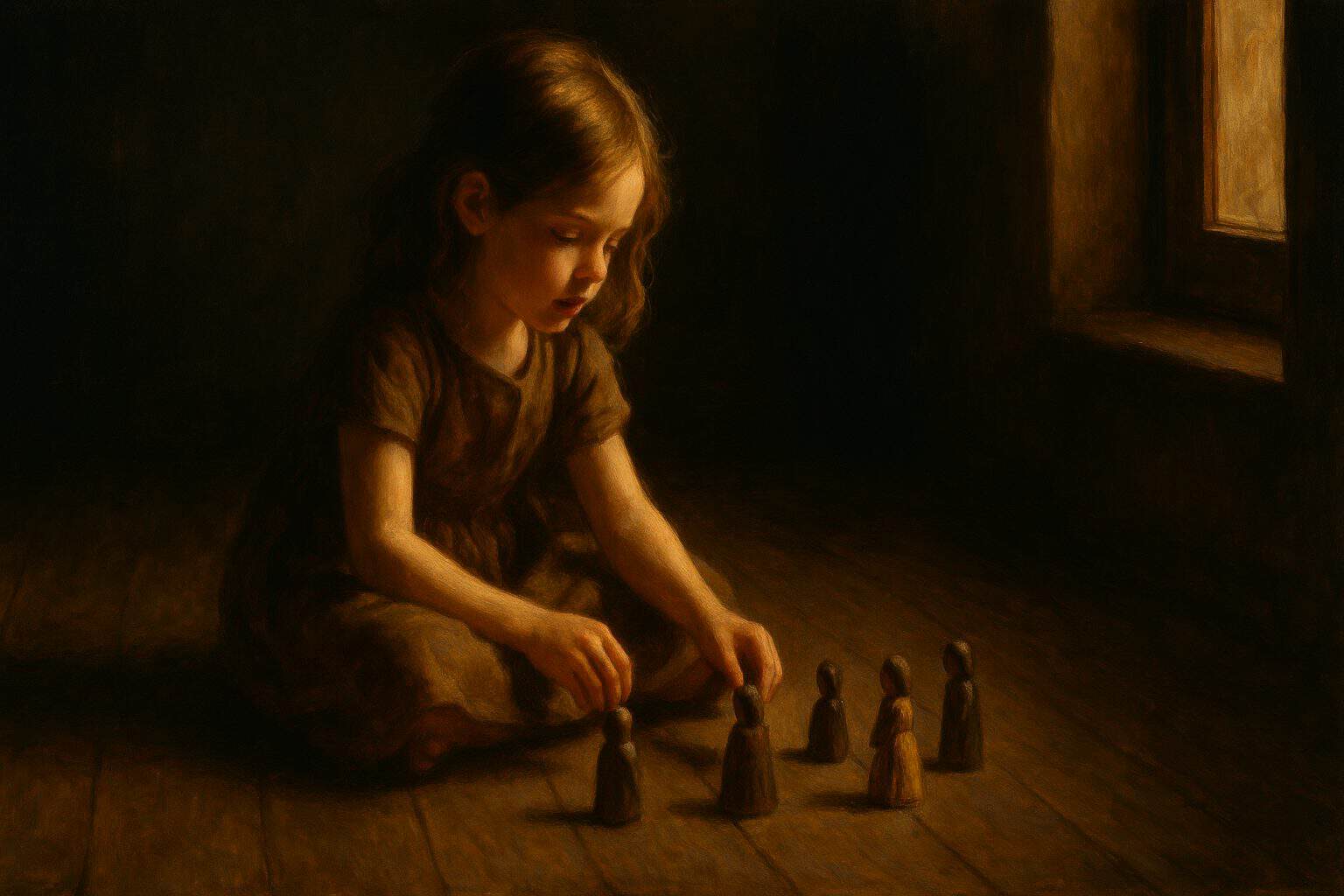
Consider how this plays out in ordinary existence. A child sits alone in her room, arranging dolls in careful conversation. She voices both parts, questioner and answerer, yet the dialogue is not mere echo. In her solitude, she discovers the structure of address itself—the reaching toward another that precedes any actual other. The empty space across from her doll is not vacant but expectant, holding open the place where genuine encounter might occur.
“Both he and she existed per se, in a physical sense, but they did not yet exist for each other.”
This existence per se but not yet for each other reveals solitude’s essential structure. We are thrown into being alone—”born alone,” as Adoré insists—yet this thrownness itself opens the horizon where others might appear. The infant’s first cry rings out into darkness, not knowing if anyone listens, yet already shaped as call, as address. Even in the womb’s ultimate solitude, the child turns toward sound, toward the muffled rhythm of the mother’s heartbeat—alone yet oriented beyond aloneness.
The Nocturnal Wanderer
“The nocturnal wanderings through Deep Ellum—these still comfort me,” Adoré writes, and in this admission we recognize a particular mode of solitary disclosure. Night walking has its own phenomenology. The streets that buzz with commerce and conversation by day become something else at 3 AM. Windows that displayed merchandise now reflect your passing figure back to you—ghost-like, translucent, superimposed on darkened interiors.
You walk these empty streets not to arrive anywhere but to move through solitude as through a medium. Each streetlight creates its pool of visibility, and you pass from one to the next like crossing islands of revelation. A cat watches from a fire escape. A light burns in a third-floor window—someone else awake, someone else alone. You don’t wave or call out. The recognition is enough: parallel solitudes that acknowledge without merging.
This nocturnal solitude differs qualitatively from daylight aloneness. By day, solitude feels chosen or imposed—you are alone while others gather. But at night, when most sleep, your waking solitude aligns with the world’s own withdrawal. The city itself becomes solitary. Buildings stand like sleepers, present but unresponsive. You move through this sleeping world as through a vast interior, the boundaries between inside and outside grown permeable.
The Phenomenology of Empty Churches
The empty church that comforts Adoré presents solitude in its most articulated form. Here, absence becomes palpable—not just the absence of people but the absence that sacred space maintains even when full. The architecture itself embodies withdrawal: vaulted ceilings that lift beyond reach, alcoves that pool shadow, the altar’s essential distance even when approached.
You genuflect from habit or respect, but the gesture feels different when performed alone. Without witnesses, it becomes pure address—not to the watching congregation but to the Presence that may or may not inhabit this emptiness. Your footsteps echo. You hear your own breathing. The sound reminds you that you are a body, finite, taking up space in this vastness designed to dwarf human scale.
The votive candles flicker in their red glass holders. Some were lit this morning, now burned low. Others freshly kindled, their flames steady. Each represents a petition, a hope, a grief—but you don’t know whose. The anonymity of these flames creates a strange communion: alone in the church, you stand among the traces of others’ solitudes. Their prayers linger like smoke, and your own solitude takes its place among them.
Solitude at the Threshold
“Feelings and thoughts from these involvements follow the individual to solitude’s door where he or she either invites them in or leaves them standing outside.” This threshold moment—solitude as doorway—captures something essential about how aloneness functions in lived experience.
You return home from a gathering. The apartment door closes behind you. For a moment, you stand in the entryway, neither fully arrived nor still departed. The evening’s conversations replay, but differently now, filtered through solitude’s particular light. That joke that seemed clever now shows its edge of cruelty. That moment of connection reveals its incompleteness. Or perhaps the reverse: what felt awkward in company now discloses its hidden grace.
Solitude becomes the space where experience sediments into meaning. Not through analysis—though that may come—but through a more fundamental settling. Like water growing still enough to show reflection, consciousness in solitude clarifies. The day’s encounters arrange themselves, some floating to surface, others sinking into darkness.
This is why we guard our solitude or flee from it. To be alone means to be with everything we’ve carried home—every unfinished conversation, every glimpse of ourselves in another’s eyes, every moment where we failed to say what mattered. Some evenings, we leave it all at the threshold, turning immediately to television, to phones, to any noise that might drown out the silence. Other nights, we invite it all in, sitting with whatever comes.
The Idol and the Icon
“The Idol of Solitude broke when I finally realized the silence I fled to was, in fact, the one Presence I had been seeking all along.” This breaking marks a crucial turn in solitude’s disclosure. What presents first as refuge—solitude as escape from others—transforms into encounter.
The movement typically unfolds like this: Exhausted by social demands, by the effort of maintaining yourself before others’ gazes, you withdraw. Initially, the relief is purely negative—the absence of pressure, of performance. You shed the social self like uncomfortable clothing. But then, in the continuing silence, something else emerges. The solitude you sought as emptiness begins to fill with presence—not your own exactly, but presence itself, undifferentiated and encompassing.
“When A and E, in silence and solitude, seek G, then both A and E will discover one another through their effort finding G.”
This formula—finding each other through seeking what transcends both—suggests solitude’s deepest paradox. True aloneness opens onto communion. Not the communion of merged identities but of parallel seekings, each solitude maintaining its integrity while recognizing its orientation toward the same beyond.
The mystics knew this. John of the Cross writes of the noche oscura, the dark night where soul meets God in radical solitude—beyond image, beyond concept, beyond even the comfort of feeling God’s presence. This darkness is not empty but pregnant, not absence but pure possibility. In losing all supports, all mediations, the soul discovers what cannot be lost because it was never possessed.
The Philosopher’s Loneliness
“They tend to favor solitude instead of gatherings of people, derive pleasure from contemplating abstract ideas as opposed to sensory stimuli.” This preference marks not just temperament but a particular mode of disclosure. The philosopher’s solitude—and here we might think of anyone who thinks deeply, not just professionals—has its own structure.
In solitude, thought moves differently. Without the pressure of immediate response, ideas can unfold at their own pace. A question posed in morning coffee might not find its answer until evening walk. The mind in solitude becomes like a vast interior space where concepts can arrange and rearrange themselves, forming unexpected constellations.
But this philosophical solitude exacts its price: “choosing to disobey instinct, disciplining the passions with reason, and helping others through the revelation of personal insight… come at a cost: loneliness.” The cost is not incidental but structural. To think deeply means to move beyond the immediate, the given, the commonly assumed. It means standing outside the circle of easy agreement, seeing what others don’t yet see or don’t want to see.
“Most of the time, my prediction of not being understood comes true. The evidence rests in your absence, dear observer.” This absence—the reader who isn’t there, the understanding that doesn’t come—becomes the philosopher’s constant companion. Yet the writing continues, the thinking persists. Why? Because the solitude that isolates also discloses. In the very act of articulating what may never be understood, truth shows itself—not as communication achieved but as fidelity to what appears in solitude’s light.
Finite Solitudes
“Finitude begins and ends with solitude. We are born alone. We die alone.” These boundaries—birth and death—frame all our intermediate solitudes. Every moment of aloneness carries an echo of these absolute solitudes, these crossings we make unaccompanied.
Watch a child learning to sleep alone. The bedroom door closes. The hallway light dims to a crack under the door. The child lies in darkness, hearing the house sounds—parents moving in other rooms, the refrigerator’s hum, the settling of wood. This is rehearsal for ultimate aloneness, practice for the solitude that bookends existence. Yet it’s also discovery: in that darkness, imagination flourishes. Shadows become creatures, then friends. The ceiling becomes sky, then ocean, then the inside of a whale. Solitude becomes the space where world creates itself anew.
Or consider the solitude of illness. The fever that separates you from ordinary life, creating a strange interior weather. Others can bring soup, cool cloths, medicine, but they cannot enter the fevered world itself. You lie there, suspended between sleeping and waking, and solitude takes on an almost physical density. Time moves differently—hours collapse, minutes extend. The familiar bedroom becomes strange territory. In this solitude, the body’s usually silent processes become audible: heartbeat, breath, the blood’s pulse in your ears.
Standing With Loneliness
“He must be willing to be alone in this world, preferring to stand with loneliness than to kneel with companionship in subjugation.” This standing with loneliness—not fleeing it, not filling it, but standing with it as with a difficult friend—marks a crucial threshold in human development.
The teenager who refuses to join the mockery, standing alone at the lockers while former friends turn away. The employee who won’t participate in the comfortable corruption, eating lunch alone while colleagues gather at another table. The artist who continues working in a style no one yet understands, studio visits growing rare, reviews growing silent.
These are not heroic solitudes—or rather, their heroism lies precisely in their ordinariness, their daily quality. Each morning brings the choice anew: stand with loneliness or kneel with companionship. The kneeling might be subtle—a small compromise, a slight adjustment of conviction, barely noticeable. But something essential is lost in that genuflection, some core integrity that only solitude preserves.
This is not misanthropy or pride. The one who stands with loneliness may love others deeply, may long for communion. But they recognize that certain truths can only be preserved in solitude, certain integrities maintained only by refusing false communion. They choose the loneliness that keeps faith over the companionship that betrays it.
The Presence in Absence
In the end, solitude discloses presence—not as filling but as the very structure of absence itself. The empty church is not empty but expectant. The nocturnal street is not deserted but receptive. The philosopher’s study is not isolated but oriented.
Adoré’s broken idol of solitude reveals this final truth: what we flee to in solitude is what we’ve been seeking all along. Not escape but encounter. Not absence but a presence so fundamental it can only appear when all other presences withdraw. Like the silence that makes music possible, like the darkness that lets stars appear, solitude creates the clearing where being itself can show.
We are born alone and die alone, yes. But this aloneness is not abandonment. It is the condition for any genuine meeting. Only because we are fundamentally alone can we truly encounter another. Only because we cannot merge can we love. The space between us—unbridgeable, absolute—is not obstacle but opening. In solitude, we discover not our isolation but our infinite address toward what lies beyond solitude itself.
The church door opens. Traffic sound returns. You step back into the world of others, carrying solitude with you now like a hidden room, a secret chapel where presence waits. You are alone still—we are always alone—but the aloneness has changed quality. It has become spacious, generous, capable of holding others without possessing them. This is solitude’s final disclosure: not the absence of relation but its very possibility.