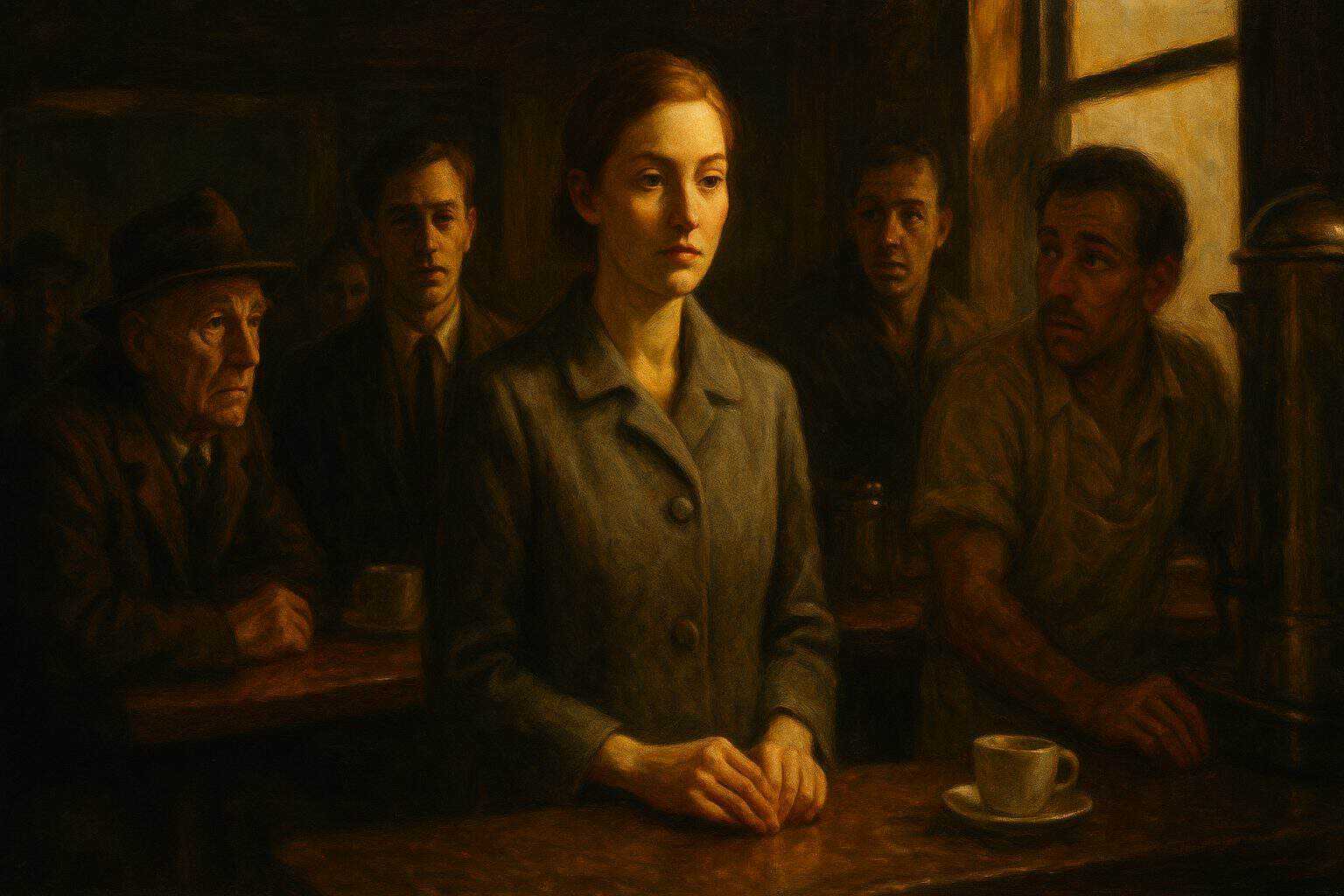
When another soul stands luminous before us, we discover ourselves suddenly weighted—pressed down by a radiance we did not ask to witness.
The morning crowd moves through the coffee shop with practiced indifference. A woman enters—not beautiful in any magazine sense, but carrying something unnamed. The barista’s hand pauses mid-pour. Conversations falter. Everyone feels it: this sudden weight, this uninvited pressure. She orders her coffee with ordinary words, yet the room has shifted. We look away, look back, look away again. Something in her presence makes us aware of our own dimness, though she has done nothing but exist in our shared space.
This is the weight of another’s glory—not the theological abstraction, but the lived burden of encountering someone whose very being seems to exceed what we prepared ourselves to meet this morning.
The Unbidden Recognition
Watch how it happens. You’re moving through your day, consciousness dispersed among tasks and small concerns. Then someone appears—in a doorway, across a room, stepping onto the train—and suddenly you feel yourself seen even when they haven’t looked at you. Their presence gathers the scattered pieces of the moment into something dense and particular. You weren’t ready for this. You were just buying groceries, just walking to work, just sitting in the waiting room. Now you must bear witness to something you cannot name.
“Until then, from her perspective, I am but one man among the many men already in her life.” The asymmetry cuts both ways. While we feel ourselves suddenly particular under the weight of another’s presence, we simultaneously know ourselves as one among many to them. The glory that weighs upon us may not even know we exist. This doubled consciousness—feeling singled out while knowing ourselves unremarkable—intensifies the weight.
The phenomenon resists our usual categories. This isn’t attraction, though attraction might accompany it. Not admiration exactly, though we might admire. Not intimidation, though we often feel small. Rather, it’s the sheer thereness of another human being registering with unexpected force. “Their physical existence—beautiful and shallow—beckoned suitors and ‘Alex-style’ suitresses alike, rendering dates and conversations among them hollow.” But sometimes physical existence is neither beautiful nor shallow—sometimes it simply is with such intensity that we must reorganize ourselves around its fact.
The Weight as Revelation
What does this weight reveal? Not primarily something about them, but about the nature of human presence itself. Each person carries more reality than we can comfortably acknowledge in our daily navigation. We develop social contracts of mutual dimming—agreed-upon reductions that allow us to function. We become “the dead among the living,” moving through our days with carefully calibrated absence. Then someone appears who hasn’t learned or won’t perform this negotiated deadness, and their full presence feels like accusation.
“This one at last is bone of my bones and flesh of my flesh!” Adam exclaimed. Eve was Adam’s “at last.”
The weight often carries this quality of at last—not because we were consciously waiting, but because the encounter reveals a waiting we didn’t know we were doing. The other’s glory shows us our own hunger for recognition, for meeting, for the full presence we’ve trained ourselves not to expect or offer. Adam’s loneliness was pure, without evil, woven into the human soul by God. Our loneliness, less pure, nonetheless vibrates with the same fundamental frequency when another’s undimmed presence strikes it.
Augustine knew this weight. The soul discovers itself as created for relationship yet perpetually restless, dispersed among temporal things until gathered by encounter with genuine presence. But while Augustine spoke of the soul’s weight toward God, we live the more immediate burden: the weight of another creature whose glory—their simple undisguised being—demands response we haven’t prepared.
The Lived Anatomy of Weight
The weight has its own phenomenology, its own lived structure. First comes the sudden arrest—the pause in our ongoing flow, as when the barista’s hand stops mid-pour. We’re caught, held, though nothing physical restrains us. The body knows before the mind: shoulders tense or drop, breath changes rhythm, hands seek pockets or hair or coffee cups—anything to discharge the sudden charge.
Then the reorientation. The room reorganizes itself around this new center of gravity. Peripheral vision sharpens while direct gaze becomes impossible. We’re simultaneously drawn and repelled, wanting to look while finding looking unbearable. The space between us and them becomes charged, measured, significant. Ten feet feels both too far and too close.
The comparison follows inevitably. Not comparison of attributes—who’s prettier, smarter, more successful—but something more fundamental. In their undisguised presence, we feel our own strategies of concealment. Their glory doesn’t judge us; it simply makes visible our own careful management of appearance. “Others chased their own happiness, too absorbed in themselves to notice my sorrow.” But when genuine presence enters, our absorption breaks. We can’t not notice.
Then comes the choice. We can flee—physically or psychically. We can armor ourselves with irony, criticism, dismissal. We can reduce them to categories that make them manageable: just another pretty face, just another ego, just another person trying too hard or not trying at all. Or—and this is rarest—we can stay with the weight, let it press upon us, accept what it reveals.
The Phenomenon of Overwhelming
Sometimes the weight becomes too much. The other’s glory—their unmanaged presence—overwhelms our capacity to receive it. We see this in how people respond to those who’ve survived extreme suffering or achieved something extraordinary. We want to approach but find ourselves backing away. Their very existence asks questions we’re not prepared to answer about our own lives.
“Beware the subtle idolatry of making another human being your ultimate source—your lowercase ‘g’ when only the uppercase ‘G’ deserves that place.” The weight of glory can indeed become idolatrous, but not usually in the way we think. The idolatry lies not in worshipping another person but in making their glory the measure of our own emptiness. We use their brightness to confirm our dimness rather than letting it call forth our own hidden light.
Sartre understood this dynamic: consciousness as pure negativity, a nothingness that experiences itself most acutely in the presence of another’s fullness. The pour-soi encounters another pour-soi and discovers its own lack through the other’s apparent completeness. But Sartre missed something—the weight isn’t only negation. It’s also invitation, possibility, a door marked exit from our self-imposed diminishment.
The Geography of Distance
The weight of another’s glory creates its own geography. There’s the zone of unbearable proximity—too close, and we lose ourselves entirely. The middle distance where we can appreciate without being consumed. And the safe remoteness where glory becomes aesthetic object rather than lived encounter.
Watch people navigate these distances. In elevators with someone whose presence weighs, we study floor numbers with sudden fascination. At parties, we maintain careful orbits—close enough to feel the pull, far enough to resist it. Online, we can approach and retreat instantly, managing exposure to others’ glory through screens and filters that promise control.
“No one’s heart is a tabula rasa… ghosts of who they were with others and ghosts of who others were with them—and these ghosts haunt the meeting.” The weight of another’s glory awakens these ghosts. In their presence, we remember other times we felt this weight, other glories we couldn’t bear to see. The present encounter carries the accumulated weight of all our previous flights from and toward genuine meeting.
The Paradox of Mutual Weight
Here’s what we rarely consider: they feel it too. The person whose glory weighs upon us likely experiences their own version of weight in return. Not necessarily from us—we might be invisible to them—but from others, from the world, from the burden of being seen or unseen in ways they didn’t choose.
“Even though the dead cannot speak for themselves, our voice can unite with theirs and they can speak through our interpretations.” The living carry a similar burden. Even though we cannot fully speak our own glory—cannot control how our presence registers in others—we remain responsible for its effects. Some people learn to dim themselves, to manage their glory down to bearable levels. Others, through suffering or grace or simple ignorance of social contracts, cannot or will not dim themselves. They move through the world trailing weight, leaving small disturbances in their wake.
The Economy of Glory
Our culture has developed elaborate economies for managing the weight of glory. Celebrity culture professionalizes it—certain people are designated glory-bearers so the rest of us can practice our responses at safe distances. Social media democratizes it, letting everyone experience both sides: bearing glory through curated posts, feeling its weight through others’ presentations.
But these managed exchanges miss the raw phenomenon. Real glory—the weight of another’s actual presence—cannot be curated or controlled. It happens in the break between expectation and encounter, in the moment when someone’s unmanaged being registers before our defenses activate.
“From their perspective, although not articulated, they are searching for someone to understand them, comfort them, pleasure them, and inspire them.” But what they often find instead is someone whose glory makes their own searching visible, whose presence reveals the poverty of what they’ve been willing to accept. The weight of another’s glory often feels like judgment, though it’s simply revelation.
The Flesh and Spirit of Weight
“They say these things assuming that spirit and flesh exist as some kind of mutually exclusive duality. They are not.” The weight of another’s glory proves this unity. It’s not spiritual or physical but both at once, indivisibly. The body feels it—the changed breathing, the shifted posture, the sudden awareness of our own physical presence. The spirit knows it—the recognition of something beyond material explanation, the sense of significance that exceeds any catalog of attributes.
Merleau-Ponty would recognize this: the perpetual dialectic between the pre-personal, anonymous life of the body and the personal acts through which we assume our situation. Another’s glory catches us in this dialectic, makes us aware of both our anonymous bodily response and our personal struggle to assume or refuse what their presence offers.
“To live life, death must be ignored. But to live abundantly, death must be confronted.”
The weight of another’s glory performs a similar function. To live socially, glory must be managed, dimmed, distributed into bearable portions. But to live abundantly, glory must be confronted—our own and others’—in its full, unbearable weight.
The Threshold of Recognition
Every encounter with another’s glory presents a threshold. We stand at the edge of recognition—not just recognizing them, but recognizing what human presence can be when it isn’t carefully managed down to social acceptability. “The knowledge of human beings is vast but also limited.” The weight of glory marks one of these limits. We can know about it, theorize it, develop strategies for managing it, but when it happens—when someone enters the coffee shop and the whole room shifts—we’re thrown back on resources we didn’t know we had or needed.
Frankl understood something of this: the tension between what one is and what one ought to become. Another’s glory makes this tension suddenly visible, suddenly urgent. In their presence, we feel the gap between our managed presentation and our possible authenticity. Their weight doesn’t crush us; it reveals how much we’ve been carrying, how much effort we expend to appear weightless.
The Communion of Weight
Sometimes—rarely—the weight becomes mutual recognition rather than burden. Two people, each feeling the weight of the other’s glory, choose to stay with it rather than flee. This isn’t romantic necessarily, though romance might emerge from it. It’s the simple, difficult act of letting ourselves be seen while seeing another, of bearing the weight of their glory while allowing them to bear ours.
“All of us breathe today because Adam breathed so long ago.” All of us carry glory today because glory has been carried through every generation—hidden, revealed, fled from, approached, but never extinguished. The weight we feel in another’s presence connects us to this ancient inheritance, this burden and gift of being human among humans.
The coffee shop settles back into routine. The woman takes her coffee and leaves. The conversations resume. But something has shifted, some small recognition has occurred. We’ve felt again the weight we usually conspire to ignore—the sheer significance of human presence when it forgets to apologize for itself.
This weight of another’s glory isn’t pathology to be cured or problem to be solved. It’s the periodic eruption of what we’re carefully not acknowledging: that each person carries more reality than our social contracts can comfortably contain. When that reality escapes its conventional bounds—through beauty or suffering or simple self-forgetfulness—we feel its weight. And in feeling it, we’re reminded of our own glory, the weight we carry and usually hide, the light we cannot bear to see in others because it reflects the light we cannot bear to acknowledge in ourselves.