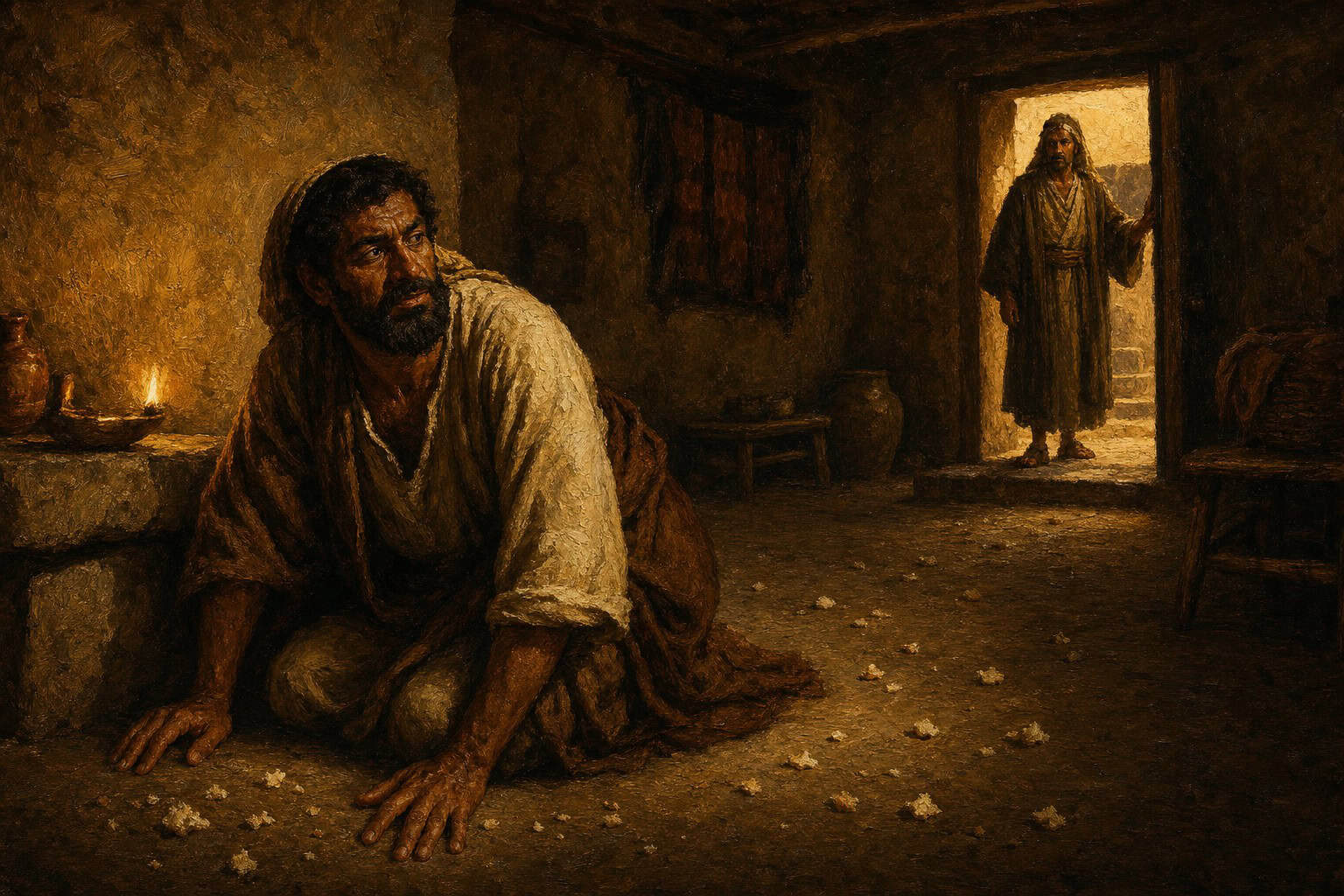
How to show intimacy on the page: a Catholic reading of Fractions of the Soul, where a teacher lays his mind bare and leaves crumbs to be found.
Crumbs Scattered on Purpose Across the Path
Intimacy begins the moment a man decides to be findable. In the fourth chapter of Fractions of the Soul, the narrator does something quiet and reckless at once. Before he says anything grand, before he builds a single argument, he stops and confesses his biases out loud. He wants whoever reads him to know exactly who is speaking. He calls the things he leaves behind threads, breadcrumbs, data points, fruits set down on purpose along the path. This is his answer to the question of how to show closeness. You do not perform it. You leave a trail. You scatter enough of yourself that another person, if they wished, could follow the crumbs back to where you actually stand. The image is small and domestic, almost embarrassing in its plainness, and that plainness is the whole point. He is not raising a monument to himself. He is dropping crumbs the way a frightened child drops them in a dark wood, hoping to be followed home before the light fails. There is a tenderness in this that caught me off guard when I first sat with the page. A man who wants to be found is a man who has stopped pretending he needs no one. He admits the hunger to be sought. He admits it in writing, which is the most exposed place a person can admit anything, because the words stay put on the paper and can be read back to you later, when you would rather they had stayed silent. To show intimacy, then, is first to make yourself locatable in the world. It is to say: here are my flaws, laid out early, so that when you draw near you draw near to me and not to the polished thing I wish I were. The crumbs are not decoration on the floor. They are the risk of being tracked, of being followed to a place you cannot afterward deny. A reader who follows them feels the difference between a writer who displays himself and a writer who confides. The chapter turns on that distinction, and the narrator knows it in his hands as he writes. He is teaching by exposing the seams of his own teaching, showing the stitches, letting the thread hang loose. That is a strange and moving way to open a bond between two people who have never met. It sets the felt tone for everything that follows: a man kneeling on a cold floor to place small pale offerings one by one, then glancing back over his shoulder to see whether anyone at all has begun to come.
The Stone Table Offered, Never Seized
The nearness deepens when the narrator hands over a strange kind of trust. He writes of laying the reader on a stone table, of the student choosing to submit as one submits to a doctor of the soul. My first instinct was to flinch, because the picture sounds like power taken by force. Read it slowly, though, and it becomes the opposite. He seizes no one. He describes a bond that can only exist by consent, where the one who lies down does so freely, having already come to know the man through his words on the earlier pages. That freedom is what makes the closeness intimate rather than cruel. You cannot be laid open against your will here. You have to climb onto the cold surface yourself, eyes open, because you followed the crumbs and decided this teacher was worth the exposure. The tenderness lives inside that freedom. He wants to be trusted enough that another soul would lay itself bare on the stone, and he knows such trust cannot be commanded into being. So he earns it slowly, by going first, by laying his own mind naked before he asks anyone else to lie still. The stone is cold in the imagining, the room hushed, the small instrument bright in the low light. And yet the whole scene aches toward care rather than harm. This is the emotional sickness he speaks of, the growth that fills the inner hollow, the thing a person often cannot reach alone no matter how hard they dig. To show intimacy, in this reading, is to offer to help remove what someone cannot remove by themselves, and to lie down and let them offer the same to you. It is dangerous work, and the narrator does not pretend otherwise. A man who leans over another soul with an instrument in hand can harm as easily as heal. He interrogates his own motives openly on the page. Does he want to help, or does he want to be needed? Is the teaching an act of love, or a subtler hunger to have someone lie down and belong to him? He does not resolve it cleanly, and I trust him more for the question he leaves standing. That tension holds the way it holds in every real closeness between two flawed people. One is always partly using the other, and grace does not scrub that away; it only walks alongside it, quiet, in the room. That is the harder and truer intimacy the chapter reaches toward. It refuses the easy comfort of pretending the giver’s hands come clean to the table.
They Walked With Love and Turned Away
Here the ground opens beneath the whole scene. The narrator turns to Eden and asks a question that will not release him. If the first man and woman walked with Love, spoke with Love, owed their very breath to Love, and still turned their faces away, what hope remains for the rest of us who never had that nearness at all? How are the sinful to succeed where the sinless failed? The question is devastating precisely because it strips the easy optimism out of love between people. He says men and women have been chasing one another since the garden, mistaking each other for the greater good, trying to lure and to consume, seeing the other as the missing piece lodged somewhere inside themselves. That mistake is the death of intimacy, not its birth. To grab at another person as your salvation is to make an idol of them, to treat something passing as though it were permanent, to draw pleasure out of them and call the extraction love. The young couple in the crowded club embodies the trap exactly: attraction and validation offered in just enough measure to satisfy, never enough to save, a movement that climbs from one shallow rung to the next and always stops short of the divine. He watches them cycle and sees the whole fallen pattern condensed into two bodies leaning close under moving light. This is the turn that reorders everything before it. Intimacy shown as grasping is not intimacy at all; it is consumption wearing tenderness like a borrowed face. He sits with that recognition and does not soften it, and the reader feels the floor tilt beneath every warm thing they ever mistook for love. The sinless had Love beside them and still reached past it. What, then, are the rest of us reaching for when we reach for each other in the dark?
Intimacy is not the closing of distance but the willingness to leave a trail that lets another soul find you.
What the Empty Hours Were Preparing
After that hard turn the narrator does something I did not expect. He does not condemn the loneliness. He redeems it. The answer, he writes, rests in how we respond to our own solitude. Only after a person has sought and asked and knocked inside their aloneness, only after they have turned their hunger toward reasonable and divine things instead of toward another warm body, does a genuine encounter with another person become possible at all. This lands with a strange gentleness, like a hand set flat on the chest. The isolation that felt like punishment, the exile that felt like proof of failure, becomes the very forge where a person is made ready to love without devouring what they love. I sat a long while with this, because it softened something I had been trained to despise in myself. The empty stretches were not wasted years. They were not evidence that I was unlovable at the root. They were the ground being turned and prepared for planting. He says men in their loneliness must seek greater reason, and women in their solitude must ask reason for meaning and for purpose. What strikes me is not the parceling of roles but the single instruction beneath both: do not run to another person to escape the hollow inside you. Sit down inside the hollow first. Let it teach you what you are actually reaching for with those grasping hands. The person who cannot bear to be alone will always consume whoever comes near, mistaking relief for love and calling the theft a gift. Here the theology refuses the tidy ending. He does not promise the loneliness lifts. He does not promise the encounter ever arrives at the door. He only says the possibility opens once the grasping stops. God is not handed to us as a rescue from the empty room but as the quiet presence within it, the one who walks beside a man through the very solitude he is desperate to flee, present in the tears, not erasing them. That accompaniment is the fruit the chapter keeps circling back toward. The narrator turns the lens on himself even here. He asks whether he ever truly did this waiting, or whether he only preaches it now because he failed to do it then, in his own younger hunger. He does not answer. The self-questioning stays raw, and it should. To show intimacy, this section suggests, you must first show what you did with your aloneness, honestly, including the nights you fled it into someone else’s arms and named the flight love. The tenderness is in the not-flinching, the willingness to look at the young man he was and refuse to spit.
A Trail Left for Whoever Comes Looking
The chapter settles not on an answer but on a posture of the body and the soul. Intimacy, in the end, is the courage to be found and the patience to wait until being found actually means something. The narrator has spent these pages laying his mind bare, dropping crumbs across the floor, offering the stone table, admitting the Edenic failure written into every human bond, and reframing his loneliness as preparation rather than sentence. What remains is a man who has made himself trackable and then stepped back, letting the choice belong to whoever follows the trail. There is enormous restraint in that quiet step backward. He does not chase. He does not seduce the reader the way the couple in the club seduce each other under the moving light. He simply leaves the crumbs and keeps writing, pressing his soul into the words, and trusts that the seeking soul will do its own seeking first, in its own dark. This is how Fractions of the Soul shows closeness: not by describing bodies pulled together, but by describing a self laid open on the page and a hand extended with no grip in it. The felt tone at the close is neither triumph nor despair. It is something quieter and harder to name, the mood of a man who has stopped performing and started confessing, who has accepted that even his best intimacies carry the double parentage the chapter names, part love and part hunger tangled at the root, and that grace does not burn the hunger out but walks beside it through the whole of a life. I keep returning to his willingness to be seen all the way through, to let another read his rotten places and remain in the room. Love, he suggests, has the strange power to see through its own enchantments and not be disenchanted by what it finds. That is the intimacy worth learning to show. It is not the closing of every distance between two people. It is leaving enough of yourself along the path that another soul, if they truly wish it, can follow the scattered crumbs and find you standing there, flawed and waiting, having gone first so they would not have to walk in afraid. The chapter never tells you whether anyone comes. It only shows you how a man makes himself findable, and lets you feel the ache of hoping he is not tracking through the wood alone. Whether the seeking is answered, whether the table is ever climbed, whether the empty hours bear their promised fruit, the book keeps for those who follow the trail all the way in.