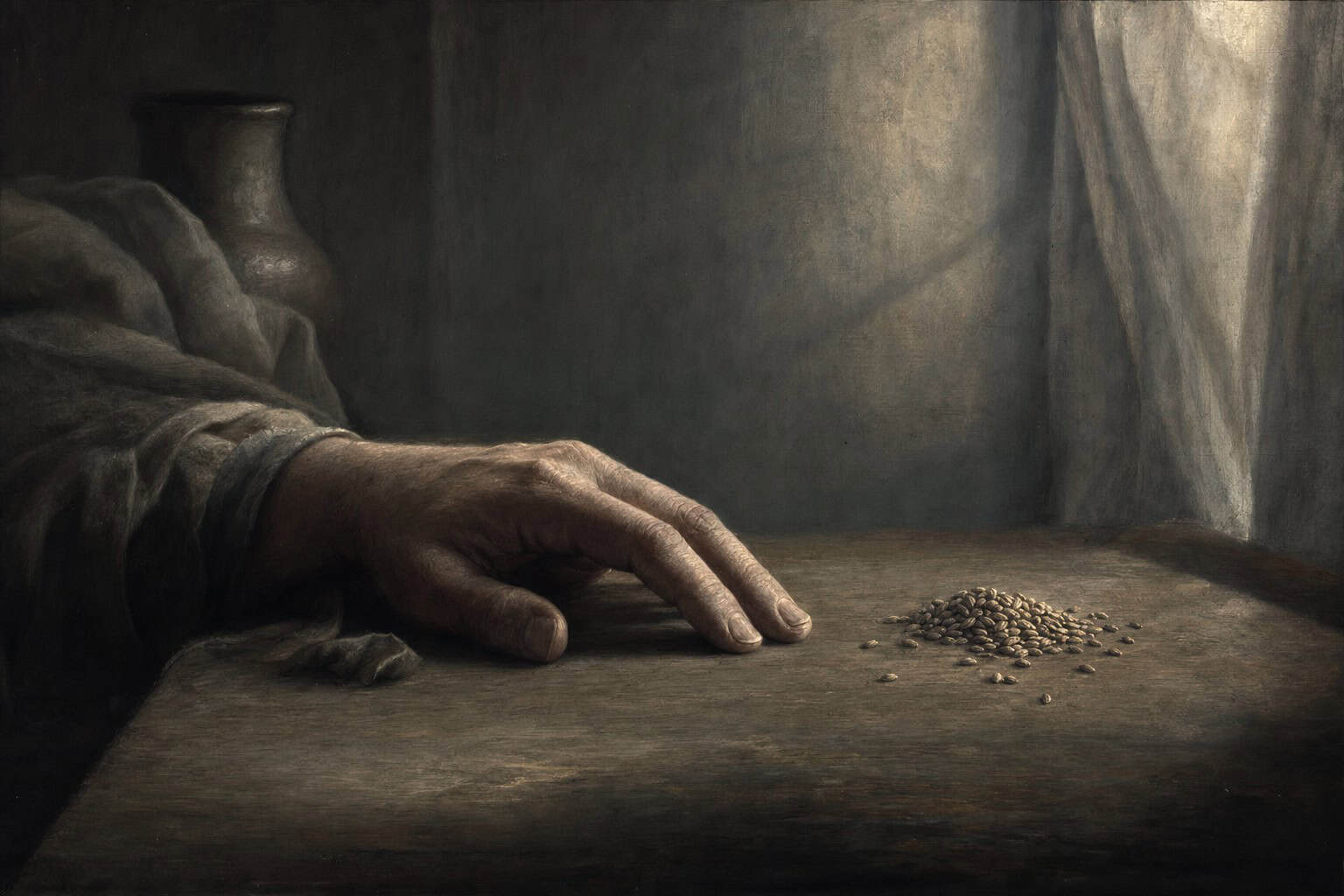
Her hands rest on the table, not reaching, not withdrawing, and he measures his whole worth against a silence so calculated it takes a kind of violence just to keep surviving it.
Her Still Hands on the Table
Two people share a table, but the real action lives in the tiny distances between skin and air. Her hands rest in front of her, fingers relaxed, nails unchipped, not reaching, not withdrawing—just still. That stillness is the strongest force in the room. He feels it pressing against his chest, that small refusal to move even half an inch closer. She has learned that staying motionless, saying less, giving almost nothing, pulls more from him than any generous touch. Each pause, each held-back word, is an instrument, tuned to the pitch of his hunger. He leans in, offers more stories, more disclosure, more proof of his loyalty, trying to win a shift in those hands, a tilt of the wrist toward him. The more he offers, the more she measures. He thinks they are sharing a moment. In truth, his desire is being weighed on the cool, steady surface of her unbending palms.
Rules Written on the Back of a Napkin
Her boundaries arrive as if they were commandments: no late-night visits, no physical affection, no emotional “pressure.” She explains them calmly, even kindly, folding a napkin while she speaks. For a time he takes these limits as proof of her integrity, the moral frame around something delicate. Then he watches those same rules evaporate for another man. Curfews vanish, exceptions multiply, the napkin might as well have burned in an unseen fire. The ache is not only rejection but classification. He realizes the codes she hands him are not universal laws, but instructions for handling what she does not truly want. Her “principles” reveal his status more sharply than any insult: he is someone who requires management, not someone who provokes abandon. In that moment the napkin changes meaning. It is no longer a sign of her virtue but a quiet label pinned to his chest: safe enough to use, not desired enough to break the rules for.
Bones Ground Fine Beneath Her Steps
After the parting, his nights stretch long and airless. Sleep will not come, food tastes like dust, and his chest hurts in a way no doctor can name. While he fades, her life begins to bloom in new colors: a new city, a new lover, new photographs flooded with sun. None of this is abstract for him. He can feel which parts of him she used to build that future—the stories he told her that now guide her choices, the patience that steadied her through old storms, the loyalty that taught her what she should expect from the next man. It is as if his ribs have been broken down into fine powder and packed under the stones of her new path. She walks lighter because he carries weight alone. No one will ever say his name when they praise her happiness. Yet under every compliment she receives, he senses the grind of his own pulverized hopes, holding the pavement firm beneath her feet.
There is a violence required to survive certain griefs, and a man can measure his whole worth against the calculated silence of someone who will not answer.
Pouring Wine Over an Empty Chair
To live with this kind of loss, he invents a strange ritual. He pours a glass of wine and sets it across from him, where she once sat. No one will drink it. It is an offering to a presence that has become a void, a way to force his body to accept what his heart keeps arguing with. He speaks aloud to the empty chair, not to call her back but to bury what still reaches for her. Each word is a shovel of dirt over a future that will not happen. This is the violence he must do to his own hope: not self-harm, but a hard mercy toward a heart that would otherwise wait forever. The Church has words for praying the dead into God’s hands; here he must do something colder, stranger—pray the living out of his own. He is not allowed the comfort of a coffin or mourners, only this quiet table, this untouched glass, this resolve to stop listening for her key in the lock.
Seeds Left in a Closed Fist
In time, the pattern grows too clear to ignore. He sees how often he has walked into rooms like this, palms open, scattering affection, patience, truth, as if any ground could be made fertile by enough effort. This woman is not the first stony field, only the sharpest. Something in him hardens, but not into bitterness—into refusal. He will no longer throw himself where there is only calculation, where another’s still hands treat his yearning as raw material for their ascent. The image that remains with him is simple: his own fist, finally closed around what he carries. Not clenched in rage, but held with a new sobriety, a reverence almost liturgical. There are souls, he begins to suspect, who might want what he brings without needing to test it to destruction. The question is whether he will dare to unclench that hand again, and in whose soil, and under what sky, he will let the next seed fall.