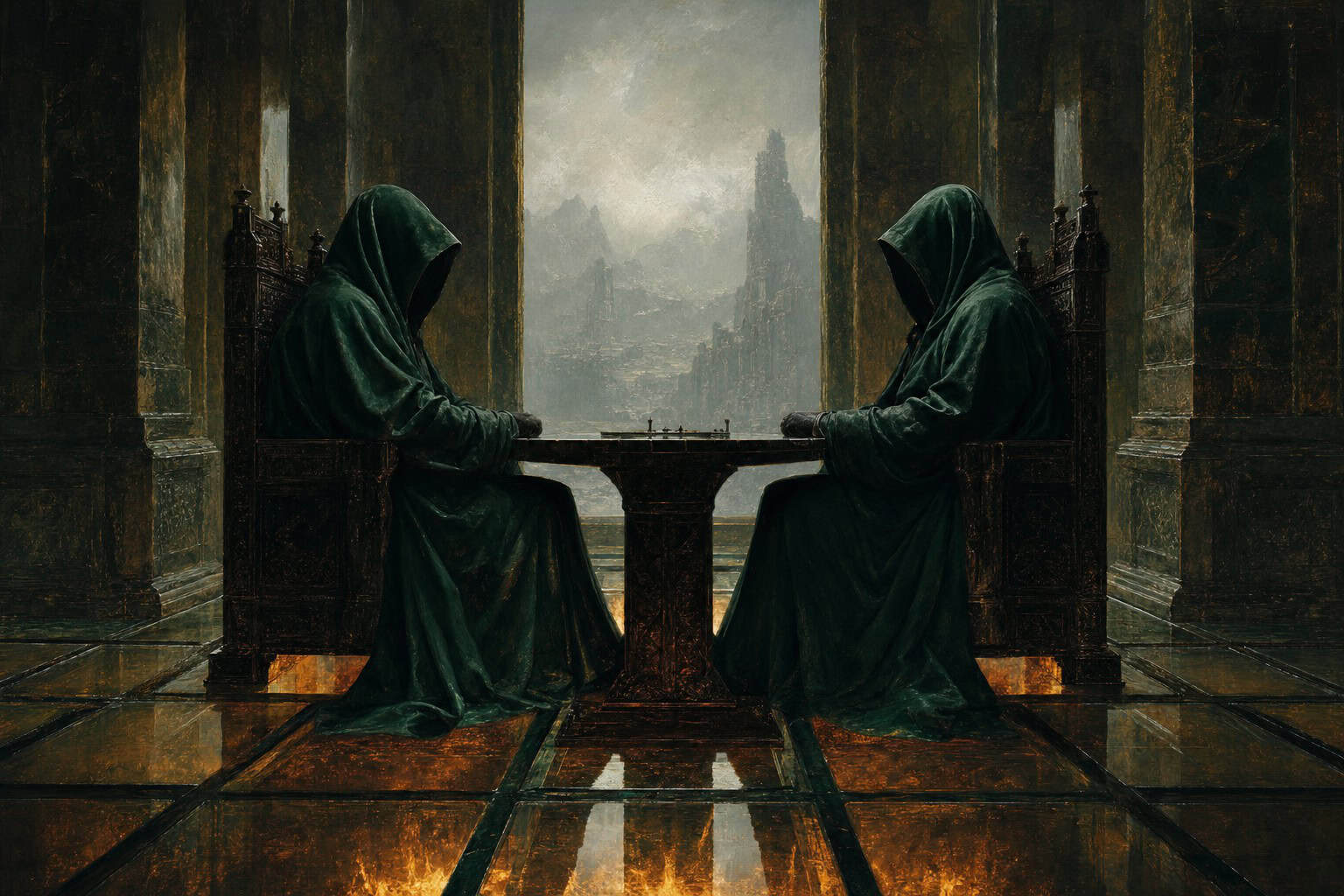
A narrow table stands between them like a balance scale, and the man who arranged his whole life by military precision meets the one thing he can never schedule: another’s freedom.
A Narrow Table, Too Many Variables
A narrow table stands between them, more like a balance scale than furniture. On one side, the young man who has spent years arranging his days with military precision—set hours for study, for prayer, for sleep, each book and thought chosen like a controlled chemical. On the other, the one who has agreed to listen, whose very presence he cannot diagram or predict. His inner world has always obeyed him; if a thought hurt too much, he could exile it, if a memory shouted, he could drown it in Latin verbs and catechisms. But this new element will not stay where he places it. A tilt of the listener’s head, a question that doesn’t match any script, and the whole equation begins to swim. He feels, almost physically in his chest, that his private mathematics are being rewritten in real time, and the chalk won’t stay on the board.
Molten Need Under a Starched Collar
His shirt is neatly buttoned, cuffs straight, nails trimmed to the half-moon. Every visible line says control. Yet as he speaks, a heat rises that has nothing to do with the room’s air. It is the old, buried hunger he has hidden since childhood—the wish to be held without being laughed at, to lean his head against another shoulder and not be told to toughen up or stop being strange. He remembers the smirks, the rolled eyes, the way hands that should have soothed instead pushed him back into himself. So he learned to trade flesh for thought, tenderness for theory, and stacked discipline like cooled lava over that burning center. Now, under the other’s mild gaze, that crust feels hairline-thin. His jaw tightens not from anger but from the effort of keeping the magma of longing from spilling into the quiet space between them.
Touching Knees, Missing Heaven
Their chairs are close enough that a small movement could make their knees meet. That near-contact carries its own charged promise, yet he knows how that story goes. Bodies can press together night after night and still wake up strangers, orbiting the same old patterns of desire, reassurance, boredom, blame. He has lived inside that flat circle before—kissing to muffle arguments, embracing to avoid the real wound, growing more tired each time the same script plays out over different evenings. As they speak now, part of him longs to slide sideways into that easier language of skin, to trade hard truth for the softer distraction of touch. But something in this conversation refuses to stay on that horizontal line. He senses that if this encounter collapses into mere comfort, the deeper question swelling between them will die unspoken, like smoke pressed back into a chimney.
To truly meet another is to discover you cannot control their freedom, only witness its terrible beauty, and let it remain forever beyond your reach.
When a Question Cuts Like Steel
The listener asks something small on the surface, a simple why that lands in his chest like the tip of a blade. It is not cruelty; there is no sharpness in the voice, only a steady insistence that does not accept his polished answers. Each follow-up slides past his stock defenses—past the clever joke, the theological citation, the polite change of subject—and opens a tender layer he had sworn no one would see. He feels himself split along old seams: the obedient believer, the wounded child, the proud recluse, all crowding the same ribcage, none quite in charge. Their very difference grates against his wish to remain a single, controlled self. At the same time, another strange sense steals in, like metal ringing against a proper stone. This particular mind, this exact patience, fits the contours of his evasions too well to be random, as if he has been matched with the one person whose questions are shaped to his hiding places.
Sitting with a Loaded Silence
By the time their words thin out, the air between them has changed weight. He knows now, in his bones, that he cannot lock this person into any outcome. They might return tomorrow or vanish without explanation; they might hold his story with care or mishandle it in ways he cannot foresee. Their freedom hums in the silence like a live wire on the table, close enough to touch, impossible to tame. His old strategies—charm, distance, flawless logic—feel dull against this raw uncertainty. To stay here, without guarantees, means accepting that his carefully managed heart could be further fractured by the very encounter that might also begin to heal it. He does not rise, does not flee back into books or screens or noise. For a few stretched moments, he simply stays seated in that heavy stillness, as if hearing, beneath the ordinary sounds of breath and shifting fabric, the slow gathering of a storm that has not yet broken.