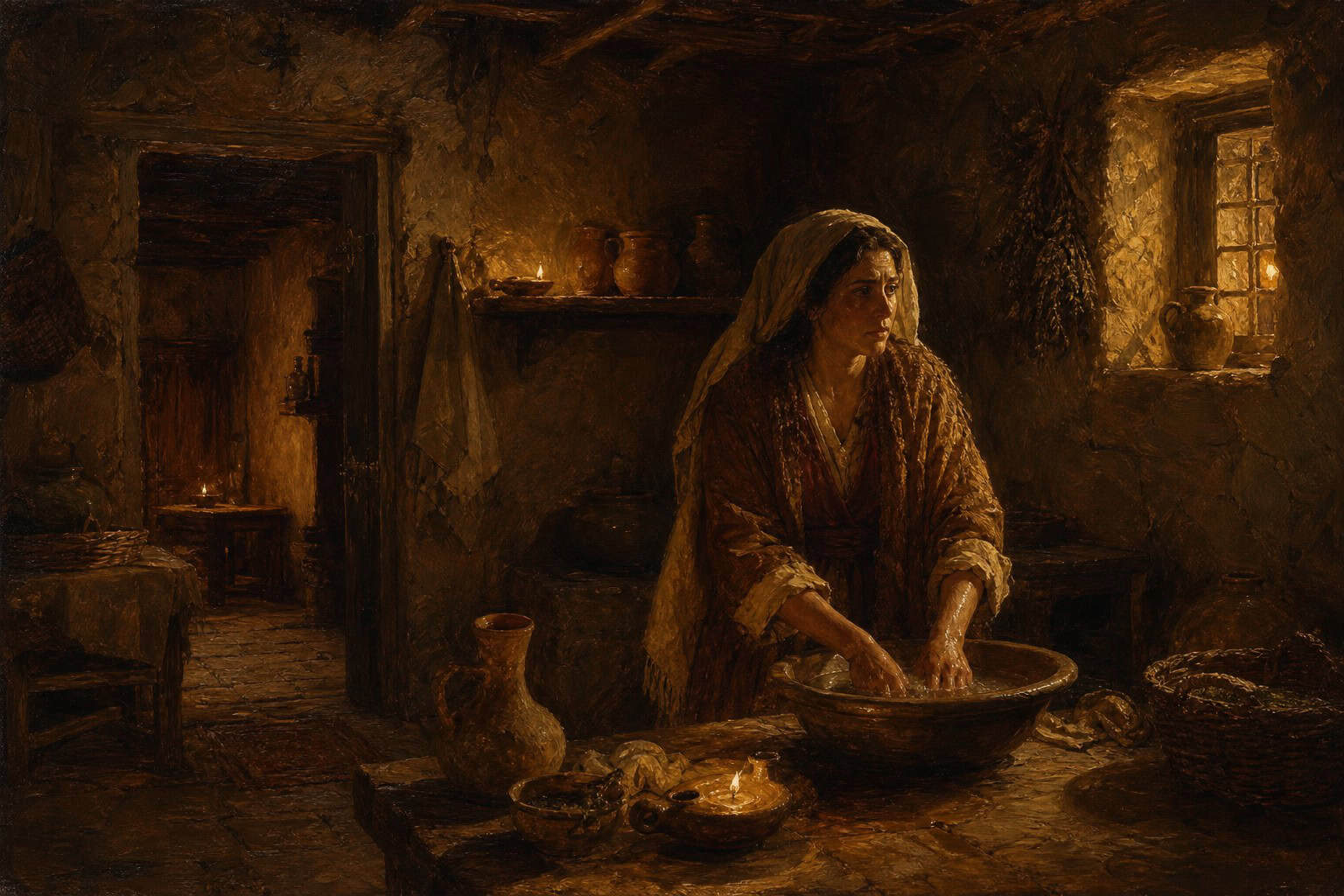
Why women love true crime: a raw, honest look at the ache underneath the fascination – what the body remembers and the soul reaches for.
Headphones On, Dishes in the Sink
You put the earbuds in while the dishwater cools. The voice in your ear is calm, almost gentle, and it is telling you about a woman who never came home. You are not a ghoul. You are washing a plate, wiping the counter, folding a small shirt still warm from the dryer, and all the while a stranger’s ending threads through your ordinary evening. The soap smell rises. The tap drips. Your hands move through the routine your body knows without you, and your mind goes somewhere else entirely, into a bedroom you have never seen, a phone that stopped answering, a car that turned down the wrong road. This is the thing you rarely say out loud: the dark ones comfort you. A missing girl, a marriage that turned to murder, a man who wore a father’s face over a predator’s hunger – these hold your attention the way nothing on the bright channels can. You could name it curiosity and be half right. But there is a deeper current under the water, and you feel it in your chest before you can explain it, a low pull like a tide against the backs of your knees. You are listening for the moment the danger becomes visible. You are practicing the recognition you wish someone had given you long ago, rehearsing the tell you missed once, the flag you waved past. There is a woman inside these stories again and again, and something in her is familiar to you – not because you would ever end up where she ended, but because you know the ache that put her in the wrong car, the wrong bed, the wrong arms. The narrator’s voice is steady, and its steadiness is part of the mercy. Somebody is finally paying attention. Somebody is finally telling the truth about what was done to her, laying it out in order, refusing to look away. You dry your hands on the towel by the stove and keep listening. The porch light hums against the black window. The kids are asleep down the hall. You are safe, and yet you keep reaching for the unsafe, turning it over like a cold stone you are afraid to lift and cannot set down. The pull is not for gore. It is for understanding – the desperate, almost holy wish to see the pattern before it closes over another life. You want to know how love goes wrong at the root. You want to learn the difference between a man who protects and a man who consumes, and you want to learn it from a safe distance, in your own kitchen, with the door bolted. That wish is not sickness. It is a kind of prayer you do not yet have words for, whispered over a sink of graying water while the house sleeps.
The Infant Left Alone in the Dark
There is a picture that will not leave you once you have seen it: a baby alone in a crib, crying into a room where no one comes. This is where so many of these stories truly begin, long before the crime, long before the headline, long before the woman on your screen was old enough to choose anything at all. A child learns very early whether her cries will be answered. If they are not, the hunger does not vanish – it goes underground and changes shape, and it waits. The woman who fascinates you in these dark accounts often carries that hunger still, folded into every decision she made that looks, from the outside, like recklessness. She was handled too roughly. She was screamed at until the sound became the weather of the house. She watched fear move through her own home and learned that attention, any attention, was better than the silence of being unwanted. You feel the truth of it land in your own body, in the tightening across your ribs you cannot always name, the way your jaw sets when the narrator describes the childhood no one intervened in. Maybe your own crib was warm and your own cries were answered – but you know someone whose were not, a sister, a friend, a face across a table, and part of listening is grief on her behalf. The stories let you mourn a stranger you never met. They let you hold the neglected infant hidden inside the grown woman who made every ruinous choice, the choices that even now the world wants to call sin instead of survival. Manipulation and seduction were not her wickedness; they were the only tools placed in her small hands. She learned to read a room before she learned to read a book. She learned that her body could summon the touch her soul was starving for, and that the touch that came was almost never the touch she actually needed – it arrived wanting something, always wanting, never simply staying. You listen, and you understand her without excusing what befell anyone. This is the hard grace of these accounts: they force you to sit with the fact that harm and wound braid together, that the one who is destroyed and the one who nearly destroys her sometimes crawled out of the same abandoned room. You reconsider your own patterns while the narrator talks, and it is uncomfortable, and you do not turn it off. Why do you keep circling this? What are you rehearsing here, plate in hand? The stories reach toward a question you carry in your own chest, the one you turn over at two in the morning: whether the hunger in you, too, ever pulled you toward a hand that would not hold you, a man who would not stay, a scrap of warmth you mistook for a home. You do not have to have lived her ending to know her beginning. The crib is universal. The dark room where no one comes is a country most of us have visited, even briefly, even as grown women, on the night the phone did not ring and the bed stayed cold and the silence had a shape. You listen because you have been that child too, and part of you still is.
The Frequency Only Predators Can Hear
Then comes the turn that changes why you listen at all. It is the moment you stop watching the monster and start watching the woman’s whole life bend toward him, slowly, like iron filings pulled to a magnet she cannot see. She cried out, and the wrong ears answered. This is the thing that stills you with your hand halfway to the faucet: the discovery that her very reaching became a beacon for the ones who would feed on her. She called for the milk of real love and drew only the men who read her hunger as an opening. You feel the horror of it land low in your gut, because you have felt a version of it in your own skin. You have sent out a signal for tenderness and had it picked up by someone who mistook it for weakness, who moved closer precisely because you needed him to. The stories reveal something you half-knew and never dared say plainly: an unhealed ache does not stay private. It carries. It shapes who steps toward you at the party and who never looks up. The unavailable man is drawn to the woman who will chase him; the user is drawn to the one who will give herself away for a scrap of notice. This is not fate and it is not her fault, but it is a pattern with a terrible steadiness, and once you have seen its shape you cannot unsee it in your own history. That recognition is the real thing you were listening for all along. Not the crime. The seeing. You realize you have been reading the map of your own life in the ruins of hers, tracing a road you have walked without a name for it.
We do not study the monster to be safe from him; we study him because we half-recognize the empty room he grew in.
That sentence sits in you like a swallowed stone, heavy and cold and impossible to bring back up. You are not fascinated by evil for its own sake. You are fascinated because the dark stories confirm what you long suspected about the machinery of your own heart – that the hunger handed to you as a child still hums beneath your choices, still tunes who arrives at your door and who you open it for. And now you understand the strange awe that keeps you upright past midnight: it is the awe of standing at the lip of something vast, the whole hidden engine of harm and longing that runs beneath ordinary faces, beneath the checkout line and the school pickup and the mild neighbor’s wave. You look down into it and it does not swallow you. It makes room for you to look. You are small before it, smaller than you like to admit, a single life balanced on a hundred hours that could have gone another way – and you are still here, still breathing over the sink, still able to turn the whole terrible thing over in your hands and learn from it instead of drowning in it. The vastness holds you the way deep water holds a swimmer who has stopped fighting.
We do not study the monster to be safe from him; we study him because we half-recognize the empty room he grew in.
After the Episode Ends, the Quiet Stays
The narrator stops. The screen goes dark. You are left in your kitchen with the hum of the refrigerator and the strange residue of having lived inside someone’s ruin for an hour, the way a smell lingers after the fire is out. Something has shifted, and you cannot fully name it. You are shaken and you are also, oddly, steadier, as if you set down a bag you had been carrying without knowing. The fallout of listening is not nightmare – it is clarity, or the raw beginning of it, the kind that stings before it helps. You look at your own relationships differently now, standing there with the towel in your hands. You see the man who keeps you at arm’s length and finally understand why you find him magnetic, and the understanding does not free you all at once, but it loosens a knot you had stopped feeling. You see your own small maneuvers – the seductions you barely admit, the strategies you run half-awake to keep people from leaving – and you are ashamed and grateful in the same breath to have named them at last. The stories held up a mirror you did not ask for and could not refuse. That is the true crime nobody puts in the title: the way these accounts of other people’s destruction quietly indict you and console you at once, in the same sentence. You are not the woman in the crib. But you carry her, and now you know it, and knowing is the first honest thing you have done in weeks. You sit down at the table. The dishes are done. The house is quiet with the particular thick quiet that follows too much noise, the quiet that has weight. You feel the nearness of your own limits pressing in – how short the whole thing is, how thin the line between the woman who survived and the woman who did not, how much of it came down to whether someone answered her cries at the right hour instead of the wrong one. That fragility frightens you and it also makes this ordinary night unbearably precious. Your children are breathing down the hall, small and alive. The door is locked. You are here, unharmed and mortal, and the awareness of how easily it could have been otherwise presses on you like a warm hand laid on the shoulder from behind. You do not resolve any of it. You do not tie it into a lesson to feel better. You simply sit with the ache the stories stirred and refuse to explain it away, refuse the cheap comfort. There is a kind of faith in that refusal – the willingness to stay in the gap between what happened to those women and the why you will never be given, and to keep trusting anyway that the dark you are sitting in is not the last word spoken over you. You cannot see the shape of the whole thing from your one chair. You only see your one small kitchen, the mug ring on the table, the porch light, and tonight that is enough to hold you.
The Cry That Finally Reaches the Right Ear
What you were reaching for in all those dark hours was never the crime. It was the answered cry. You wanted proof that the infant left alone in the room is finally heard, that the pattern can be seen and named and, one day, broken instead of passed down. This is where the fascination has been pointing all along, though it took you years to feel the direction of it: beneath the true crime lies the oldest ache there is, the hunger to be known and held by someone who does not want to consume you, who comes close and simply stays. The stories keep circling the wound because the wound is real, and no amount of listening stitches it shut – but the listening is not wasted. It is a form of vigilance, a way of keeping watch over your own soul in the dark hours, a lamp carried through a house you are learning to walk without tripping. Here is the hard mercy you begin to sense at the very bottom of it: you are not left alone in the crib. The room where no one came is not the final room you will ever stand in. There is an ear that hears the same frequency the predators heard, but hears it as love instead of opportunity – a presence that does not read your hunger as an opening but sits down beside it, quiet, patient, unhurried, walking with you inside the very ache you cannot cure yourself. You do not get pulled out of the dark by the collar. You get accompanied within it, which is stranger and better and harder to believe than rescue. That is the thing your midnight listening was groping toward without a name. This is the terrain a certain memoir walks with unflinching honesty – the abandoned child inside the ruined adult, the hunger that bends every doomed choice, the awful nearness of harm and the stranger nearness of grace that does not switch on a light to erase the room but lowers itself into it beside you. Fractions of the Soul does not hand you a tidy reason women love true crime. It offers something harder and truer: a long, steady look at the wound underneath the fascination, and a hand reaching into the dark rather than a switch flipped to make the dark politely disappear. If the stone in your chest has a name, you may find it named there, held with a severity that never once curdles into contempt. You set the phone face-down on the table. The night settles around the house. And for the first time in a long while you do not reach for another episode, because the thing you were listening for all along has finally, faintly, from somewhere near, answered back.