The descent into the vital field is not a detour from the transcendent self, but the only ground upon which it learns to breathe.
In the memoirs we find Anthony Adoré moving through what Adrian van Kaam would recognize as the formation field—that invisible fourfold web of forces (intra-, inter-, extra-, infra-personal) that does not announce itself until the person stops resisting it. The vital impulses arrive first: the body’s hunger, the flesh’s insistence, the immediate reactivity that feels like the whole of self. But van Kaam’s insight, which the memoirs enact, is that this vital stirring is not yet the self forming. It is the material through which formation becomes possible. The descent is not punishment. It is the necessary saturation, the waterlogging of the will, so that something pneumatic—something oriented toward transcendence—can break through.
“Do not resent the descent; it is where the ascent finds its meaning and purpose.”
This is van Kaam’s architecture: the vital and the pneumatic do not war in the formation field. They interpenetrate. The flesh becomes the medium through which spirit learns its own shape. Adoré’s narrative traces this precisely—the sexual becoming liturgy, the mingling becoming sacrament—not because the flesh is sanctified despite its vitality, but because the pneumatic self, learning to consent within the field of embodied desire, discovers there the texture of its own transcendence. The formation field breathes. The person learns, through descent, to breathe with it.
I. The Vital Field as Formative Threshold
The memoirs do not begin in clarity. They begin in the fog of vital impulse—the body’s ancient grammar, the reactive patterns inherited and reinforced, the gravitational pull of immediate satisfaction. Van Kaam would call this deformation: not yet malformation, but the state in which the self has not yet gathered itself toward its transcendent horizon. The person lives in the field without recognizing the field. They mistake the vital currents for the whole of existence.
Adoré describes this precisely: the pursuit of sensuality as though it were the destination, the woman as object of worship where the ascension should have continued. This is the soggy self—not broken, but heavy with undifferentiated desire, the fibers of intention stretched and clinging, losing their loft. The formation field has become waterlogged with immediacy.
Yet van Kaam insists that even here, in this apparent collapse, the transcendent self has not vanished. It has only become latent, waiting for the pneumatic interruption.
II. The Pneumatic Hint: Recognition in the Field
Formation begins not with effort but with noticing. The memoirs record this moment repeatedly: the sudden awareness that something in the encounter exceeds what the vital self can account for. A dialogue reveals more than information. Touch becomes dialogue. The spirit of one who mingles his soul with another through flesh registers as different—not because the flesh has changed, but because the pneumatic dimension, which was always already at work beneath intention, suddenly becomes felt.
Van Kaam calls this the pneumatic hint—the moment when the formation field itself seems to whisper that there is a horizon beyond the vital’s horizontal hum. The person does not manufacture this recognition. They receive it. The field offers it. And in that reception, the formation field begins to reorganize itself.
“It is in the tension between intimacy with God and mission in the world, between solace and struggle, that the soul grows strong.”
This is not the tension of opposition. It is the tension of consonance—the proper and harmonious alignment of heaven-spirit and flesh, the transformed alignment that Jesus Himself embodied. The memoirs show Adoré discovering that the descent into the vital, when met by pneumatic awareness, does not negate the ascent. It grounds it. The formation field becomes the place where spirit learns to speak the language of flesh without losing its transcendent grammar.
III. Deformation as Drift, Formation as Re-Consent
Van Kaam distinguishes carefully: deformation is not sin, though sin may deepen it. Deformation is the state in which the person has drifted from alignment with the transcendent dimension of the formation field. The vital impulses, unopposed by pneumatic awareness, calcify into patterns. The field no longer feels like a breathing medium. It feels like a prison.
The memoirs record this drift: the solipsistic pursuit, the woman filtered through the man’s own need, the ascension halted. This is deformation—not because the vital is evil, but because the vital, unopposed by the pneumatic self’s quiet protest, becomes totalizing. The person loses the capacity to be surprised by meaning, by excess, by the sacred Companion who keeps pace on the road.
But formation—true transformation in van Kaam’s sense—requires something the memoirs show with unflinching clarity: the person must consent again to the field, even after deformation has made that field feel oppressive. This is not resignation. It is the transcendent self’s small, disproportionate “yes” to the pneumatic interruption that arrives unbidden.
IV. The Blacksmith’s Alternation: Fire and Water
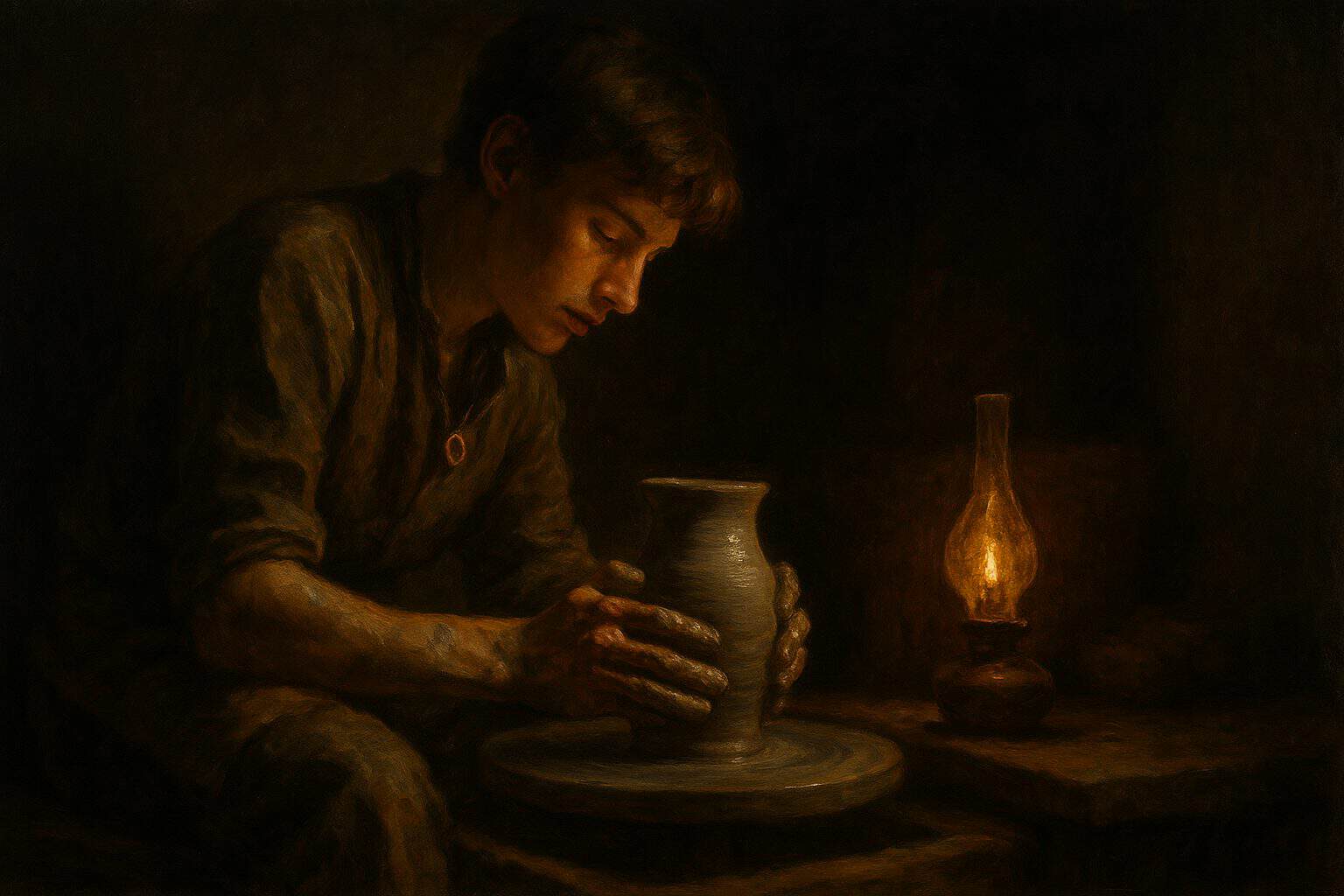
The memoirs invoke the image directly: “Like a blacksmith, He alternates our blade between fire (ascent) and water (descent)… and shapes our spirit in the pressure between His hammer and anvil.” This is van Kaam’s formation field made visible. The transcendent self is not formed in isolation. It is formed in the pressure between the pneumatic call and the vital resistance, between the upward pull and the downward weight.
Adoré’s narrative shows this pressure relentlessly. The ascent toward spiritual clarity meets the descent into fleshly confusion. The pursuit of G (reason dwelling beyond limitation) intersects with A’s strategies and E’s tactics, the old patterns of luring and being lured. The formation field does not become less turbulent as the person matures. It becomes more conscious.
And here van Kaam’s insight deepens: the transcendent self does not escape this turbulence. It learns to navigate it. Formation is not the triumph of the pneumatic over the vital. It is the gradual alignment of both within the field, the discovery that the vital, when received into pneumatic awareness, becomes the very substance through which the transcendent self achieves its shape.
V. The Mud of Mercy: Formation Through Interruption
“Perhaps this is what the mud of mercy sometimes looks like—not always a healing balm pressed against blind eyes, but the shock of being interrupted by desire.”
The memoirs are a record of such interruptions. The person does not choose them. They arrive in the formation field unbidden. A dialogue that reveals more than was intended. A touch that becomes something other than what the vital self anticipated. The presence of another who, by their own pneumatic openness, calls forth the transcendent dimension in oneself.
Van Kaam would recognize this as the formative event—not the grinding-down of the whetstone, but the sudden reorganization of the field itself when two persons meet in their transcendent dimension, when the pneumatic hint becomes mutual recognition. The formation field is no longer merely the arena of vital impulses. It becomes a space of consonance, where flesh and spirit, in their proper alignment, resonate together.
This is not sentimentality. The memoirs show the cost: the dissection required, the necessary modifications, the expansion of consciousness into new horizons. The person must become willing to be interrupted, to have their patterns exposed, to consent to a reformation they did not initiate.
VI. Co-Authoring the Field: The Transcendent Self’s Participation
Formation, for van Kaam, is not something done to the person. It is something the person participates in, through their transcendent self’s own free response to the pneumatic call. The memoirs show Adoré gradually understanding that his pursuit cannot be merely receptive. The transcendent self must answer. It must consent. It must, in small ways, reconfigure the field by its own free choice.
This is where the two memoirs become the living text of van Kaam’s theory. The first memoir is largely a record of deformation—the vital field’s apparent totality, the pneumatic hints arriving but not yet met by the transcendent self’s full awakening. The second memoir traces the slow, painful work of re-formation: the person learning to recognize the formation field as a breathing medium, learning to breathe with it, learning that the descent into the vital, when met by pneumatic awareness and free consent, becomes the very ground of ascent.
The transcendent self does not escape the field. It learns to inhabit it differently. It learns that the proper and harmonious alignment of heaven-spirit and flesh is not achieved through the vital’s suppression, but through its reception into pneumatic consciousness. The field reorganizes itself not through the person’s willfulness, but through their quiet, repeated yes to the pneumatic interruption.
VII. Formative Spirituality as Breathing
Van Kaam’s concept of formative spirituality is, finally, a spirituality of breath—the capacity to receive the formation field as a living medium, to sense the pneumatic dimension working always already within the vital, to consent to the pressure of the hammer and anvil because the person recognizes, at last, that the Blacksmith is shaping not a foreign object, but the self’s own deepest possibility.
The memoirs end not in resolution but in attunement. Adoré has learned to walk together with another toward the same destination, not halting in awe of the other but continuing the ascension with the other, their spirits mingling through flesh in a way that honors both the vital and the transcendent. The formation field, which once felt oppressive, now feels like home—not because the turbulence has ceased, but because the person has learned to breathe within it.
This is van Kaam’s gift to the reader of these memoirs: the recognition that formation is not escape from the vital field but awakening within it. The descent is not detour. It is the only path the ascent knows.