The difficult person discovers their vocation not in what they give, but in what they refuse to soften—and in the strange durability this refusal requires.
I. The Room’s Recoil
There is a moment, repeatable and terrible, when you speak a truth the gathering did not consent to hear. The silence arrives first—not the silence of attention, but of arrest. Faces reorganize themselves in real time. Someone’s jaw tightens. Another looks away with the particular kindness that signals distance. You have done it again: you have introduced friction into a space engineered for glide.
To be the difficult person is to live in the recurring discovery that your presence functions as a kind of interruption. Not interruption as intrusion, but as a halt—a point where the smooth social narrative must stop, look at itself, and either disintegrate or reconstitute on ground more honest and therefore more painful. You did not choose this role. It chose you through the accumulated evidence of others’ discomfort, their sighs, their strategic absences from rooms where you will be.
The first vocation arrives as shame. You are what ruins the mood. This becomes a quasi-identity, worn like a scar that never quite heals because it keeps being reopened. Yet beneath the shame, something else stirs: a stubborn sense that something truer just entered the room because you refused to smooth yourself down.
The difficult person learns early that they are not loved for their softness. They are sought out in private—for counsel, for the unvarnished word, for the mirror that shows what others refuse to see—and publicly disowned. This is not cruelty, exactly. It is the structure of a world that wants truth only when it can be contained, managed, made safe.
II. The Weight of Non-Compliance
The body knows before the mind articulates it. To be difficult is to occupy space with a density that refuses the laws of social buoyancy. Your throat is heavy. Your presence does not glide; it lands. Others sense this before they name it—a thickness that will not be dissolved by charm, humor, or the practiced arts of self-diminishment.
The difficult person is told, repeatedly and in various registers, that they are too much: too honest, too intense, too unwilling to let things pass. What this language obscures is that the difficult person is not offering excess; they are offering resistance. They are the coordinate of reality that will not be erased for the sake of comfortable illusion.
Augustine knew something of this restlessness—that quality of being in the world but never quite of it, always pulled between the scattered and the gathered, between what others want you to be and what you are being called toward. The difficult person lives this tension in their very flesh. They cannot belong without betraying something they have been entrusted to protect.
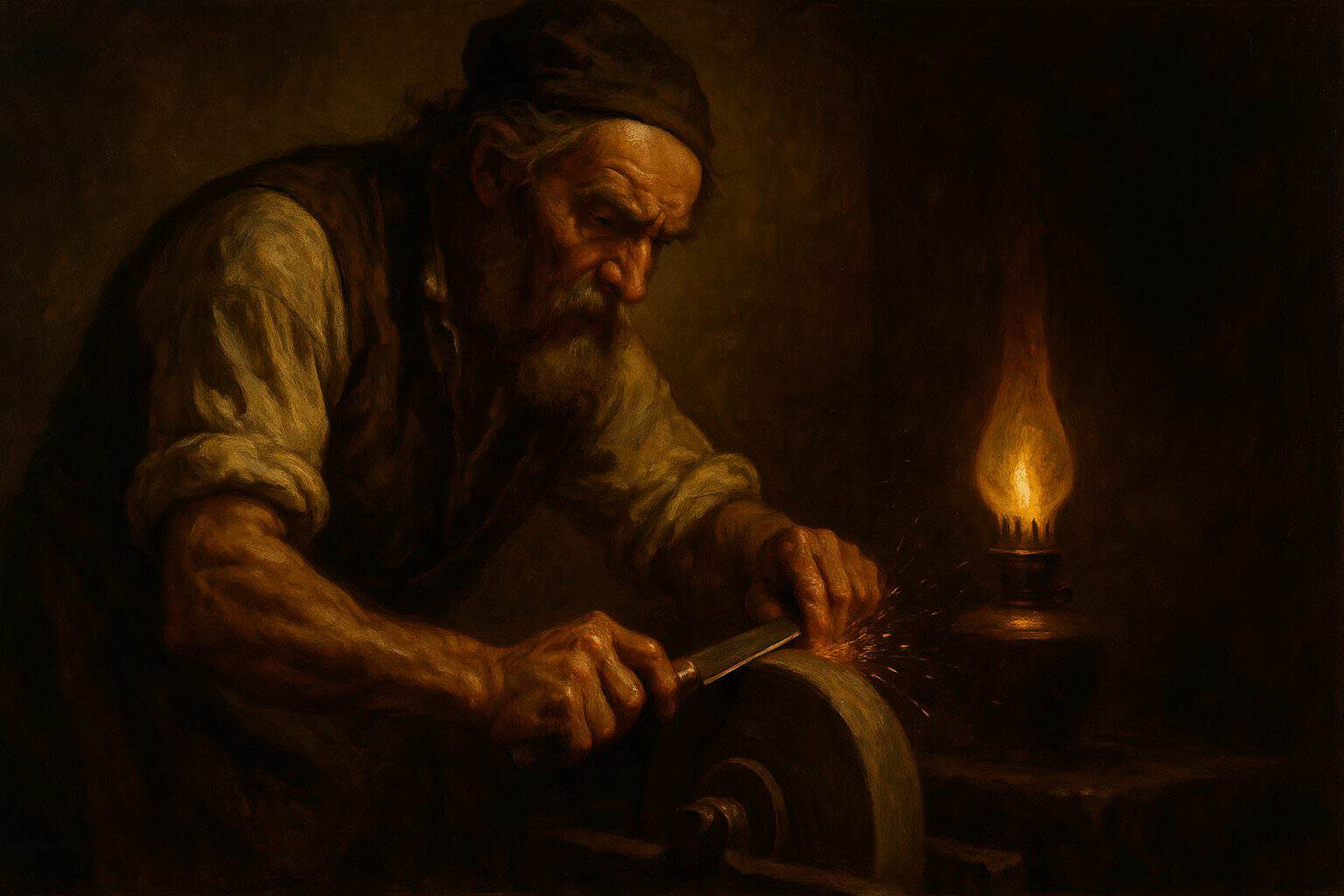
We are commanded to interact with rocks and blades regardless of our personal weariness, annoyance, or desire to withdraw from the world.
This command—whether we hear it as divine or as the voice of our own deepest nature—arrives not as invitation but as necessity. The difficult person does not choose to abrade. They choose, again and again, not to soften.
III. The Pedagogical Interruption
There is a specific moment when the difficult person’s vocation becomes visible: it is the moment when a conversation forced to stop, look at itself, and either collapse or be rebuilt on deeper ground. This is not comfort. It is not the gift of easy belonging. It is something else entirely—something that might be called necessary friction.
The difficult friend asks the question no one wanted asked. They name the tension everyone feels but no one wants to say. They refuse the joke that papers over the wound. In doing so, they become the existential speed-bump—the one who forces the room to decelerate, to acknowledge what it has been racing past.
This function precedes any conscious choice. The difficult person does not decide to be pedagogical; they discover, through the responses of others, that their presence teaches. And the teaching is always the same: that truth costs, that authenticity is not comfortable, that the price of being known is exposure.
Erikson understood that each developmental stage presents a crisis—a moment where growth becomes possible only through the tension between opposing forces. The difficult person is that tension made flesh. They are the voice that says: You cannot stay here and remain yourself. You cannot belong to this world without losing something essential.
IV. The Double Hunger
Yet the difficult person is not without longing. There is a hunger—almost unbearable in its constancy—to be loved not despite but because of one’s roughness. To find someone who does not experience your edge as a wound but as a gift. To discover that the very quality that isolates you might also be the ground of genuine intimacy.
This hunger coexists with another: the sense that to soften, to become more palatable, would be a betrayal. Not of others, but of something entrusted to you. There is a vocation in this refusal—a calling to remain sharp, to hold the line, to be the one who will not let others escape into comfortable lies.
The tension is real and unresolved. The difficult person wants to belong and to maintain their integrity. They want to be softenable and to refuse softening. They want others to receive them and to accept that reception may never come.
This is not a problem to be solved. It is the structure of a particular kind of existence—one lived at the intersection of desire and discipline, longing and refusal.
V. When Resistance Confesses Desire
Watch closely the faces of those who resist you most strenuously. Often, beneath the irritation, the avoidance, the strategic coldness, there is something else: a latent wish to be changed. The difficult person’s presence activates something in others—a recognition, however unwelcome, of what they have been avoiding.
This is why rejection can function as a negative form of consent. When someone pulls away from you sharply, with energy and emotion, they are often confessing—without meaning to—that your presence matters. They are not indifferent. They are affected. The very force of their resistance reveals that something in them has been touched.
The difficult person learns to read this language. They come to understand that the sigh of a room—that collective exhalation when the sharp voice speaks—is not merely fatigue. It is the sound of others shedding their superficiality, whether they consent to this shedding or not.
The relationship between blades and whetstones is not simply one of two bodies interacting with one another for temporary pain or pleasure.
It is something deeper: a mutual formation, asymmetrical and often unchosen, where one body becomes sharper precisely through contact with the other’s resistance.
VI. The Vocation of Responsible Wounding
But there is a discipline required. The difficult person must learn to distinguish between cruelty and necessary friction, between compulsion and presence, between the performance of sharpness and its authentic expression.
This learning is slow and costly. It involves mistakes—times when the abrasion caused harm that could not be repaired, and times when others accepted the gift and became better people as a result. The difficult person carries both: the memory of wounds they inflicted without warrant, and the quiet knowledge that their presence has, on occasion, clarified someone’s vision of themselves.
The formation of tact in the difficult person is not a softening. It is a refinement. It is learning when to speak and when to remain silent, not out of fear but out of love. It is understanding that timing matters, that a truth spoken at the wrong moment may wound without teaching, may damage without transforming.
This is the work of a lifetime. It requires what the manuscripts call a delicate hand—the ability to apply pressure without crushing, to abrade without obliterating. It requires presence: not the performance of difficulty, but the sustained, embodied choice to remain authentic even when authenticity is costly.
VII. The Strange Durability
The whetstone does not grow sharper through its work. It wears. It becomes smaller, its surface roughened by the blade’s repeated passage. Yet this wearing is also a clarification. The whetstone becomes more itself through the very process that diminishes it.
The difficult person discovers something similar: that the resistance they provoke, the loneliness they endure, the repeated experience of being misunderstood or rejected—these do not diminish their vocation. They clarify it. Each encounter that tests their willingness to remain sharp, to refuse softening, to stand at the intersection of love and friction—each one confirms something essential.
You are remembered not for your presence but for what you strip away in others. You are known for the edges you maintain, the truths you will not let pass, the comfortable illusions you refuse to fertilize. This is a strange kind of fame—one that brings no comfort, no belonging, no ease.
Yet there is a durability in it. The difficult person, worn thin by their vocation, still stands. They have been tested repeatedly—by rejection, by misrecognition, by the terrible knowledge that their gift is often received as burden. And still they remain.
This is not heroism. It is something quieter and more persistent: the simple refusal to become other than what one is, even when becoming other would be easier, kinder, more rewarded.
The vocation of the difficult person is to abrade the world into honesty, one conversation at a time, knowing that they will rarely be thanked, often be blamed, and that the work will never be finished. It is to live as the whetstone lives—useful precisely because one does not soften, clarified by the very friction that wears one away.