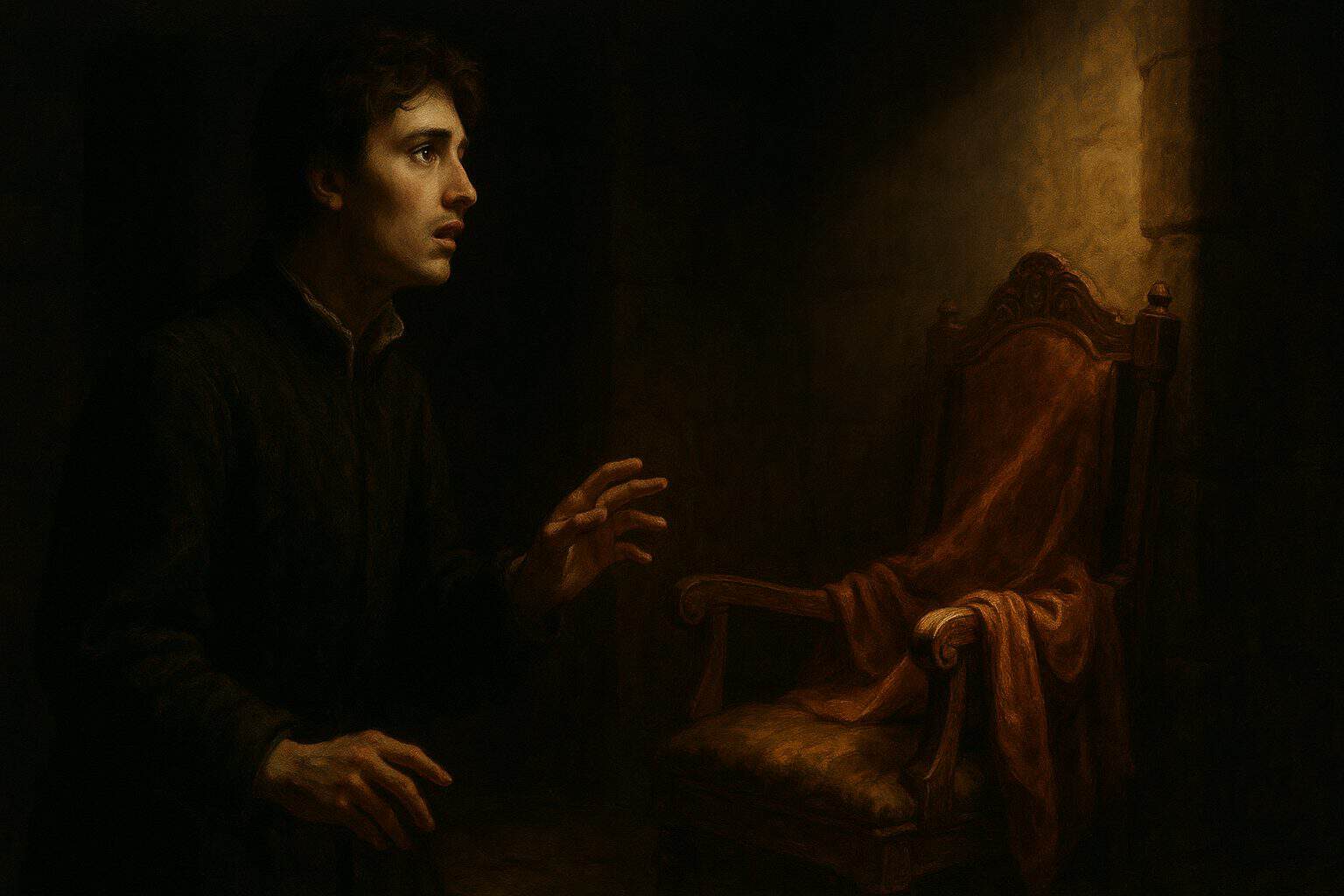
How the beloved becomes a god, and the god becomes a prison.
The lover’s gaze transforms everything it touches. Watch how it moves across the beloved’s form—not merely seeing but consecrating. The curve of a shoulder blade catches afternoon light and becomes scripture. The hollow at the base of a throat pulses with divinity. These are not metaphors. In the lived moment of desire, the flesh before us carries absolute weight, commands total devotion, promises final satisfaction. We kneel before what we have made holy.
The Alchemy of Sight
It begins innocently enough—a glance that lingers a heartbeat too long. The eye, that organ we imagine neutral, becomes an instrument of transubstantiation. As Anthony learned watching desire move through him: the pleasant sight of soft, curvy, inviting flesh entices passion and encourages erotic thoughts—willful submission, reciprocated burning, the exaltation of ego and potency. But notice the precise phenomenology here: it is not that we first see beauty and then desire it. Rather, desire itself creates the beauty it worships. The wanting eye performs a kind of dark miracle, transforming ordinary flesh into sacred vessel.
This transformation happens below the threshold of decision. Before thought can intervene, before moral categories can organize experience, the body has already genuflected. The pupils dilate—involuntary worship. The breath catches—spontaneous prayer. The blood redirects itself—an offering poured out. We tell ourselves we are merely appreciating beauty, but the body knows better. It has already begun constructing an altar.
The Grammar of Idolatry
“At the center of this storm lies the most dominant sin animating their power—the inverted love that exalts the self.”
The idol made of flesh speaks a particular language, one that reverses all natural order. Where genuine encounter says “you,” idolatry says “mine.” Where love opens toward mystery, lust grasps at possession. The grammar itself becomes inverted: subject and object collapse into a single devouring hunger.
Consider how touch becomes a separate dialogue in these moments—not communication but consumption. The hands that reach for the beloved are not trying to know but to possess, not to honor but to use. Even in what appears to be mutual desire, something more sinister operates. As Anthony observed in his own experience: the shift moves from mutual, lustful desire to a dynamic offering one partner greater security, more control. The idol demands not just worship but sacrifice—the gradual emptying of the other’s personhood into the vessel of one’s own need.
This is why physical beauty itself becomes a trap. Those whose “physical existence—beautiful and shallow—beckoned suitors” find themselves caught in an endless circulation of hollow pleasantries before physical consummation. Good-looking people move on to fresh meat because the idol, once possessed, immediately loses its divinity. The flesh that promised transcendence delivers only more flesh. The mouth that seemed to speak eternity offers only momentary pleasure.
The Theology of Substitution
At the time, Anthony convinced himself that an appetite to drink the pleasure of consenting women did not violate a heart that walked with God. This self-deception reveals something essential about how the idol made of flesh operates—it does not announce itself as replacement for God but as complement to God. The clear exception, we tell ourselves, is a heart that worships lust as a god. But this distinction collapses under phenomenological scrutiny.
For what is idolatry but the displacement of the infinite by the finite? When flesh becomes the horizon of meaning, when another’s body becomes the promised land, when sexual union becomes the eucharist of self—then we have already broken the first commandment: “You shall have no other gods before me.” The idol made of flesh does not need to explicitly deny God; it simply occupies the space where God would dwell.
Notice how this substitution manifests in lived experience. The yearning that should reach toward transcendence curves back upon itself, finding its object in what can be touched, tasted, possessed. Instead of continuing the ascension together toward something beyond themselves, lovers stop and intertwine, mistaking delights of the flesh for delights of the spirit. The vertical movement toward the divine becomes a horizontal circulation between bodies, each seeking in the other what neither can provide.
The Phenomenology of Possession
When we make an idol of flesh, we enter a particular mode of being-in-the-world that Augustine knew intimately—the state of being possessed by what we seek to possess. The beloved’s absence becomes unbearable emptiness. Their presence becomes anxious grasping. There is no middle ground, no space for simple being-with. Every moment becomes either having or not-having, fullness or famine.
This possession works both ways. As we seek to possess the beloved, we find ourselves possessed by the seeking itself. The mind becomes colonized by fantasy—her clasping back, soft pants and light moans communicating pleasure and abandon. These images are not mere thoughts but presences that occupy consciousness with religious intensity. They become more real than the real, more present than presence itself.
The possessed consciousness loses its freedom not through external force but through its own investment. Having poured all meaning into the idol, it cannot withdraw without losing meaning itself. This is why sexual obsession feels simultaneously like the most free and most enslaved state—we are doing exactly what we want while being unable to want anything else.
The Eucharist Inverted
“When we deny God’s love for us, we deny its tangible proof in the bread-body and the wine-blood shared with us.”
The idol made of flesh performs a dark parody of the Eucharist. Where Christ offers his body as bread for the life of the world, the idol offers flesh for the hunger of the self. Where the Eucharist creates communion, the idol creates consumption. Where sacred meal transforms participants into one body, sexual idolatry reduces the other to food for one’s own emptiness.
She involves herself with others and takes what she can from them, brings their fruits to her partner’s table and prepares the banquet of her body. But this banquet never satisfies because it feeds the wrong hunger. The appetite it serves is not for union but for acquisition, not for gift but for theft. Each act of consumption only deepens the hunger because what we really seek—infinite love, absolute meaning, final rest—cannot be extracted from finite flesh.
The tragedy is that sexual union itself points toward something genuine—the possibility that touch might become dialogue, that flesh might become word, that two might become one while remaining two. But idolatry forecloses this possibility by collapsing the other into an extension of the self’s need. The beloved becomes not a person to encounter but a resource to mine.
The Wound That Will Not Heal
We descendants make choices already contaminated by sin and therefore cannot choose anything outside of its imposition without grace. This contamination shows itself most clearly in how we cannot simply decide to stop making idols of flesh. The wound runs deeper than will, older than decision. Even when we recognize the idol for what it is, even when we see how it empties both self and other, we find ourselves returning to it like dogs to vomit.
The priest who warned that temptation does not cease but rather intensifies with religious commitment understood something essential: the idol made of flesh draws its power not from simple biological drive but from the spiritual vacuum it promises to fill. The more one reaches toward transcendence, the more appealing becomes this counterfeit transcendence that requires no surrender, no transformation, no death to self.
This is perhaps why America’s lust for money shares the throne with God alongside sexual idolatry—both promise satisfaction through possession, meaning through accumulation, transcendence through immanence. Both create elaborate liturgies of desire that mimic true worship while inverting its direction. Both leave practitioners emptier with each apparent fulfillment.
The Interruption of Grace
Perhaps this is what the mud of mercy sometimes looks like—not always a healing balm pressed against blind eyes, but the shock of being interrupted by desire. Grace does not always come as comfort; sometimes it comes as disruption of our idolatrous patterns, as failure of our substitutes to satisfy, as the beloved refusing to remain a god.
When the idol made of flesh finally fails—and it always fails—we face a terrible freedom. The beloved stands before us not as divinity but as fellow creature, not as answer but as question, not as possession but as mystery. This can feel like death because in a sense it is—the death of the god we made, the altar we built, the religion we practiced in the dark.
But this death opens possibility. When flesh stops being god, it can finally be flesh—good, limited, graced, mortal. When the beloved stops being salvation, they can finally be beloved—particular, irreplaceable, free. When sexual union stops being eucharist, it can finally be what it is—a sign that points beyond itself, a participation in something it cannot contain.
The Wisdom of Disillusionment
Treasured are those who seek to see the world as it truly is, to stand in reality rather than fantasy. The wisdom that emerges from the collapse of the idol made of flesh is precious precisely because it is so dearly bought. One must first have worshipped at this altar, first have believed its promises, first have been betrayed by its failures, to understand the nature of its deception.
This wisdom recognizes that genuine desire is not always self-serving; it can be an instrument for peace. But this peace comes not through possession but through reverence, not through consumption but through contemplation. The same capacity that creates idols can, when purified, recognize the sacred in the other without needing to own it.
The movement from idolatry to reverence does not eliminate desire but transforms it. The eye that once possessed learns to behold. The hand that once grasped learns to bless. The mouth that once devoured learns to speak words that create rather than consume. Touch becomes dialogue again, but a dialogue that respects the infinite distance within intimacy itself.
The Flesh Made Word
In the end, the idol made of flesh reveals itself as a fundamental confusion about the nature of incarnation. We seek infinity in finite flesh, eternity in temporal pleasure, absolute meaning in contingent encounter. But flesh cannot bear this weight—not because flesh is evil but because it is created, limited, pointing beyond itself.
The true mystery is not that flesh might become god but that God became flesh—not to be possessed but to possess us, not to be consumed but to consume us in a love that does not diminish but rather establishes the beloved. This is what we glimpse, perhaps, when sexual union momentarily transcends itself, when the spirit of each resonates in the flesh not as idol but as icon, not as endpoint but as doorway.
The idol made of flesh promises immediate satisfaction but delivers only infinite deferral. Each conquest leads to the next conquest, each possession to the next possession, in an endless circulation that never arrives. But when flesh is allowed to be flesh—graced, limited, mortal, beautiful—it can finally speak its true word: not “I am god” but “God is here,” not “I am everything” but “I am gift,” not “Possess me” but “Behold.”
This is the wisdom born from disillusionment, the freedom found in failure, the grace discovered in the collapse of our substitute gods. The idol made of flesh must die for flesh itself to live. And in that death, in that relinquishment, in that final failure of the finite to be infinite, we might glimpse what we were seeking all along—not the beloved as god but God in the beloved, not flesh as salvation but salvation blessing flesh, not the other as possession but possession by an Other who makes all possession impossible and unnecessary.
The lover’s gaze still transforms everything it touches. But now it transforms by seeing what is really there—not a god to worship but a person to love, not infinity to grasp but finitude to cherish, not an idol made of flesh but flesh made luminous by a light it does not contain but only reflects. And in that reflection, in that play of light across perishable skin, something eternal shows itself—not as possession but as promise, not as arrival but as invitation, not as ending but as beginning of a love that does not consume but consecrates, does not diminish but establishes, does not possess but sets free.