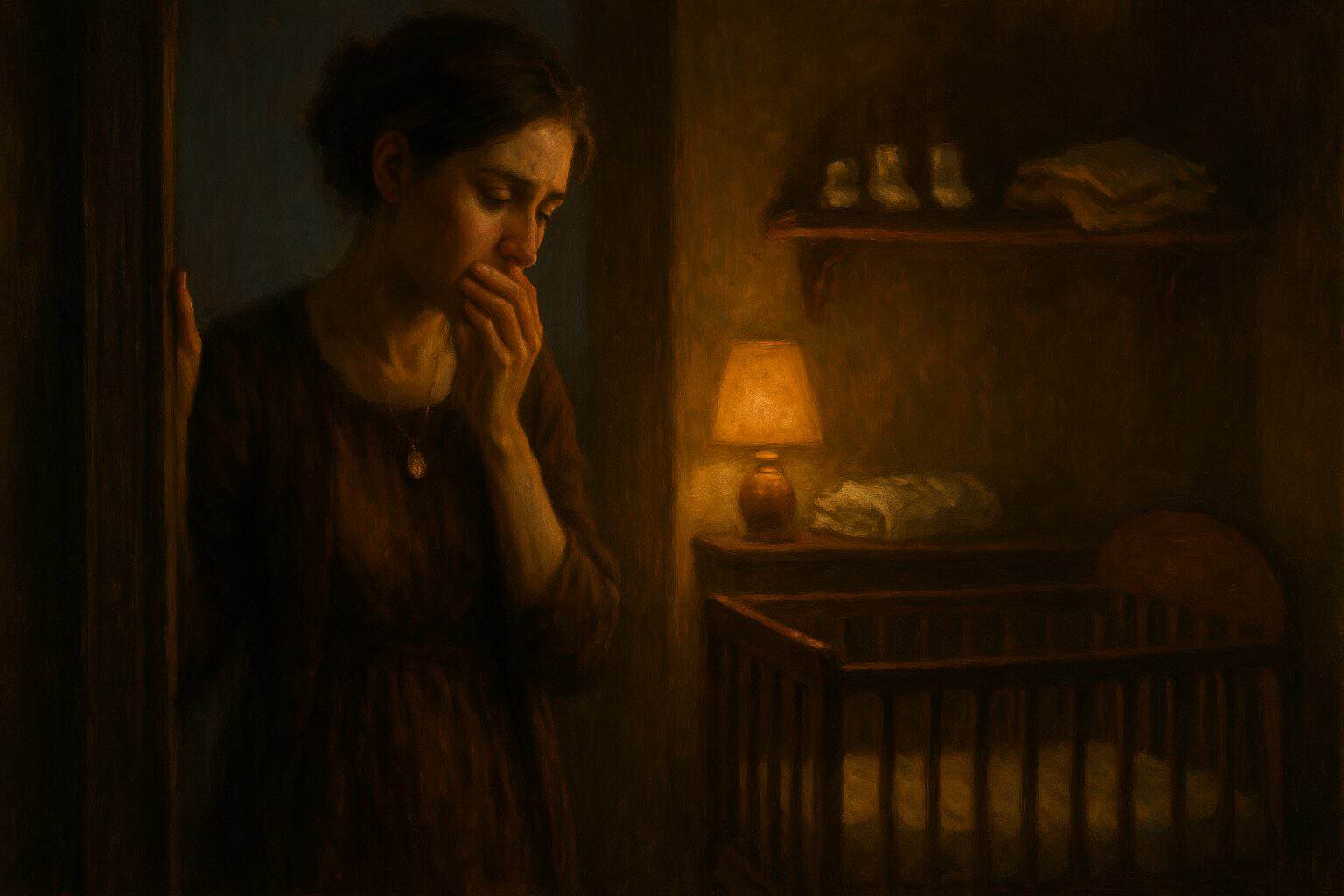
How the absent father lives on in the spaces we prepare for what will never arrive
The Room That Calls
In Confessions to the Empty Chair, Anthony describes a space that continues to wait: “Bags of diapers remain unopened, bottles unused, and tiny socks and mittens accentuate the new space created—the baby room—with toys and gifts neatly arranged throughout for the new little visitor.” This is not merely an empty room. It is a room that calls. Every object placed there with care—each tiny sock, each unopened package—extends itself toward a future that will not come. The room does not know the child is gone. Or rather, the room knows only what rooms know: how to hold, how to wait, how to offer shelter to what might arrive.
The phenomenology of the prepared space reveals something essential about loss. We do not simply lose what was; we lose what was becoming. The baby room exists in what Merleau-Ponty might call the corps vécu—the lived body of the home itself, where each object reaches toward its purpose like a hand extended in greeting to someone who will never take it. The bottles wait to nourish. The mittens wait to warm. The toys wait to delight. This waiting is not passive but active, a kind of calling that continues even after the one called cannot answer.
The Spiritual Father
“Though the child would have been biologically mine, the baby would have been spiritually his.” This single line from Anthony’s memoir opens an entire horizon of fatherhood that exceeds biology. There is the father of the flesh and the father of the spirit, and sometimes these are not the same man. The spiritual father—perhaps never present in body—nonetheless shapes the space where a child would have grown. He is the one whose absence creates a particular kind of presence, whose not-being-there becomes a form of being-there more persistent than physical proximity.
“Dreams of peace, love, and happiness after never having known them is our distant remembrance of Eden.”
This remembrance that Anthony names is not nostalgia for what was but for what was promised—the Edenic state we carry as a kind of genetic memory of the soul. The fatherless self knows this Eden only as absence, yet knows it nonetheless. It is what Augustine discovered in his Confessions: the restless heart that seeks what it has never possessed yet somehow remembers. The spiritual father exists in this space between memory and hope, between the Eden we cannot recall and the home we cannot stop seeking.
The Ghost Behind the Eyes
Jeannètte appears in the second memoir not as presence but as a particular kind of absence: “She sat opposite me—not in a room, but as a ghost I could not exorcise, living behind my eyes.” This is not the absence of simple departure. This is absence that has taken up residence, that lives within rather than merely being gone. The phenomenology of the beloved-as-ghost reveals how certain absences become more present than presence itself.
When Anthony writes of “the image of her in another man’s arms, finding sweaty pleasure with him—her absence—became a constant, torturous testament to an annihilated future with me,” we encounter absence not as void but as active negation. Her absence does not leave a space empty; it fills that space with what will not be, what cannot be, what has been given to another. This is the cruelest form of absence: not the absence that might return but the absence that has chosen elsewhere.
Manufacturing Distance
“She manufactured distance through long absences, leaving me to wake up in an empty bed.” The verb here—manufactured—reveals distance not as something that simply occurs but as something made, crafted, produced through deliberate acts. One does not simply become absent; one creates absence as a potter shapes clay. Each departure, each empty morning, each unanswered call becomes another coil in the vessel of distance being formed.
This manufactured distance differs from the distance of death or circumstance. It carries within it the mark of choice, of will, of decision. The fatherless self knows this particular wound: not the father taken by death or duty but the father who chose distance, who manufactured his absence through a thousand small departures. Anthony elsewhere describes affections collected “like one interrupts their walk to bend down and pick up loose change on the ground”—casual, intermittent, never the full attention that presence requires.
The Foreknowledge of Loss
“A few days later, a sadness rooted in foreknowledge forbade my sleep.” This foreknowledge that Anthony describes is not prophecy but a kind of embodied wisdom. The body knows what the mind refuses. Sleep will not come because the future has already announced itself in the tissues, in the breath, in the quickening of the heart that recognizes approaching loss.
This anticipatory grief appears throughout both memoirs—the sense that loss is not only remembered but somehow pre-remembered, that we carry within us a knowledge of all the ways we will be left. The fatherless self becomes expert in this foreknowledge, able to read the signs of departure before they fully manifest. Every relationship carries within it the seeds of its own absence. Every room prepared may become a room that waits forever.
The Death That Remains Dead
“If ever I loved her, I must remain dead in her eyes, that my ghost not hold her back from living anew.” Here Anthony articulates a tenderness so complete it requires self-annihilation. To love the one who has left means to perfect one’s own absence, to become so thoroughly gone that even one’s ghost cannot disturb their new life. This is not the dramatic gesture of disappearance but the patient work of becoming nothing in another’s world.
“His life’s meaning, dependent upon her, leaves him unable to exist apart from her. Thus, when she is gone, so is he.”
The fatherless self recognizes this dependency, this inability to exist apart from the one who gives meaning. Yet what Anthony’s memoirs reveal is something more complex: the way tenderness itself becomes a form of existence, even in absence. To tend the empty room, to remain dead in beloved eyes, to carry the ghost behind one’s own eyes—these are not failures of independence but forms of fidelity to what was promised, even if never delivered.
The Companion Who Disappears
“As was demonstrated through the disappearance of my student, my companion, earlier.” This passing reference opens another dimension of absence—the companion who simply vanishes, leaving no ghost, no manufactured distance, just sudden nothing where something was. The student, the companion, the one who walked alongside—gone without ceremony or explanation.
The phenomenology of disappearance differs from other forms of absence. Death leaves a body to mourn, departure leaves a direction to follow, but disappearance leaves only questions. Where did they go? Why did they leave? Will they return? The fatherless self knows this particular uncertainty, the father who didn’t die or leave but simply stopped being present, fading like a photograph left in sunlight until only the suggestion of a figure remains.
Returning Without Leaving a Note
“Without leaving a note, my parents and I headed back to West Texas.” This movement—sudden, unexplained, wordless—carries its own significance. No note means no explanation, no closure, no narrative to make sense of the departure. The journey to West Texas, to Fabens, to El Paso, becomes a return to origins that cannot be articulated, only enacted.
The fatherless self often moves this way, following promptings that cannot be explained, returning to places that may no longer exist as they were. “Traveling—like old times—to Fabens and then to El Paso, to visit her in the hospital. Little did I know she would be gone in just a few months.” The old times are invoked even as they dissolve. The visit to the hospital becomes the last visit without announcing itself as such. We are always arriving too late to what we didn’t know was ending.
Tenderness as Presence
What emerges from Anthony’s memoirs is not a philosophy of absence but a phenomenology of tenderness—tenderness for what is not there, for what will not come, for what chose to leave. This tenderness does not seek to fill the absence or deny it but to tend it, as one tends a garden or a grave. The baby room is kept ready not because the baby might arrive but because readiness itself is a form of love. The ghost behind the eyes is not exorcised but acknowledged, given its place in the geography of the self.
The fatherless self that Anthony embodies is not defined by what it lacks but by how it tends that lack. Every absence becomes a space for tenderness to inhabit. The unopened diapers, the unused bottles, the tiny mittens—these are not symbols of loss but actual presences, things that exist in their waiting, in their readiness for what will not come. They are tender toward the future that will not arrive, just as memory is tender toward the past that cannot return.
This tenderness extends even to the self, the fatherless self that must learn to father itself, to provide its own shelter, its own meaning, its own reason to continue. Anthony’s memoirs do not resolve this condition but inhabit it fully, showing how absence itself can become a dwelling place, how the fatherless self can discover in its own tenderness a form of presence that no father could provide.
The crossing between Fractions of the Soul and Confessions to the Empty Chair reveals this truth: we are all, in some sense, fatherless, all tending absences that shape us more than presences ever could. The father we seek, the child we prepared for, the beloved who left—these absences do not diminish us but call forth from us a tenderness we might never have discovered otherwise. In learning to tend what is not there, we discover what is most deeply here: the self that remains, that continues, that refuses to stop preparing rooms for arrivals that will never come, knowing that the preparation itself is the arrival, the tenderness itself is the presence, the fatherless self is its own difficult and necessary birth.