How do you do missionary work? Not by force. A reflection on patient watching, the barred will, and the long, humbling labor of love.
You Came for a Tool and Met a Watcher at the Field’s Edge
You typed the question because you wanted something you could use. You wanted to know how to bring a person to God, how to open a heart that has bolted itself shut, how to find the one sentence that clicks the lock and lets the light pour in. I know the hunger under that question, younger self, because I carried it in my own chest for years, and I will tell you now what I could not tell you then: the hunger is half love and half pride, and you cannot pull them apart by how they feel. They feel identical. Both burn. Both keep you up at night rehearsing what you will say. In the fourth chapter of Fractions of the Soul there is a moment that has followed me around like a smell I cannot wash out. The first man and woman stand whole in the garden, unspoiled, new. At the edge of the field an intelligence crouches, barred from entering them. He cannot force his way in. The Creator has laid down a law that no being may cross into another against the will, and so the destroyer is left with only his eyes. He watches. He gathers what he sees the way a man gathers coins, one at a time, hoarding them. He learns their patterns across what reads like ages, correcting himself when he is wrong, refining, keeping better records of their nature than they keep of their own. This is the terrible mirror the scene holds to your face. The one who wanted to ruin them did not shout or command. He worked by attention. He learned the woman at the pond, learned where the man’s whole heart poured out and where the woman held herself back, learned the soft ground under each of them. And here is what should stop your breath at the sink some morning. From a distance, the method of the destroyer and the method of the missionary look almost the same. Both stand outside a gate they may not force. Both study a soul they cannot enter. Both wait, and wait, and wait. The difference is not the watching. The difference is what you mean to do once the door swings, and whether you can bear to walk away with empty hands if it never swings at all. You wanted a method, younger self. What the garden actually handed you was a discipline of the eyes and a leash on the hands, and you spent a decade hating the leash before you understood it was the only thing that kept your love from becoming a hunt.
The Rib-Wound That Will Not Match the Other
Sit down inside what the scene shows, because you skimmed it looking for the trick and missed the ache in it. The Creator has made a rule that looks, at first, like a crack in His own design. He will not enter His creatures by force. He will not override the will even when the will is walking straight off a cliff. This is not carelessness. It is the whole load-bearing wall of love. A love compelled is not love, and a soul dragged bodily through the gate arrives dead on the other side, still and cooling. You spent years, younger self, trying to argue people into faith, trying to be so right that your rightness would crack them open like a nut. You kept a private ledger of their contradictions. You noticed, the way the watcher in the garden noticed, exactly where each person was thin and where each was thick. And you called this love, this cold accuracy about another’s weakness, when it was the very craft the destroyer practiced, only aimed up at heaven instead of down. The scene shows something quieter that you never slowed down to feel. The woman’s loneliness is not the man’s loneliness. Hers is an echo of his, taken from him and reshaped, made her own at her making, so that she cannot love back with the same totality he pours toward her. His whole self empties into her. She loves him truly, but not in that surrendering, filling way; she keeps a room in herself locked, from him and from God both, not yet ready to hand over the key. There is an unevenness built into the first two hearts before any serpent opens its mouth, a small grief that comes before sin. Feel how that lands on your project of saving people in batches. You imagined one right key would swing every locked heart with the same clean click. But hearts are made one at a time, each wound cut to a different shape. What surrenders in one withholds in another. You cannot mass-produce the labor of love; there is no assembly line for it. The watcher grasped this better than you did. He studied each soul separately because he knew the human heart is a bottomless thing, hidden even from the one who carries it around all day. If evil took that much care with our particularity, patient as a jeweler, how careless were you, younger self, with the actual people you tried to win, your one argument loaded and aimed, your foot tapping for the light to come on before you had learned even a few words of the dark they were living inside?
The Still Pond Where She Learned to Love the Face Looking Back
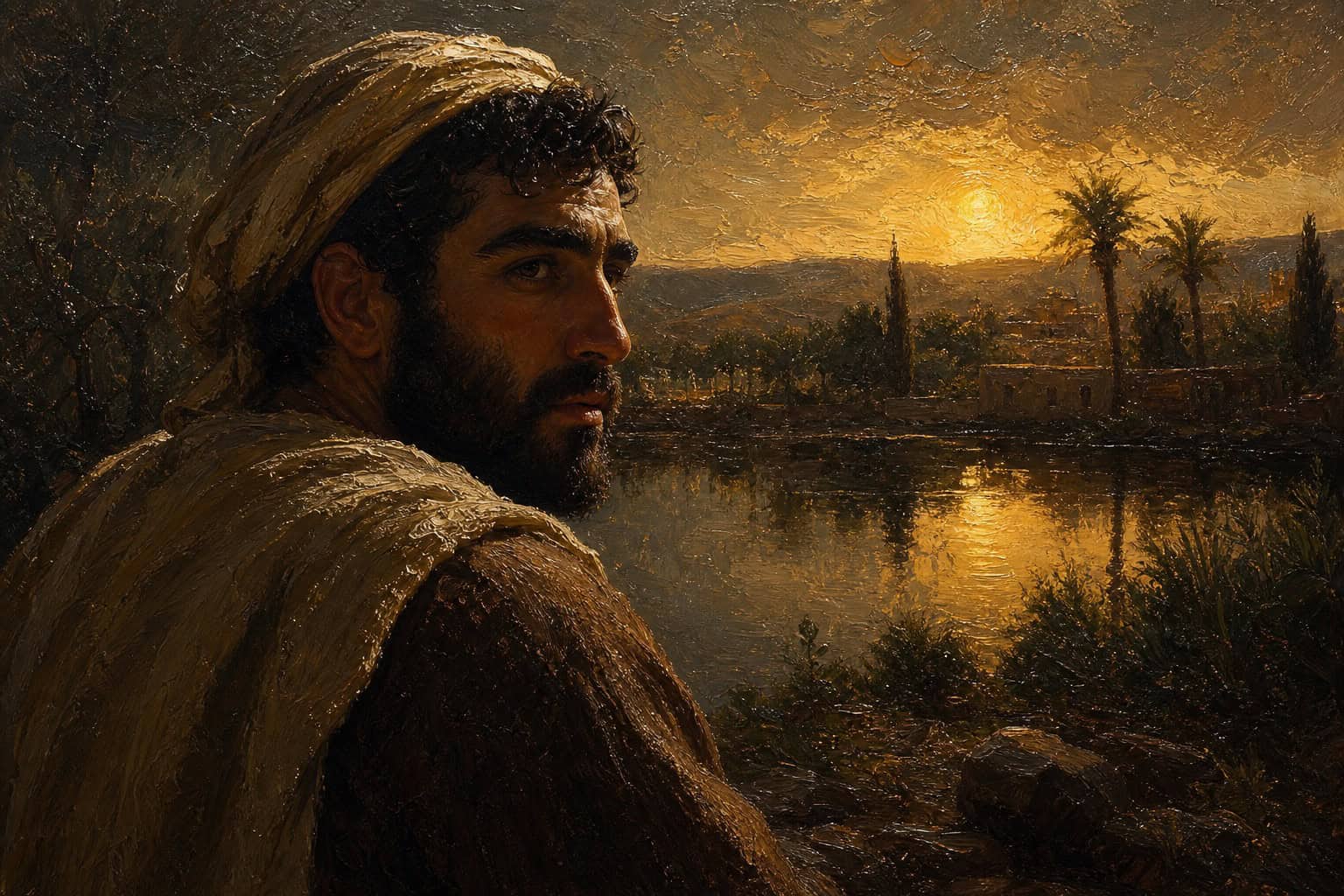
Here is the turn, and it took the floor out from under me when I finally saw it plain. The watcher notices that the woman lingers over a still pond, gazing at her own reflection, arranging herself, taking a strange private pleasure in the image that gazes back up through the water. That is the softness he marks in his ledger. Not a great sin, not yet, nothing dramatic. Only a soul starting to bend toward itself, building a small altar in still water before any voice has whispered a word. And I understood, far too late, that this is exactly where all my schemes for saving people had been pointed wrong. I thought conversion meant getting a person to look up, away from themselves, toward God and truth and the sentence I had polished for them. But the deeper thing is getting a person to bear being seen at all, and I had never once let myself be seen. I stood at the rim of every field, watching, studying, keeping my own reflection carefully arranged, refusing to walk down and kneel over the pond of myself and find the man there wanting. Shame is the thing coiled under all of it. The woman’s delight in her own face and the watcher’s cold reading of that delight are two shapes of the same fear: the terror of being seen and found lacking, the animal wish to cover yourself and vanish from your own eyes. You wanted to do missionary work, younger self, partly so you would never have to stand exposed. You would be the one who watched, the one who knew the tells, the one whose own soft places stayed tucked behind the good work. This is the line I would cut into the doorframe of that garden for you to read every time you passed under it. You cannot pour God into another; you can only stand near enough, long enough, that the door they alone can open begins to seem worth opening. The whole labor is presence, not entry. It is the willingness to be seen while you watch, to let your own face ripple in the water beside theirs, to have no method left in your hands but nearness. The watcher had knowledge and no love, and so his nearness was a hunt, a stalking. What you were being asked for was love with far less knowledge, a love that studies a soul not to find where it will break but to find where it is already leaning toward home, homesick without knowing the word for it, and then to wait right there, unarmed, at the barred gate, until the one inside decides. That was the whole of it, and I withheld it from you for years.
You cannot pour God into another; you can only stand near enough, long enough, that the door they alone can open begins to seem worth opening.
After the Field Empties and No One Has Opened
So you learned this, and still you failed, and I will not smooth that over, because the memoir does not smooth it over either. You stood near people you loved. You gave them the fruit of your own soul, the best of what you had gathered, and you watched them eat it and turn and walk off toward greener grass without one glance behind. The one you poured your years of wisdom into abandoned the road partway and left you standing alone, doubting whether you had ever truly known a single thing worth passing on. This is the part no search engine warns you about, younger self, the part they leave off the list of ten easy steps. Doing the work rightly does not make the door open. That is the entire meaning of the barred gate: the will on the far side is free, and free means free to refuse you, to refuse God, to refuse the light clean down to the final hour and past it. You did everything the garden taught. You watched with love. You stayed. You did not force. You let yourself be seen at the water. And still the field emptied out around you like a held breath let go. Here is where the despair went raw, and I want to be honest about it, because a tidy moral pinned on here would be a lie against every person I lost. Death sits over all of this like weather. Every soul you fail to reach is a soul that will end, be washed down into the same dust, forgotten inside a few short generations, and that same wide ocean of mortality laps at the shore of the little island you and they stood on together. There were nights the ache in me reached out, without my leave, for arms, for some rest the will simply cannot hand itself, and shame rushed in and armored me over before I could weep. I could name the fall. I could trace the first loneliness and the woman bent over her pond. But the body will not be argued with, and neither will an empty field at dusk. And in that emptiness, this is the strange thing, the one true thing: God did not fix it. He did not refill the field or hand the lost soul back into my keeping. He was simply there, in the dark with me, walking in the very failure, near in the tears, present in a way I could not have felt at all had the rescue arrived on time. Grace was not the door swinging. Grace was that I was not alone at the gate even after I had failed to open it.
What the Locked Gate Was Teaching You All Along
Let me leave you, younger self, not with a technique but with your whole wanting turned around in its socket. You asked how to do missionary work. The answer the garden gives is that you do it the way God does it, and God does it by refusing the one thing you kept itching to use, which is force. He built a limit into His own hands, a restraint stronger than His power. He will study a soul across all its long ages, He will know its patterns better than it knows itself, and He will still stand outside the barred gate and wait for the will to turn on its own. The destroyer in the scene holds all the knowledge and none of the restraint of love, and that is the whole reason his knowing is a blade. Yours was hardening into a blade too, younger self, and I tried to catch your wrist before you felt it happen. The work is this, and it is smaller and harder than any method. Learn the person, not to find where to press but to find where they are already homesick for something they cannot name. Stay near, longer than is comfortable, far longer than shows results. Let yourself be seen at the pond, your own arranged image breaking up in the ripples, so the one you love meets a fellow beggar and not a hunter. And when the door does not open, when the field empties and the dust closes over them and over you, do not decide the love failed. The love was never the machine that opens doors. The love was the presence that God Himself is, the company that does not lift the dark away but will not walk out of it either. The rare miracle does come, yes; sometimes a gate swings wide and it is unmistakably grace breaking through, and you will stand there and shake and weep. But that is the exception, the thunderclap, not the daily weather, and if you stake your whole faith on producing it you will end in the despair I came to know by its first name. Stake it instead on the nearness. This is what Fractions of the Soul was pressing into me through that watcher at the field’s edge, and I am handing it back down to you now across all these years. The measure of a missionary life is not how many gates you forced but how faithfully you stood, unarmed and seen and mortal, beside the ones you could never enter, keeping steady company with their freedom the way God keeps company with yours, staying in the dark, not leaving, until the tide that comes for every one of us finally rises and washes the whole field smooth.