Does sex ease grief? A man hurls his flesh at death itself—and learns what the body is really begging for when it reaches for another.
Rain on the Glass Before the Phone Spoke
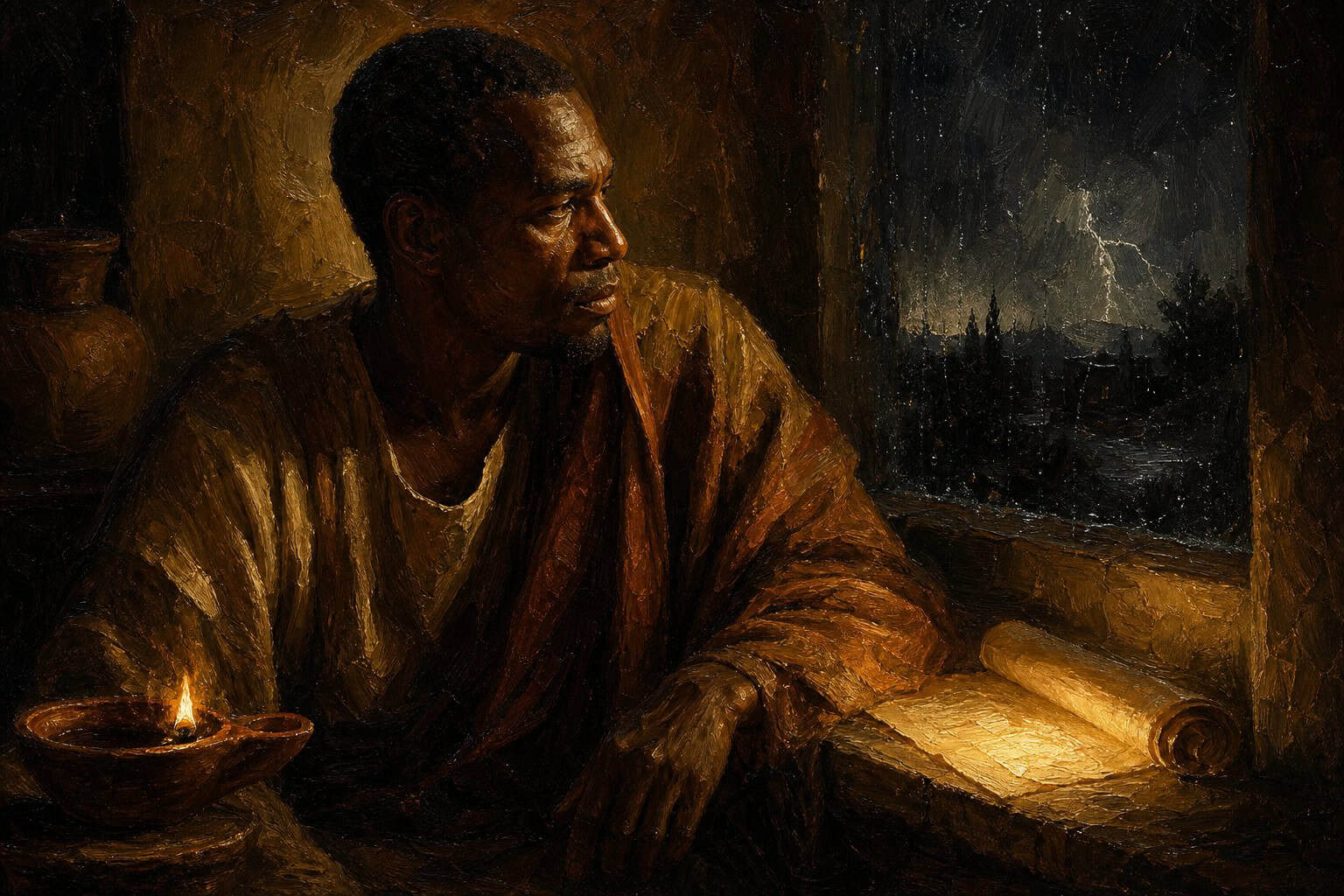
Lightning splits the night, and the thunder lands like a fist on the roof. A man wakes in his bed already knowing. Thin ribbons of rain streak the window, catching what little light there is, and the certainty settles on his chest the way the storm settles on the glass. There is no phone in his hand yet, no voice, no news, only the flat, sick sureness that someone he loves is gone. When the phone finally lights up on the nightstand, he answers before the caller speaks. He says two words first, plain and unadorned: I know. His mother, unsteady, tries to greet him, tries to lead gently toward the blow, and again he says it, the same two words. I know. This is where Chapter 10 of Confessions to the Empty Chair stands you, inside a body that receives death the way a field receives a storm front rolling in low and heavy. His grandmother is gone, buried, as he puts it, under words never spoken and feelings held back. He is no beginner in mourning. Seven years earlier he watched an eighteen-year-old cousin lowered into the cold December ground, and he saw the sorrow spread through the family like a stone dropped in still water, ring after ring after ring. He saw a younger brother left standing in the cold. He saw parents forced to bury their own child, which no parent should ever have to do. So the physical craving a person carries to the dark—make my body feel alive, make the ache stop, prove I am not dying, not alone—finds its mirror here. The grandmother’s dying is not a theory to him. It is a body in a bed, a hand he did not fully hold, a hospital room full of family. He hates death. He does not soften that word or dress it in comfort. He hates the way it negates, the way it ends every argument, the way it makes everything he failed to say suddenly permanent and beyond reach. Before the book turns to whether skin can quiet what the grave opens, it makes you feel the pain entire. The storm keeps falling, indifferent, wetting the glass, while he sits with a knowledge he never asked for and can never hand back.
The Woman He Would Not Let See Him
Who do you think you are, a woman once asked him, and he answered that he did not ask. He has heard these lines before, every practiced dismissal some women keep ready to send a man off, and still he insisted he was conclusively different from the others, though no one ever seemed able to read that difference on him. That is the wound beneath the wound. He does not simply want release. He wants to be seen. In the hospital room he confesses a stranger refusal that cuts deeper than the grief. He did not trust his grandmother to see him clearly. He did not even trust God to grant her that sight. Their bond never ran along that channel; to speak from the spirit between them would have felt foreign, out of place, almost embarrassing, a thing neither of them knew how to do. So he held himself back. He told himself she had troubles enough, that maybe she needed him as a distraction from her fear rather than another mouth of worry. But he was editing himself out of the room before she could misread him, and he had done this his whole life. He is the kind of man who disturbs more than he consoles, who learned long ago to shrink, to fold himself small, to accept being misunderstood as the cheaper price of a fragile peace. That self-erasure is a burial he performs on himself, alive, in advance. Now bring that back to the body’s plea. A person reaching for another to feel whole is often reaching for the same thing he refused his grandmother: to be seen fully, and still wanted, without the constant editing. Nearness is the ache beneath the ache—the longing to have the far made near, to close the cold distance between two people and be recognized there. He wanted her close and kept her at arm’s length in the same breath. And he draws a terrible line through all of it: perhaps only death sharpens the lens that can bring a soul like his into focus—not as a burden, not as a threat, but simply as he is. The dying, he suspects, see what the living cannot. So the body begins to speak what the soul cannot say. When a man cannot be recognized, he goes looking for a substitute in flesh. The reach is right. The aim is not yet.
Flesh Knotted Against the Cemetery Silence
Then the book names it, blunt and unashamed. Sex against death. Faced with that absolute finality, that flat negation of everything alive, his affairs took on a new and defiant meaning. Like the old king who chased pleasure and company across every vanity under the sun, he began to assert life against the grave, pleasure against pain, another warm body against the crushing loneliness of loss. This is the turn, the raw center of the chapter, and the honest answer already forming beneath the simple question. Does sex reduce pain. For a while, yes. The body becomes a weapon thrown at the silence of the cemetery, each encounter a small rebellion, a living testimony hurled at the tombstone. He is not chasing beauty. He is chasing proof. Every touch insists: I am still warm, I am still moving, I am still here, I have not yet been lowered into cold ground. The old wisdom spoke of a threefold cord not easily broken, meant to bind souls together in strength; here that cord is rewritten as flesh knotted against flesh, a desperate carnal theology of survival worked out in the dark by a man who cannot sleep. And turning the lens on himself, he sees now what he could not see then. He mistook the craving for simple appetite. He told himself it was hunger, a weakness of the will he could name and file away. But underneath it was something closer to a prayer, a bent one, a wordless cry against being wiped out. The body knew what the soul would not admit. When he pulled someone close in those months, he was not seeking to be healed so much as seeking a witness that he still existed, that the storm and the fresh grave had not yet reached him. The union he wanted was real longing, real reaching across the cold space between two people who both wanted to be found. But he was bending it into a shield, asking a stranger’s warmth to do the work of resurrection. No warmth can do that. The book does not pretend it works. It shows you both the power and the poverty of the proof at once. There is genuine defiance here, a real assertion of life against the void, and there is also a hollowing, because the thing he truly wants cannot be reached through skin at all.
We reach for another body not for pleasure but for proof that the grave has not yet closed over us.
What the Warm Bed Cannot Bury
Morning comes, gray and ordinary, and the graveside is still there. This is the fallout the midnight search does not want to hear. The other person leaves, or he leaves, and the grave is unmoved, patient, exactly as it was. The grandmother is still gone. The cousin is still eighteen and still in the December ground. Nothing in the flesh has reversed a single loss or closed a single distance that mattered. The relief of touch does not hold, and the man who used his body as a shield learns what every mourner learns: the pain was only waiting for the room to empty. The analytical armor he built to survive—the old habit of sorting people and their behaviors into tidy categories so their rejection could not land on him personally—hardens now into a fortress. It keeps the pain at arm’s length, true, but it also keeps out the very closeness he was reaching for. He wins the argument with loneliness and loses the intimacy he was fighting to win. The same detachment that shields the self prevents the self from being met. He raises a wall thick enough to survive behind, then finds himself alone behind it, safe and unseen, which is its own slow erasure performed by his own hands. And yet the book refuses to leave him only in defeat. It does not tell you that love conquered the fear, that one holy night mended him, that grace swept in like weather and lifted the dread clean away. That is not how it works in this book, and it is not how it worked in his life. What he finds instead is stranger and quieter. God does not remove the darkness he is standing in. God walks with him inside it, present even in the sin, present in the bent prayer of a body reaching for the wrong salvation. Sorrow, he comes to understand, is not a failure to be fixed or medicated away. It is a hollowing, a sacred and terrible carving out of the soul, a kind of liturgy that widens the self so it can hold something it could not hold before. The grief does not shrink. His capacity grows around it, slowly, painfully, like a wound stretching into a larger shape. There is even a hint that the fire he took for abandonment was never abandonment at all, but a refining presence working on him from somewhere outside of time. He wanted to be seen and held against the void, and there is one who does exactly that, tirelessly, in the dark, long after every lover has dressed and gone home.
What the Storm Left on the Glass
So the honest answer to the question—can the body be argued out of death by another body—is no, and the narrator would tell you that without cruelty and without flinching. Pleasure is not medicine for mortality, however loudly the flesh insists otherwise at two in the morning with the rain running down the window. It quiets the ache for a night. It proves you are alive. It flings a small defiance at the grave and wins that skirmish. But it does not heal the deeper hunger, because that hunger was never for pleasure at all. It is the hunger to be seen as you truly are, beneath every erasure you have performed on yourself, and no encounter in the dark can grant that recognition. The tragedy is not that we want the body; wanting the body is human and good. The tragedy is that we ask the body to carry what only the eternal can carry, then blame it when it buckles under a weight it was never built to hold. The man in Confessions to the Empty Chair learns this the long way, through loss after loss, through women who would not see him and a grandmother buried before she ever could. He learns that only certain lenses bring a soul like his into focus. Death may be one. God is the other, and the greater by far. Perhaps, the book wonders quietly, his grandmother sees him now, in the presence where all redactions fall away and the true face is finally readable. That thought does not scorn the body or its ache. It honors the reach and then turns it toward its proper object. The craving is a prayer that got misaddressed in the dark; the body knew it needed to be held, it only aimed too low. What he truly needed was that late-night communion, the silent hour where he could be fully known and still be loved. The rain has stopped now. The glass is still beaded with what fell. He does not close the account. He leaves you standing where he stood, at the edge of a loss no amount of touch can reverse, seeing that the ache you carried was never really about the body at all. It offers no cure. It offers something harder and truer: the sight of a man who reached wrong, over and over, and was not abandoned in the reaching.