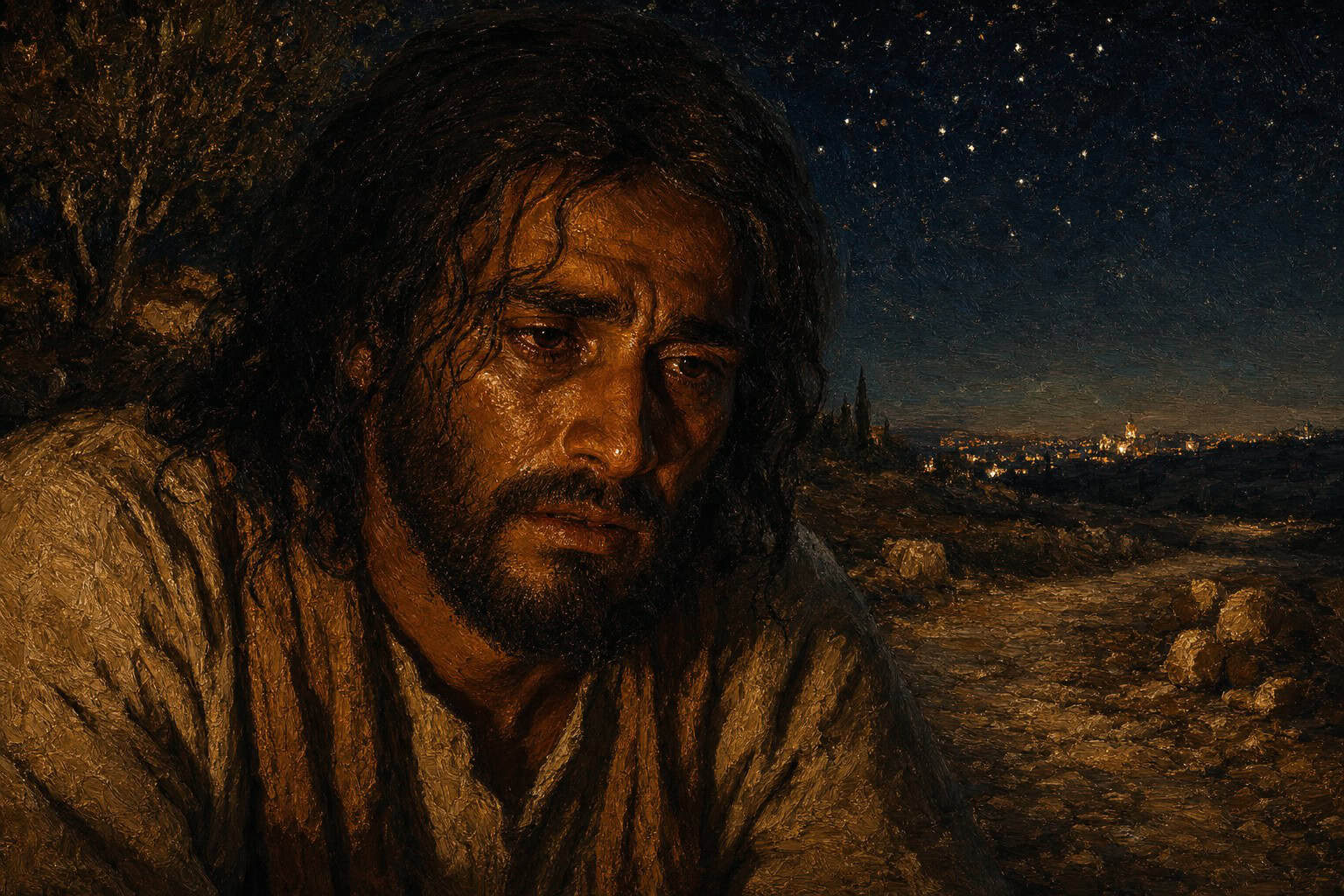
Walking late at night to think, to grieve, to breathe? A reflection on how the dark sky becomes a witness that holds both your sorrow and your joy.
The Road Past the Last Streetlight
You know the pull. It arrives after dinner, after the plates are stacked, after the day has scraped you clean of words. You want to be outside where the lit windows stop and the sky starts, where the hum of the city thins into cold air and the small ticking of a cooling engine on the shoulder of a road. I have felt that pull too, the ache to drive past the final streetlight and step out onto loose gravel just to tip my head back. In the pages of Confessions to the Empty Chair, a young man does exactly this on a clear night. He takes a woman he loves several miles beyond the edge of the city, pulls the car over, and asks her only to look up. He points at no monument, no glowing sign, nothing a hand could reach and touch. He points at distance itself, at the wide cold field of light that keeps no address and stands under no roof. What sends a person out walking at night, or driving into it, is almost never a plan. It is a mood that shows up uninvited and stains everything it touches, a felt tone that whispers the day’s rooms have grown too small for what you are hauling around inside you. The older narrator, looking back on that road, understands this now in a way the younger man on the gravel could not have named for himself. He was not running from anything out there. He was going toward the one audience that had never once turned its face from him. What actually happens is small and tender, almost embarrassing in its plainness: a car parked on a shoulder, a ring hidden in a coat pocket, two people breathing side by side under a slow wheel of stars. Yet beneath that plainness runs a current the man can only make out from years away. He had come to that sky before, in a mood the opposite of this one. He had stood beneath the same stars once when he had no one at all, when his grief could find no human ear to fall into, and he had spoken to those far lights because there was nothing else in the world that would hold still long enough to listen. He is at chapter fifteen now, near the far shore of a book that has been one long confession. Walking at night, driving into it, so often comes down to this simple thing: a return to the only quiet that never sent you away, the only silence that never told you to hush and be reasonable.
The Same Sky That Heard You Weep
Here is what the older man sees now, the thing that gives that quiet moment on the roadside its whole ache. The stars he presents to her were not new friends he had just met. They were the ones who had already watched the worst of him. There was a painful stretch of his life, he admits, when he talked to those lights and showed them his sorrow, when they were the only witnesses to a grief too heavy to carry into any room with a person in it. This is why the hunger for night air is never really about beauty, though the beauty is there. It is about being seen without being weighed, being heard without having to build an argument for your pain. The sky does not flinch when you finally speak. It offers no advice. It does not tell you to move on, to be sensible, to count your blessings. It simply stays, cold and enormous and patient overhead, while you empty yourself out beneath it. And so a strange thing unfolds across the years, though the young man on the gravel could never have arranged it: the audience of his lowest hour becomes the audience of his highest. He does not go looking for a fresh place to be happy in. He drives back to the exact field where he came apart, and he asks it to witness his joy. That is what the walk at night is quietly doing when its pull takes hold of you. You are not chasing distraction. You are chasing continuity, a thread. You want the part of the world that knew you at your very worst to also stand there and know you now, the same eyes on both selves. All the intellectual maneuvering that crowds a life through daylight hours, the arguing and defending and performing, the remembrance you keep polishing to make yourself look better, all of it falls silent out there on the shoulder of the road. What is left is a want so bare it feels shameful to say aloud: I want to be known by something that will not leave. The older narrator turns the question on himself here, without mercy. Did he go to the stars because he trusted them, or because he could not yet trust a living person with the whole of him? Were they a comfort, or a place to hide? He does not answer it cleanly. He only notices, from where he stands now, that the God he half-believed in during those dark conversations was perhaps already there, listening through the very lights he had taken for empty. The sky was never neutral ground. There was someone in it the whole time.
Bringing the Beloved to Meet the Dark
The turn comes when he does the one thing a lonely man never plans to do. He brings someone with him into that place. He steps behind her while she is still gazing upward, and he tells her, plainly, in his own halting words, that these are his friends, that they once heard his sorrow, and that now he wants them to hear something new from his mouth. This is the hinge of the whole reflection, and the older man feels its full weight. It is one thing to grieve alone under the stars where no one can see your face. It is another thing entirely to say to a living, breathing person: come stand where I once stood shattered, and let me tell this same sky a different truth with you beside me. That act is a kind of nakedness worse than the body’s. It hands her the map to his lowest ground. It says, here is where I fell apart in the dark, and I am inviting you into it not as a locked museum of my old pain but as the ground where I mean to build my joy. He does not kneel to her, and he tells us why with a strange firmness: he kneels to God alone, and no one else will have that posture from him. Yet what he does instead is braver than any kneeling. He shows her the raw floor of his despair and asks her to help him build a marriage on top of it. Her hands fly up and cover her mouth, and in that small helpless gesture the older narrator reads years of meaning he could not have read at the time. She did not recoil. She did not step back toward the car. She turned toward the very darkness he had just confessed and stayed inside its circle with him. This is the unexpected shape the moment takes, and he keeps turning it over. Did he ask too much of her, drawing her out to the site of his ruin and calling it romance? Was he offering her a gift or a burden dressed as a gift? He does not tie the question off neatly, because the honest answer sits somewhere between the two. He can only sit inside the awe of what she did, the sheer improbability that a person could be shown the worst of him and choose, in the same breath, to be entrusted with it. The vastness above them dwarfed them both, two specks on a dark shoulder of road. And yet the immensity did not crush the moment. Somehow it made room for it, held the small human question steady inside all that cold and endless light.
The stars that saw you break in silence are the only witnesses worthy to hear you sing again.
When the Old Griefs Are Woven In, Not Erased
What falls out of that yes is not the tidy resolution a lesser story would rush to hand you. The dark did not lift when she spoke. He is stubborn about this, and the older narrator refuses to soften it into comfort. The clamorous, dissonant notes he had carried inside himself for years did not vanish the instant she agreed to marry him. He does not expect they ever will vanish, not fully, not in this life. This is the hard grace of the scene, and the reason it will not turn sentimental in your hands. He does not describe love as an exorcism that scrubbed him clean and left him shining. He describes it as harmony, which is something else entirely, something stranger and more costly. Harmony means two sounds that do not cancel each other out but sound together, the sorrowful melody and the harsh one both still playing, folded now into a single pattern he can almost make out when he grows still enough to listen. This is why driving out to the great field of stars so often clarifies rather than soothes. It does not lift what troubles you off your shoulders. It gives you the scale in which to hold it. Standing under that immensity, you feel yourself shrink to a speck in an ocean of time and light, and somehow inside that smallness a strange room opens up where you can finally breathe. The dread that suffocated you inside a low-ceilinged space becomes bearable under a sky with no ceiling at all. The older man sees now that his younger self on the gravel was not begging the stars to repair him. He was asking them to hold two things at once, the wound and the woman, and to witness that a man could carry both without being ripped in half between them. Still he interrogates himself. Did he confuse her acceptance with being healed? Did he lean on her to do what only God could do? He does not resolve it. He only reports what he saw with his own eyes: that she did not flee, that she stood in the presence of the mixed and muddied waters of him and did not turn away from what she felt chained inside him. In that not-fleeing, something he had never once let himself believe suddenly became possible. The harsh notes, he says, were caught up and woven into a larger and more beautiful composition, then entrusted back into his hands to keep playing out. Grace here is not a rescue that lifts him from the dark. It is a companion who sits down inside it and stays.
A Speck the Quiet Has Been Keeping
So when the urge takes hold of you again, when you find yourself reaching for the keys past midnight or lacing your shoes to walk down empty streets with no destination, the older narrator of Confessions to the Empty Chair would not tell you to fight it off. He would tell you what it is actually for. Walking at night is a return to a witness. It is going out to the one part of creation that will not argue with your grief or hurry it toward the door, and standing under it until your own smallness begins to settle you rather than swallow you whole. The vastness does not shrink you into nothing. Strangely, it makes room for you inside itself. You are a speck, yes, one flicker of warmth on a cold shoulder of road, but a speck that is seen, a speck the enormous quiet has been keeping company with all along. He learned, across years he could never have foreseen from that gravel, that the God he half-addressed in those bleak conversations had never treated a single word of them as falling into emptiness. That is the awe of it, the thing that leaves him still. Not that the sky answered him in a voice. But that it stayed, and that in the staying there had already been someone present, closer than the light. The best response to a moment when the vast breaks open over you, he suggests, is not to freeze there gaping but to move toward its source, the way travelers once followed a single star across a long dark until it came to rest over what was true and good. His own road out past the city limits led him, in the end, not away from his sorrow but straight through the middle of it into a harmony he still cannot fully explain to anyone. What he can say plainly is this: the stars that heard him weep were the only witnesses worthy to hear him sing, and the woman he brought to stand beneath them did not turn from the darkness she was shown. He makes you no promise of the same. He offers no clean ending, because his own is not clean; the dissonant music plays on beneath the harmony even now. But he hands you the shape of a hope you can carry. Go out into the night if you have to. Show the sky your sorrow, all of it. And keep coming back, because one clear evening you may return to that same cold field of light with something entirely new to say, and find the witness waiting there, patient, immense, and full of someone who never once left.