Is the world cruel? A raw reflection on why we see so little of it, and how our narrow, wounded sight might still be mercy.
Standing at the Doorway of a Room You Cannot Fully Enter
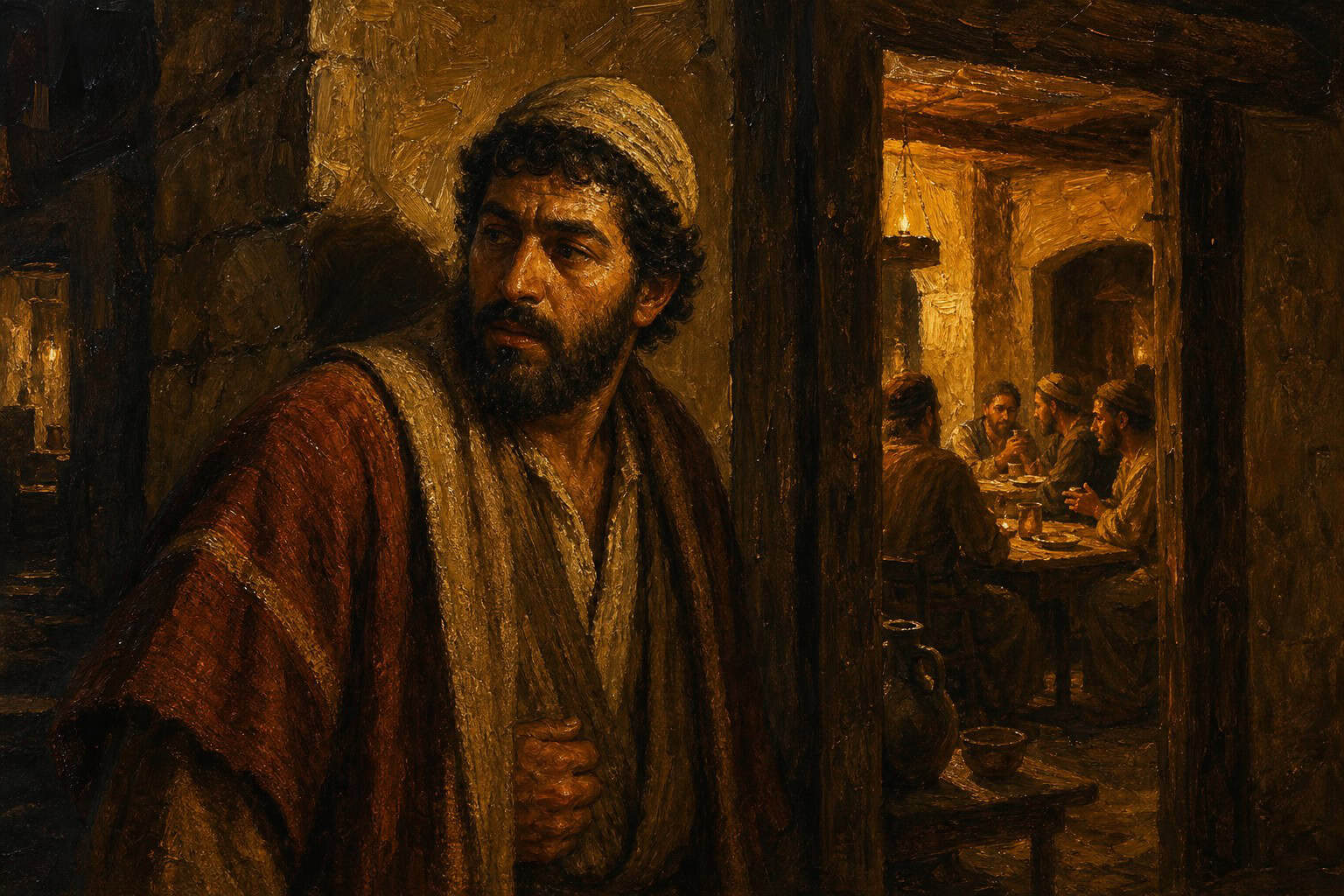
Why does the world feel cruel when you can only take in so little of it? That is the ache under everything in this early stretch of Fractions of the Soul. The narrator sets a plain scene, small enough to seem harmless. A person pauses at the entrance of a restaurant. They see the inside only from where their feet have stopped. From that spot the tables angle away like spokes. A wall cuts off half the room. A doorway at the back hints at spaces not yet walked into, a kitchen glow, a corridor that bends out of sight. The point starts small and then it swells. What you see is decided by where your body happens to be planted. You cannot lift off the floor and drink the whole room at once. You are stuck in one place, one pair of eyes, one slow turning of the head that catches things in sequence, never all together. The narrator names this gently, without contempt for himself or for us. He notices that a limit in space is kind in one particular way. The size of the room whispers that there is more to find. Walk further in and new things surface. A back corner with a candle burning low. A face you did not expect to be there. Space keeps its promise. Move, and it gives you more. But then he names a harder limit, the one that has no doorway to walk through. That is the limit inside us, the shape of the mind itself. The lens we look through does not hand us a better lens. You cannot step deeper into your own way of seeing the way you step deeper into a room. There is no further wall to walk toward. This is where the ache begins to burn. We are set down inside a single body, at a single moment, facing one direction, and the rest of reality streams past behind our backs while we stare at what is near. The world is not cruel for being large. It only feels cruel because our sight is narrow and we keep forgetting that it is narrow. We mistake the sliver for the whole. We stand at the threshold and call the doorway the entire building, sure we have taken it all in. The narrator does not scold this in himself or in us. He grieves it softly, the way you grieve a child who cannot yet reach the high shelf and does not know why the world keeps its good things above their fingers. He lets the smallness be tender before he lets it be tragic, and that tenderness is the first thing that makes this chapter feel like a hand laid on the shoulder rather than a lecture delivered from a height.
The Long Reach and the Short Arm of the Body
The tension gathers when the narrator refuses to let this stay a comfortable idea you can nod at and set down. He turns it on the body itself, on the flesh doing the seeing. We judge distance by what we can do with our limbs. A far wall is far because it would cost us many steps. A high shelf is high because our arm falls short of it. We never measure the world in cold numbers first. We measure it in reach, in stride, in whether our hands can close around the thing we want. The body is the ruler, and the ruler is short. Then he presses harder, and the room widens into something older. He brings in the animals. He notes the strange, humbling fact that we share almost all our building blocks with the chimpanzee, that only a thin sliver of difference separates us from the ape crouched in the trees. In that sliver, he says, sits everything we are proud of. Our art. Our discoveries. Our reaching toward the divine. He mentions the primates taught to sign, the gorilla who learned words, the chimp who came to understand human speech through long exposure, the way a small child learns a mother’s voice from across a crib. He is fair to them. He grants them real minds, real understanding, a real ache to be known and to make themselves understood to the people watching them. And still he insists the human child outruns the brightest ape, that our potential opens onto rooms they cannot enter. He points to the throat and the tongue, the soft flesh that lets us speak, and to the shared shape of brain and ear that lets both of us listen and take language in. The difference is partly meat. Partly the bend of a bone. This is the humbling turn, and he lets it be humbling. Our glory hangs on physiology. On the accident of a tongue shaped one way instead of another. If our vocal cords were slightly different we would grunt where now we sing hymns. The narrator lets this land without softening its edge. Our pride in our own accomplishments starts to look thin and borrowed when we see how it hangs by a genetic thread we did not spin. And underneath, a harder question stirs in the dark. If the ape cannot conceive of our cosmos, cannot reach even the low edge of what we know, then what sits above us, unreachable, that we cannot begin to conceive? The reflective narrator turns the blade toward himself here, where it hurts most. He has spent his life sure of his own clear sight, certain he understood the people around him, certain he could read a face and know the heart behind it. This scene begins to accuse that certainty quietly. If he sees only from one doorway, how much of the people he claims to have loved did he simply miss? How much did he decide was the whole when it was only the near wall of a far larger room?
A Species One Step Higher, and the Small Mercy of Not Seeing
The turn comes with the imagination exercise the narrator borrows from an astrophysicist, the one that asks us to picture a species standing one small step above us in the exact way we stand above the ape. Just that thin sliver again, but placed on the far side of us instead of the near side, above our heads instead of below our feet. To such a being, our finest work would look the way a clever ape’s trick looks to us. Our cathedrals, our symphonies, our proofs, our prayers, all of it a cute reaching, a bright animal doing the most a bright animal can do before it tires. This is the moment the chapter breaks open, and by every law of the heart it should have crushed the narrator flat. It nearly does. If we are that small, if our whole civilization is a chimpanzee clapping toward something one rung higher and unaware of the rung, then the world does feel cruel, and our proudest achievements feel like a joke being told about us behind our backs while we grin. But something quieter happens instead, and it is the whole beating heart of the passage. He sees that we cannot perceive everything there is to perceive, because the mind itself has walls, and those very walls are what let us go on living at all. If the entire flood of reality poured in at once, unfiltered, we would drown in the first second of it. The single flawed lens does not only fence us in. It enables us. It hands us a world small enough to actually stand inside without dissolving. The narrator sees, kneeling there in the dark, that his smallness was never an insult flung at him. It was a room built to a human’s size so that a human could survive the strangeness of being alive in it. And here God does not arrive to fix the smallness or lift the narrator up above his own eyes into some wider vision. God arrives inside the narrowness, walking with him in it, close in the very limit that had felt like abandonment a moment before. The mercy is not a wider window flung open. The mercy is that the window is bearable at all, and that He is standing here at it, breathing the same near air. This is not comfort that cancels the grief. The grief is still true. The smallness is still real and still stings. But the smallness is no longer only a wound. It has become, in the same breath, a shelter with someone inside it.
We do not see the whole because we could not bear it; the narrow window is not our prison but our mercy.
We do not see the whole because we could not bear it; the narrow window is not our prison but our mercy.
What the Narrow Sight Cost the People He Loved
The fallout is not calm, and the narrator does not pretend it is. Once he sees his sight as small, he cannot un-see what that smallness did to the people who trusted him with theirs. This is where the tenderness turns to something that stings, because tenderness toward himself forces a hard honesty about them. He begins to suspect that he did to living people exactly what the customer does to the half-seen restaurant. He stood at the doorway of a woman’s life and called the near tables the whole building. He decided he knew her from wherever he happened to be standing that day. He set aside the rest of her, the rooms he could not see from his spot, the long history that ran beneath her like an underground river, patient and ready to rise. He treated the sliver he could perceive as the entire truth of who she was, and then he acted on that thin sliver as though it were the settled fact of her. The scene’s own idea rises up and accuses him plainly. When facts get stripped of their weight and bent to fit the desire of the passing moment, the person in front of you stops being a person. She becomes a screen for the thing you already wanted to see projected there. He wonders now, unsettled, how often he did that without noticing. How often he loved the version of someone that fit neatly through his doorway and quietly ignored the parts of them that would not fold small enough to pass through. There is a particular grief in this, and it does not resolve. The flesh knows before the mind will admit, and looking back he can feel that his body had already sensed the fuller person, had trembled at more than his eyes would confess. He had felt her true size and chosen the smaller image anyway, because the smaller one was lighter to carry and easier to hold at arm’s length. That choice was not innocent, and he refuses to call it innocent now. He did not merely lack sight. He preferred his blindness where it kept things convenient. He curated what he let in the way a man arranges a shelf so the ugly thing stays behind the others. This is the confession the chapter drives him toward, and he does not tie it off with a bow. He sits down inside it. He asks the question that will not let him sleep: whether the narrowness that is mercy for the self becomes cruelty the moment it is aimed at another soul. The same limit that lets him survive being alive is the limit that let him diminish the people he swore he cherished. He handed them a doorway when they deserved the whole house lit up. And he cannot walk back into those closed rooms now. The tables are cleared. The chairs are up. He is left holding the thin, flawed image he chose, and the late, cold knowledge that she was always larger than the frame he crushed her into and called love.
Kneeling at the Human-Sized Table
Where it settles is neither comfort nor despair, but something stranger and truer, the exact tone that runs like a spine through this whole book. The narrator does not climb out of his smallness at the end. He learns to kneel down inside it. He stops raging at the narrow lens and begins to treat it as the thing it always was, a gift cut to his size, a table set low enough for a creature like him to actually reach the bread on it. There is no rescue staged here, no sudden widening of the eyes, no vision handed down from a great height. There is only the quiet, stubborn fact that he is accompanied in the narrowness, that the God who let him see so little sees the whole of it and stays anyway, close in the dark, present in each falling tear, walking at his side through the very failure he is confessing aloud. This is the softening the chapter has been reaching toward since that first pause at the restaurant doorway. The world is not cruel because it is too wide for us. The world is wide, and we are small, and both of those things are true at once and neither one is a punishment handed down. What was cruel was his own use of his smallness, the way he shrank whole people to fit his frame and then dignified the shrinking with the word love. The tenderness he finally reaches has two faces. It is tenderness toward the self he was taught to despise, the small creature who could only ever take in one wall at a time and never should have been asked for more. And it is a harder, later tenderness toward the people he could not see whole, a low ache to have loved them at their true and unmanageable size. He cannot undo any of it. He can only carry it, and let the carrying change how he stands at the next doorway he comes to. This is the whole way of Fractions of the Soul, and this early passage is its first clear ringing. It takes the humiliating fact of our smallness and then refuses to leave us stranded in the humiliation. It walks the reader right up to the lip of despair and there, instead of a rescue, sets down a companion in the dark and leaves the light off. If you have ever felt the world is cruel because you can hold so little of it in your two hands, this chapter will not lie to you and promise you can hold more. It will say something harder and far kinder. It will say the narrow window is a mercy, that you are not alone at it, and that the smallness you were ashamed of is the exact size of the table where you were always meant to sit and finally, without apology, be fed.