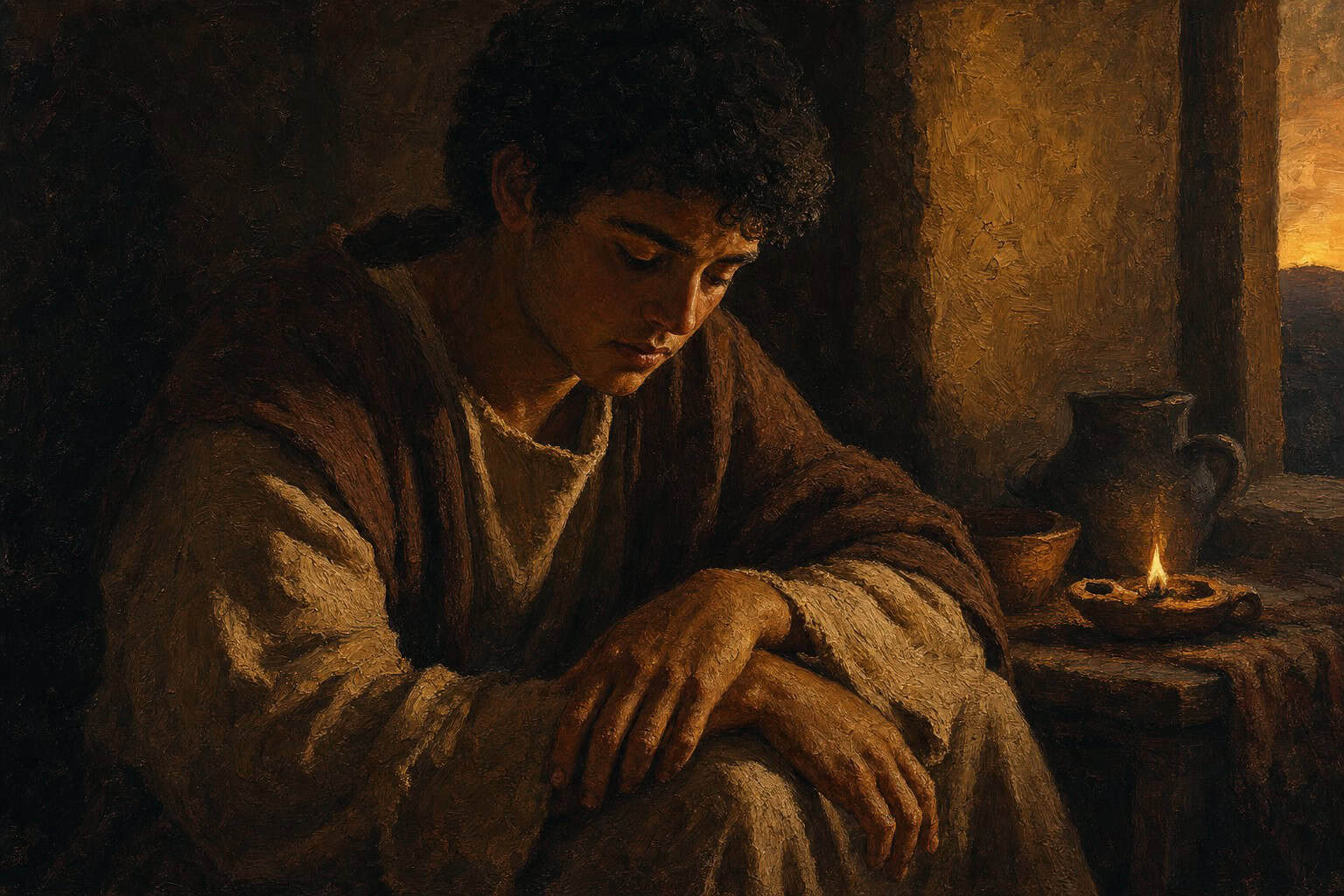
Abused and enraged at your own weakness? A reflection from Confessions to the Empty Chair on the rage we turn inward, and where God waits in it.
The Weak, Wanting Animal in His Own Skin
What do you do when someone is hurting you and your own body refuses to fight back? That question sits low in the chest, heavy as a stone swallowed wrong, before a single line is read. Chapter 12 of Confessions to the Empty Chair pins that exact question to the floor and stands on it. The narrator does not watch his powerlessness from a safe distance and take notes. He is inside it. He is in a room where his hands will not obey his will, where compliance has already begun and he can feel it moving through him the way cold moves into a house at night. There is a woman close to him. There is his own flesh, and it is answering some older law than the one he thought he lived under. He calls the thing inside him an animal, weak and wanting, and that word is not decoration. It is the plainest name he can reach for the part of himself that has just betrayed the rest. The horror is not only what is being done to him. The horror is that some hungry corner of him is not fully unwilling, and he knows it, and he cannot unknow it. He is being seen. Worse, he is seeing himself, and what he sees he cannot stand to look at. Shame comes faster than thought, faster than breath. It floods the space around him and changes it. The walls seem closer. His own skin means something new and terrible. The distance between his mind and his arms stretches out until his arms feel like they belong to a stranger. He wants to cover himself. He wants to disappear from his own eyes. But there is nowhere in that room to go, and the farthest, most unreachable place is the inside of his own chest. This is where the memoir does its hardest work, and it does it early. It will not let him be only a victim. It will not let him be only guilty. It holds both in one hand and makes you hold them too. The scene does not explain itself. It does not soften itself. It simply lets a man watch himself fail to be master of his own body, and lets you feel that failure land as its own wound, deeper in some ways than the harm arriving from outside. You learn, reading it, that abuse does not stop at the skin. It reaches the place where you keep your trust in yourself, and it breaks something there that does not set clean.
When the Fist Cannot Find Its Rightful Target
The rage comes, and here the reader searching for what to do will flinch, because the rage does not go where it should. He is not angry at her. Or not first at her. The fury lights up and swings inward, straight at the wanting animal, at the compliance, at the softness that would not hold the line. This is the terrible logic the chapter lays bare and refuses to talk away. Anger needs somewhere to land. The one who truly deserves the blow is out of reach, or too tangled up with him to strike without striking himself. So the anger does what thwarted anger always does. It fans out, hunting for a target, and finding none it can hit clean, it turns back on the self. Then it overflows. It cannot stay contained in that inward strike, and it stains what he does with his own body. His compliance hardens. It becomes rough. It becomes punishing. The submission he could not refuse turns into a sentence he carries out on himself through the very act he despises. Here the honesty of the manuscript becomes almost too much to sit with, because he will not let himself off. He digs at the source of the cruelty with his own hands. Was he punishing her, or punishing himself through her? Was the roughness a protest, or was it the animal taking what it wanted while wearing the mask of rage? He cannot answer cleanly, and he will not invent an answer that clears him. You feel the air of the scene thicken and go dark. Anger is not a spike in his chest here. It has become the whole atmosphere, the weather the room breathes, coloring everything in ugly light. A man who spent years trying to be devout, to be governed, to be a fortress of the will, watches that fortress fail from the inside, and the failure enrages him more than any outside enemy ever could. This is the trap abuse builds so quietly you do not hear it close. The hurt you cannot answer curdles into a self-hatred that goes looking for a stage, and the stage is often another person, or your own skin, or both at once. The scene sets you down in the exact place where suffering and sin stop being separate things. He is being wronged. He is also doing wrong. The two are braided so tight he cannot pull one strand free of the other without tearing his own hands. If you came asking what to do when you are being abused, the memoir hands you no plan and no exit. It hands you a mirror, and in the mirror you watch the injury turn a man into someone he does not recognize, and it does not pretend the recognizing comes with a cure attached.
The Overflow That Names Him to Himself
The turn arrives in one word he keeps circling back to, the way a tongue keeps finding a broken tooth: overflowed. The rage was so great it could not stay inside its intended target. That overflow is the whole revelation. It shows him that his self-hatred was never really sealed away, never really private, never only his own to carry alone. It spilled onto another person and made her pay a cost she never owed. And in that spilling he learns the most frightening thing the chapter has to teach him. The violence he aimed at his own weakness was, in the very same motion, already violence aimed outward. There is no wall between the two. The man who cannot forgive his own surrender becomes, in the same breath, the man who makes someone else carry it. This is where the searcher’s question splits open like a struck log. What do you do when you are being abused? Sometimes, the memoir confesses with terrible plainness, you become an abuser inside the same hour, not by clean choice, but because the fury had nowhere else to spend itself. He sees this in himself and does not blink. He will not use the harm done to him as a screen to hide the harm he did. He holds both truths like broken glass, refusing to set either one down. And in the middle of that recognition, something else is present that he nearly walks past. There is no rescue. No hand comes down to pull him out of the room or unmake the act. But he is not alone in it either. God is there, quiet, standing in the very place of the sin, walking beside him inside a fury he cannot govern, present in a shame he could never survive on his own. Not fixing it. Not erasing it. Only there, near, in the dark, closer than the animal, closer than the rage itself.
The hatred you cannot land on the one who harmed you does not vanish; it hunts the nearest flesh, and often that flesh is your own.
That nearness is not comfort in the cheap sense. It does not make the act less real or the guilt one grain lighter. If anything it sharpens the shame, because now he is seen all the way through, by the one witness who cannot be lied to and cannot be sent away. And yet the seeing is not only condemnation. It is company. The climax of the chapter is not that he slips the trap. It is that he is finally and fully known inside it, and known without being abandoned there, which is a harder mercy than rescue and, in the end, a truer one. To be caught red-handed and not walked away from is a strange grace, and it does not feel like grace while it burns.
The hatred you cannot land on the one who harmed you does not vanish; it hunts the nearest flesh, and often that flesh is your own.
What the Cooled Room Leaves Behind
After the overflow, the room does not go back to what it was. The rage cools the way a fever cools, leaving the body shaking and damp and the mind suddenly clear enough to count the damage. He comes back into himself and finds he has done a thing he cannot undo, in a situation he did not choose, driven by a fury he did not fully write. The fallout is not loud. It is quiet, and it is permanent, the way real consequences almost always are. He has to live now as a man who was harmed and who harmed, and the memoir will not let him fold those into one comfortable name. He cannot say he was only the one wronged. He cannot say he was only the one who sinned. He has to be both, and being both is a kind of homelessness, a state of never being able to rest in a single story about himself. The room that held the act keeps holding him in memory. He returns to it in his mind again and again, standing once more in that near, trapped, airless space, asking what he refused to see. What she really was to him. What the animal really was, the one he named so fast. Was calling it an animal just a way to disown it, to pretend it was not fully him, to hand the worst of himself to a beast so he could keep believing in the man? He turns that over and does not answer it gently. This is the register the whole book breathes in: severity without contempt, honesty with no relief of a verdict at the end. The falling action here is the slow, unglamorous labor of carrying what happened without lying about it and without being crushed under it. He does not forgive himself in a sentence. He does not receive absolution as a tidy beat in the plot. He simply keeps looking, keeps being looked at, and slowly learns to stay in the room of memory without shielding his eyes. For a reader who typed a desperate question into the dark, this is not the answer they were hoping to find. It is a truer one. Abuse is not one moment with one right response waiting at the end. It is a wound that keeps making choices for you long after the harm is done, and the work is to feel the rage rising before it overflows, to name the animal without letting it take the wheel, to refuse to make the nearest body pay for the one you cannot reach. The chapter promises no clean success at any of this. What it promises is that you will not be alone in the trying.
The One Witness Who Did Not Leave
Where it settles is not on a solution but on a presence. He ends this stretch of the book still bruised, still guilty, still unsure whether the animal inside him was a stranger who broke in or his oldest self wearing his own face all along. He does not tie it off. He lets the ache go on aching. But he has learned one thing he did not have when the rage first caught fire. The shame that made him want to vanish from his own gaze was witnessed by more than himself, and that witness did not look away. God did not spare him the room. God did not stay his hands. God did not lift him out before the act was finished. That is not the God this memoir preaches, and it is more honest for refusing to. What it offers is stranger and heavier than rescue. It offers a God who stayed inside the very hour of the fall, who was present in the tears that came after, who walked with him in his sin instead of waiting at the edge for him to wash and dress and come out presentable. For anyone caught in abuse and asking what to do, the deepest word the book has is not a strategy. It is that you are not as alone as the shame keeps insisting you are. The fury that walls you off, the self-hatred that swears no one could bear to see what you have become, is lying about the emptiness of the room. Someone is in it with you. Not to fix it in one stroke, not to make the harm never have happened, but to be near inside it, and nearness is the only thing that reaches all the way to the bottom. The chapter leaves you hungry for the rest of the book precisely because it would not comfort you on the cheap, and that refusal is what earns your trust. You want to know how a man carries this and keeps living, keeps kneeling, keeps confessing to an empty chair that turns out not to be empty after all. You want to see whether the animal is ever tamed or only, over long years, understood and held. The memoir will not spare you the descent. But it swears, in its stern and unflinching way, that the descent is accompanied every step, and that the God who does not haul you up out of the dark is the very same God who has never once, not for a single breath, left it.