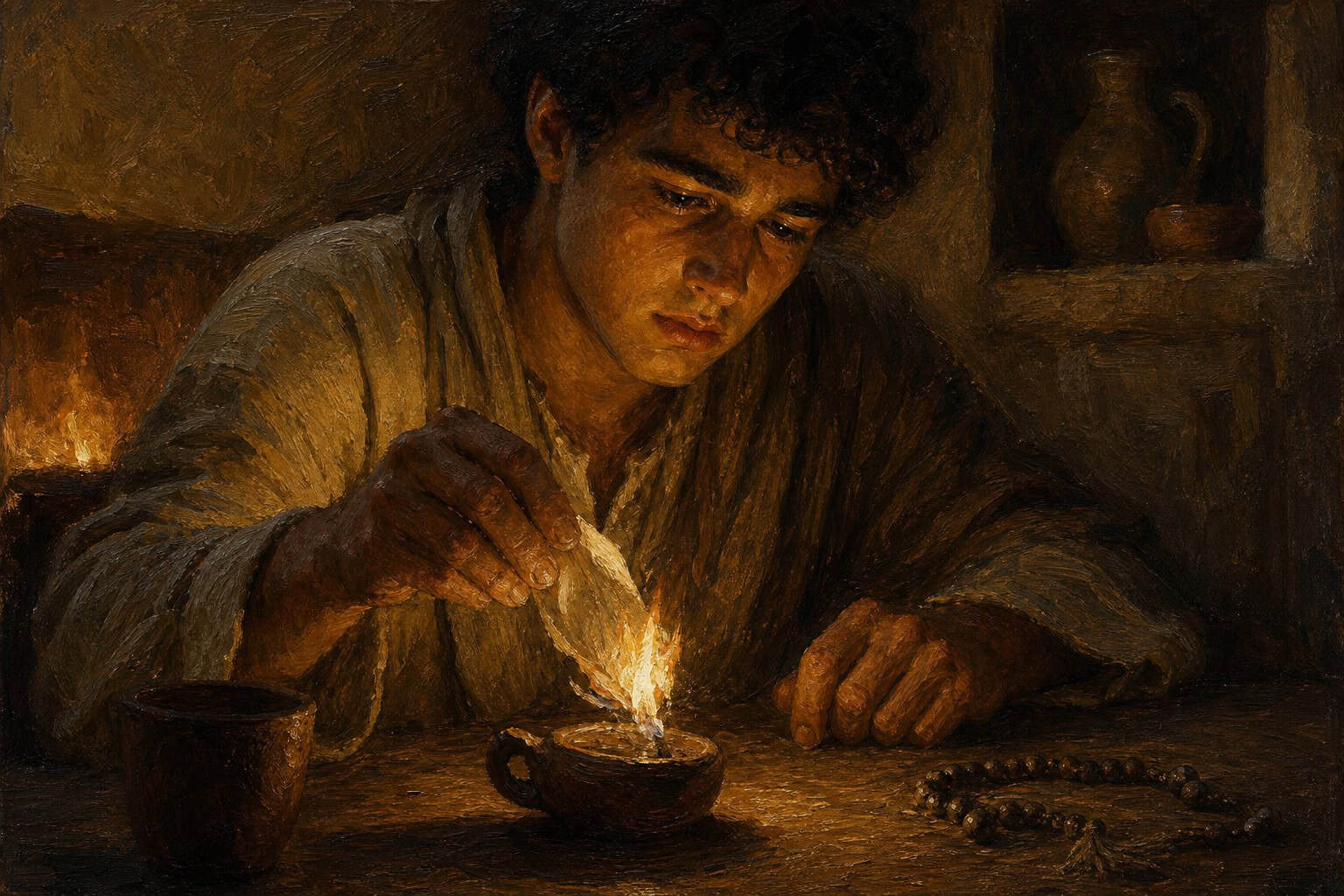
Can love be destroyed? A raw look at a boy who tried to hold heaven and hunger at once—and what survived the fire.
The Boy Who Wanted Two Kingdoms at Once
Can love be destroyed? The question comes quiet, usually late, after the letters have already gone cold in a drawer and the person who wrote them has stopped being a face and become a wound you carry the way you carry an old break in a bone. I ask it because a boy in these pages asked it first, though he did not yet have the words for it. He was seventeen, and testosterone had launched him out of childhood the way a flood launches a house off its footings. He held a picture of sex in his head that was almost unbearably beautiful—the body reaching toward the divine, two people honoring God with their skin, a dance older than language, a physical way of doing honor unto the One who made bodies in the first place. Then came the girl. Dirty blonde hair, blue eyes, freckles scattered across pale skin, shy and soft-spoken, attentive to whatever he said in a way that undid him. His high, clean idea of love met the surging, animal fact of his own flesh, and the two would not sit at the same table. He wanted both kingdoms. He wanted heaven’s air in his lungs and hell’s fire in his blood at the same hour, in the same body, and he told himself he could keep them in separate rooms with separate doors. This is where the reflection begins in Confessions to the Empty Chair, early in the fifth chapter—not with a fall, but with a plan. The plan was control. He would walk right up to the edge of transgression and stop there, one careful step shy, protected, he believed, under the shadow of wings. He would master with his mind what his whole bloodline had spent millennia making impossible to master. He drew a line and swore he would not cross it. Every time he reached that line, it moved. That small, terrible detail holds the entire trouble in miniature. A boy who believes his faith is strong enough to leash desire has already mistaken control for holiness, and he does not yet know it. He does not yet know that the flesh is not an enemy to be jailed but a good thing to be loved rightly or refused honestly—never negotiated with. And so he kept the hugs, kept the kisses, kept telling this girl who did not share his God that he was different, that he was careful, that he had rules. He was building something he called holy on ground that could not hold the weight of it. The reflection settles here first, patient, letting the boy believe his own strategy—because you have to watch the plan stand tall before you can feel how it comes apart.
Negotiating With a Fire You Called a Friend
There is a particular pride in the young that looks exactly like devotion, and wears its clothes, and speaks in its voice. He granted himself permission—that is his own word, permission—to explore feeling and action right to the dangerous edge, engaging pleasure to the very brink of its dominion but not, he swore, one inch past it. Notice how he keeps a ledger. He was not resisting temptation; he was managing it, dosing it, counting out how much he could take and still call himself clean the next morning. This is the game every person who has ever bargained with their own hunger will know in their gut. You tell yourself the danger lives out there, at the cliff’s lip, and that you will feel the ground change under your feet in time to step back. You never do feel it in time. The line you drew this week becomes the line you cross next week, and then you draw a new one further out into the dark and call the movement growth. The tension gathers because the girl is real. She is not a test God mailed him to strengthen his character. She is a shy person with her own longing, treasuring the time she spent with him, telling him he was unlike anyone she had met—and he took that tenderness and used it as scaffolding for his private war. Here is the cruelty hidden inside spiritual striving: he made her the guardian of his purity. He asked her, without ever saying it aloud, to help him not sin. He set the whole weight of his soul on her patience, her attention, her willingness to stop when he said stop. That is not a relationship. That is conscription, and it is a quiet violation of a person who came to him open-handed. A thoughtful woman reading this feels it in her stomach—the exhaustion of being asked to keep a man holy while he refuses to keep himself, the loneliness of being loved as a boundary instead of a person. And yet he was not a monster. He was a boy who genuinely believed he honored her most by loving God more. Both things were true in the same breath, which is exactly why the memory still stings him decades later, retrospectively, when he can see what he could not see then. He wanted to inhabit heaven and hell simultaneously and be praised for the ambition. But the flesh does not run on the mind’s schedule. It keeps its own weather, its own hurricanes, its own tides, and a boy who thinks faith alone will still that storm is standing waist-deep in the surf, calling the water by name and ordering it home. He was not the master of that fire. He only imagined he was. The whole architecture of his control was a story he told himself so that he would never have to actually choose between the two summits pulling him apart.
Hell Has Only One Master, and He Was Not Him
Here is the turn, and it does not arrive loud. It comes as a plain sentence he would return to for years afterward: hell has only one master, and he was not that master. Everything he had built cracks along that single line. All the careful edges, all the boundaries drawn and redrawn and drawn again, all the confidence that a strong enough faith could chain the lust budding in him—it collapses into one flat admission he can no longer argue his way out of. He had been trying to walk two paths at once, one climbing toward God and one running toward the girl, and he had not yet grasped the thing that would take him years and much wreckage to see clearly: those two paths only ever meet when they climb toward the same peak. Point them at different summits and you are not walking two paths at all. You are being torn down the middle, one foot on each mountain, the ground between them widening. He was building a holy life on unholy ground, and the ground beneath it was his own pride wearing the mask of discipline. This is the ancient confusion in a young shape—the boy mistaking the flesh for eternity, believing the whole cosmic order hung suspended on one girl’s freckled face and her single yes or no. Every earthly beauty had promised him what only God could deliver, and he had swallowed the promise whole. The devastating part is not that he failed. Boys fail; that is not news. The devastating part is that his failure had been disguised as strength the entire time it was happening. He thought his willpower was faith. It was appetite wearing faith’s coat, and the coat fit so well he could not tell where the borrowed cloth ended and his own skin began.
You do not chain the flesh with faith; you either offer it up or it offers you up in its own time.
What the Ash Remembered
You do not chain the flesh with faith; you either offer it up or it offers you up in its own time. Something did not survive the plan. The two kingdoms he tried to hold in one seventeen-year-old body could not both live, and the death was slow and unspectacular—no lightning strike, but a long attrition, the way fire eats a folded letter inward from the edges until the words in the middle are the last to go. What the older man sees now, looking back across the years, is harder than any single collapse. He sees that the girl deserved to be loved as herself, not as the terrain of his spiritual war, not as the test his God supposedly set in his path. She was shy, passionate, attentive to what he said; she had found something in him that once got thrown in a toy box and forgotten, and she went looking for it and drew it back out into the light. He was, for once, wanted—genuinely, particularly, chosen by a person who saw him. And what did he do with being chosen? He turned it into an occasion for control. He is unsparing with himself here, and this is where the memoir earns your trust. He does not let the boy off the hook. He asks the question that still will not release him: did he ever really see her, or only the pattern she happened to fit—the hair, the eyes, the pale skin, the freckles that had first pulled at him when he was six years old and would keep pulling for decades to come? Was his love for her love at all, or the recognition of an old hunger repeating itself, a shape his body knew before his heart ever consented? This is the humble speculation the memory opens, held with care rather than delivered as a verdict. Yes, there are patterns worn into how people are drawn, ancient grooves in desire that neither man nor woman chose or asked for. But a person is never only a pattern. She was a whole life lived from the inside, with her own reasons, her own softness, her own free and unrepeatable heart—and to reduce her to a type he was fated to want is its own small violence, a way of ducking the answer for how he actually treated her. He knows this, which is why the memory refuses to soften into nostalgia. The falling of this chapter is the falling of illusions, one after another after another, and God is not standing there to catch them cleanly before they hit the floor. God is present, yes, but not as rescue. Present as the quiet witness inside the wreckage, walking beside the boy through his own sin rather than lifting him free of it, near in a way that convicts far more than it soothes. The nearness itself is the mercy. It is also the wound that will not close.
The Longing That Outlasted the Lie
So can love be destroyed? The reflection will not hand you a tidy answer, because the boy did not get one and the man refuses to counterfeit one now. Here is what he learned instead, and it is enough to keep you turning pages. What he called love was partly true and partly a story he had written to flatter himself, and the story died. The pride died with it. The clean picture of himself as a soul strong enough to master his own flesh—that died first and hardest, and it deserved to die. But the longing underneath all of it did not die. The hunger to reach toward the divine through another body, the ache to honor God with his whole embodied self, the dream of a love that climbs toward one peak and does not tear the walker in half—that survived the fire and came out the far side, changed and blackened but breathing. It survived because it was never really his to destroy in the first place. Longing of that kind is planted deeper than any single failure can reach. What can be destroyed is the counterfeit: the control that dressed itself as holiness, the strategy that used another person as a guardrail, the young certainty that faith alone would still the storm. Those things burn, and they should burn. What cannot be destroyed is the true thing they were only imitating—the desire for union that God himself set aching in the body from the beginning, the pull toward a love that is fire and stillness at once, passion and peace held in the same tired breath. The boy could not hold both yet. Almost no one can at seventeen. The stretch of years between the old slavery and the promised land is a desert, long and dry and disorienting, and he was standing at the very edge of the sand, mistaking the first shallow oasis for the whole kingdom. Confessions to the Empty Chair does not promise you the desert is short or the walking easy. It promises only that you are not walking it alone, even in the long stretches where God seems to say nothing back and the sand keeps going past the horizon. If you have ever tried to strike a bargain with your own hunger, or quietly asked another person to keep you holy so you would not have to, or lain awake wondering whether the love you lost was ever really love at all—this chapter meets you there, at the moving line, before the fall, and it will not lie to you about what comes after it. Read it if you want to know what the boy did with being wanted. Read it if you have ever mistaken your appetite for your faith and called the mistake devotion. The ash still remembers what burned in it. The longing still remembers what it was reaching for.