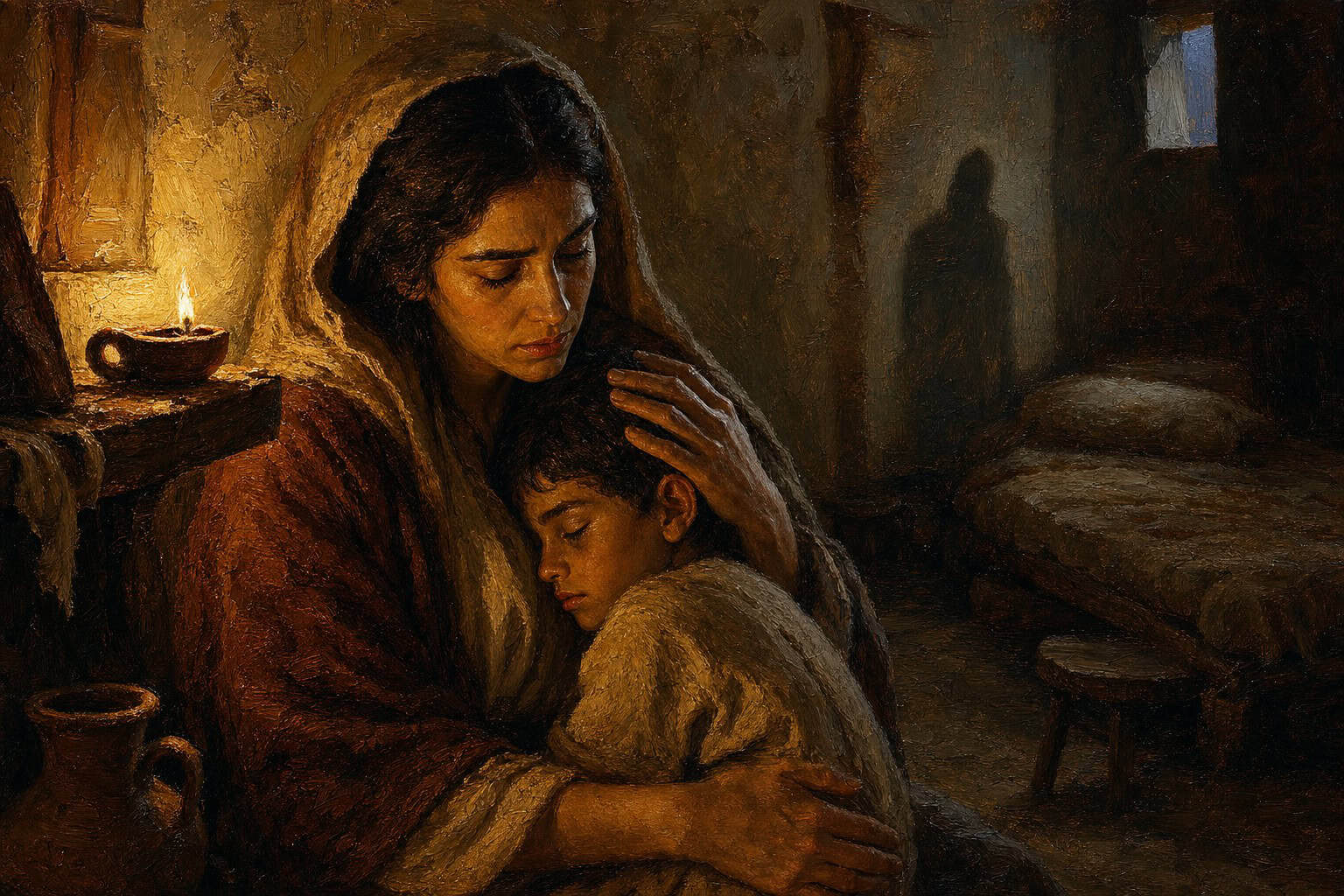
Adult symptoms of childhood abuse—intrusive thoughts, unspeakable memories, a fear you can’t name—read through a memoir that meets them without flinching.
The Duplex Where the Air Learned to Bend
Where does a fear come from that you cannot trace to any memory you own? You lie in bed as a grown man, forty years from any nursery, and something old presses down on your chest, and you cannot say why it is there or how it got in. This is the ache the opening of Confessions to the Empty Chair walks straight into, without apology and without a soft place to set you down. The narrator is three years old. His babysitter is sixteen, still a child herself, and she performs a ritual on him, again and again, in the small rooms of a rented duplex, and she is not doing it alone. She has invited a partner into the act, something far older than she is, and the two of them work at him together in the dark hours between supper and sleep. The word he chooses—collaborating—carries its own quiet horror. This was not a single accident, not one bad night. It was a partnership, rehearsed and repeated, a secret kept between an adult-in-training and a power she believed she could handle and could not. The boy does not consent. The boy does not understand. He is three, and consent is not yet a word his body knows how to make. Whatever happens to him happens below language, down in the muscle and the breath, in the place where a child first learns whether the world will hold him or drop him on the floor. The scene refuses to make it larger than it was. It gives you the ordinary bedroom, the ordinary early hour, the babysitter who was supposed to keep him safe while the grown-ups were gone. That ordinariness is the wound’s disguise, and it is why so many adults cannot find the door their fear came through. Nothing looked wrong from the hallway. The harm wore the face of care. It sat in the chair beside the bed. It spoke in a familiar, trusted voice, and it counted on the child being too small to know the difference. The narrator, looking back across decades, will not flatten this into a clean clinical label and file it away. He names it as he believes it truly was—a door pried open in him, a mark left on him, a summons handed to a war he never enlisted to fight. A reader may not share his frame. But even from outside it, the scene tells a plain truth about early harm: it arrives before you are able to refuse it, and it stays long after everyone who caused it has forgotten the room. The duplex is gone now. The air it bent inside that boy has never once straightened out.
A Seam That Would Not Close Again
After the family moves out of that duplex, the narrator expects distance to work as a kind of medicine. Put enough miles between the child and the babysitter, and surely the harm stays behind in the emptied rooms, behind in the town they leave. It does not. This is the first hard thing the scene teaches about what comes after early abuse: geography changes nothing about the seam that was torn between a person and the world. Something in the boy has been thinned. The membrane that should have held firm between what he could touch and what he could not has been rubbed almost to nothing. Months after the ritual, in the new home, on a fall evening as he lies waiting for sleep, something crosses that thinned place and comes to him. He describes a small shape, vaporous and lanky, no taller than a grown man’s forearm, standing where nothing at all should stand. He never sees it again in his life. But it does not need to come back, because it has already finished its work. It has taught his young body a lesson the body does not forget: that a room is never fully shut, that the dark can hold a watcher, that safety is only a rumor the grown-ups tell. Set this beside the adult who cannot understand his own alarm at nothing, and the connection sharpens to a point. The narrator names his particular torment with real precision. It is not the seizing of the body. It is not the wrecking of a house. It is obsession—intrusive thoughts and images that plague both his waking hours and his sleeping ones, inappropriate, persistent, arriving without invitation and leaving on no schedule but their own. Anyone who has lived downstream of early harm knows this weather in the bones, no theology required. The thought comes unbidden. The image will not go. You did not call it and you cannot send it away. The narrator’s honesty is that he never pretends he chose any of this, and he never pretends it was small enough to shrug off. He also refuses the tidy comfort that it was only a bad dream, only the busy imagination of a frightened boy. He stays inside the harder possibility—that something real reached across and touched him, and that the touch was built to leave him alone with it. Here is the cruelty folded inside the cruelty. An experience this strange cannot be told. Who would believe a shape a foot tall, a teenager’s secret ritual, a mark no doctor can find on the skin? So the survivor learns his silence not from shame alone but from the plain terror of sounding insane. The seam stays open. A wound no one will hear becomes a wound that quietly rots, doing its slow work on how a whole life walks through every doorway it must pass.
The Wet Raspberry Blown at a Terrified Child
Here the scene turns, and the turn is stranger and worse than the terror that came before it. We expect evil to arrive with grandeur—a tragic fire, a towering dread that at least matches the size of the damage it does. What the narrator remembers instead is mockery. The thing that visits the boy does not only frighten him; it makes a fool of him while it does it. It blows a wet raspberry at a child who is shaking under the covers. It defiles his innocence by wrapping the horror in something absurd, so that the boy is left holding a memory too ridiculous to ever say out loud. This is the cruelest piece of architecture in the whole aftermath of early abuse, and the narrator names it without softening the shame that clings to it: the harm was engineered from the start to be unspeakable. A grand tragedy can at least be mourned with dignity. A humiliating farce lodges sideways in the throat and stays there. The child who is terrified and also made to feel foolish learns that even his terror will not be granted its own weight. And so the adult carries a double wound. There is the fear itself, and there is the flat certainty that the fear can never be confessed without inviting laughter, or a raised eyebrow, or a gentle clinical question about whether he is well. The narrator understands, decades on, that this was strategy and not accident. He lays the enemy’s tactics out plainly, the way an old soldier maps a battlefield he survived. Deception comes first—the thin tendril that slips in wearing the costume of something harmless, something almost sweet. Then division, prying the soul loose from whatever might have protected it. Then diversion, turning the eyes away from the real trouble. And last, the crushing discouragement that convinces a person to stop trying to name what is wrong at all. Discouragement is the word that lands hardest here, precisely because it is the quietest one. It is not a scream in the night. It is the slow leaking away of the will to speak, to hope, to believe he might be believed. This is where a searcher who typed a question about the marks of childhood abuse into a dark screen at midnight meets the narrator most directly—not in the spectacle, but in the tiredness. In the loneliness of a fear that has outlived its own beginning by half a lifetime, and that still sounds like madness the moment it reaches the air. The wet raspberry is small. That is the whole point of it. It shrank a real terror down until the boy could not even grieve it honestly, and the man is still learning how.
What was done to you before you could speak still shapes how your body meets every room.
The Room the Watcher Could Not Enter
He calls the mark an appointment. That single word does more work in the aftermath than any diagnosis could, and it is also where the narrator’s own honesty gets hardest on himself. To read the thing done to him as a summons, a commission hidden inside a curse, is to insist that even this had a shape and a purpose he could not yet see—that he was not merely broken but drafted, conscripted into a war he never chose and could not have chosen at three. And here he turns the lens on himself without mercy. Did he build this frame to survive, he asks, because a soldier with orders is easier to be than a child who was simply used? Is calling it a commission a truth he was given, or a story he needed so the humiliation would stop feeling like nothing more than humiliation? He does not tie the question off. He lets it stay open and raw, the way Confessions to the Empty Chair keeps most of its hardest questions open. What the fallout looks like, plainly, is a boy who grows into a man reading every room for the watcher, flinching at nearness, expecting the familiar voice to turn. The violation did not only hurt him once. It restructured what it means for him to be touched, to be approached, to be chosen by anyone at all. That is the quiet devastation the scene lays bare: early harm does not stay in the past as a memory he can visit or avoid. It becomes the very way his body meets the present, the standing posture from which he greets each new person who comes close. And yet the narrator will not let the enemy have the last word on his own soul. He holds to something stranger and older—that when God truly visits a soul, He comes in total darkness and deep concealment, dwelling in a place so far inside that neither angel nor devil can reach it or even find it. If that is so, then the very dark the boy was abandoned to was never fully empty. Something was there that the watcher could not see, keeping a room the ritual could not open. This is not rescue. The narrator is careful about that, and it costs him to be. God does not lift him out of the terror or erase the intrusive images or hand him a clean night’s sleep as reward for his faith. The dark stays dark. What changes is only this—that he begins, slowly, to suspect he was never as alone in it as the shape wanted him to feel. The accompaniment does not fix the wound. It walks beside it. And for a man who learned at three that safety was a rumor, being accompanied in the fear rather than delivered from it turns out to be a different and heavier kind of mercy than the one he kept praying for.
What the Groaning Chapel Finally Says Aloud
So the question the searcher carried into the dark—why do I hold a fear I was never handed, why does a room feel unsafe for no reason I can point to—does not get answered with a technique or a tidy resolution here. It gets answered with a life laid open. The narrator’s wager, at the very start of this memoir, is that the most isolating experience a person can hold becomes medicine only once it is confessed with precision, out loud, in front of witnesses instead of groaned alone in some private chapel. What he suffered as a boy was built to keep him silent. Speaking it back, decades on, is the one move the strategy could not plan for. He describes it almost as a debt—the older self owes the younger world his darkness made articulate, owes the frightened three-year-old a voice that will not shrink from the wet raspberry or the foot-tall shape or the babysitter who was supposed to be kind. That is why he refuses to trim the story into something respectable. He keeps the absurd part, the humiliating part, the part that makes him sound unwell, because leaving it out would betray every reader who carries the same unspeakable thing and has never once said it. For the person reading this at a bad hour, that is the true offer of the book. Not a cure. Not a five-step path out of the intrusive thoughts. Not a promise that the seam will finally seal and the room will finally feel closed. What it offers is company inside the very darkness the fear lives in—the plain, steadying news that someone else was marked before he could speak, and lived, and learned to read joy and terror and beauty through the same cracked lens, and found God waiting in the deepest room where the watcher could never reach. The narrator does not pretend his path was clean or his motives pure. He interrogates his own frame, his own need to make meaning of the mark, his own long silence and the pride that may have shaped it. He leaves the hardest questions standing where they fell. But he does the one thing the abuse was designed to make impossible. He tells it. He hands the child’s terror its dignity back by naming it in full daylight, and in doing so he leaves the reader holding something firmer than comfort—the sense that the fear you cannot trace has been named before, out loud, by a man who would not look away from it. That is where the opening of this memoir leaves you: not delivered, but no longer the only one awake in the dark, listening for the small shape against the wall.