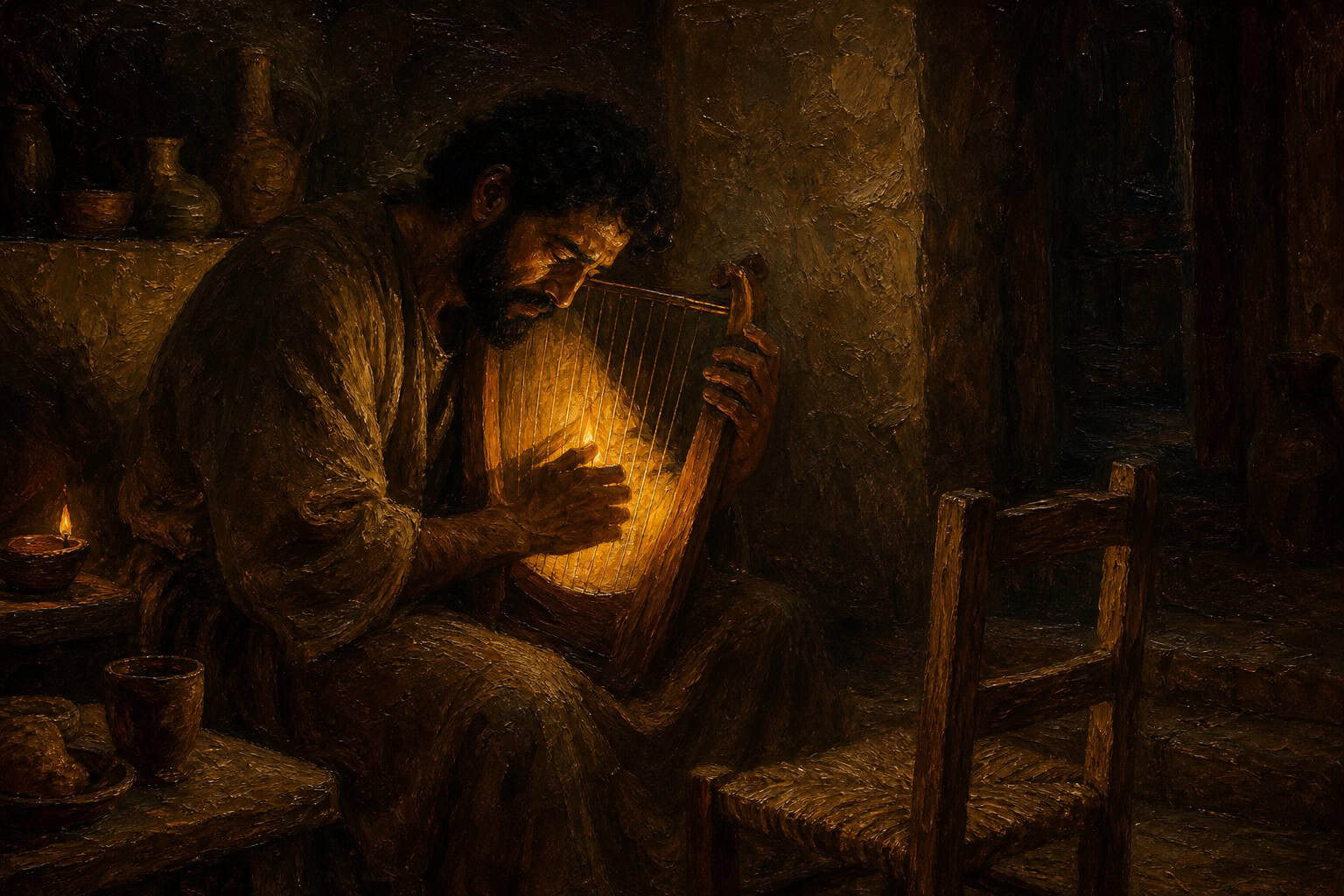
What age do you start feeling old? Not a birthday, but a song from your youth that still knows where you keep the ache. A reflection.
The Speaker Cone Still Holding Your Fifteen
You feel it before you can name it. A song comes on that you have not heard in twenty years, and something in your chest folds inward, tight and sudden, the way a hand closes around a coin it does not want to lose. That is the ache you searched for. You typed a question about age, about the year it starts, and what you were really asking is why an old song can reach through your ribs and find a boy you thought you had buried. In Confessions to the Empty Chair, the narrator sits alone with a late-night radio and a long playlist he built years ago, and the songs are not decoration. They are fossils. Each track holds a specific pain the way amber holds an insect: intact, suspended, still recognizable after all the years. He is not young anymore, and he knows it, but the knowing does not come from a mirror or a birthday cake. It comes from the sound. When the speakers push those old chords into the room, his body answers before his mind can. The shoulders remember. The chest remembers the tightness of being sixteen and unable to say a single true thing out loud. This is where feeling old actually begins. Not in the joints, not in the gray hair, not in the paperwork of a birthday. It begins in the recognition that music which once described you now describes someone you used to be. Notice how the chapter carries a list of records like a ledger of the dead: the harsh screaming tracks stacked beside the aching ballads, all of them held in his memory with the same care a man gives to grave markers. The small print of labels and dates meant nothing to him as a boy. They were just the fine text behind the wound. Now that fine text is part of the burial. There is a distance now between the man in the chair and the boy in the song, and that distance is the aging. He listens to the harshest tracks, the ones that scraped and screamed, the ones that gave shape to a fury he had no other place to put. Back then the sound was a companion who walked beside him. Now it is a witness who testifies against him. The room he sits in is quiet except for the speaker, and the quiet is enormous, pressing on the walls like water. He does not skip past the painful songs. He plays them on purpose. He reaches for the wound the way you reach for a scar in the dark, needing to feel where the skin knit itself back together, needing proof that the break was real, needing to know the boy existed at all.
When the Screaming Was the Only Honest Thing
Go back with him to the boy who first loved these songs, because that boy is the one your question is really about. He was young and full of a longing he could not translate into a single sentence. His body wanted union, wanted to be seen and held and answered, and the world gave him no clean way to say so. So he found the loud music. The aggressive tracks, the ones built out of distortion and rage, became a kind of church for him. When he could not scream in his own house, the singer screamed for him. When his desire had no name and no direction, the pounding drums gave the pressure somewhere to go. There is a truth here that a gentler world does not want to admit: sometimes the only honest thing in a young man is his anger, and he needs a place to lay it down that will not shame him. The speakers became his altar. The volume was his liturgy. He offered up a fury he did not understand, and the music received it without asking him to explain himself. Underneath the rage, though, was something softer and more dangerous. There was want. There was the pull of the body toward another body, the ache to be chosen, the terror of being invisible in a hallway crowded with people who did not see him. He was learning early that longing hurts, and that no one had taught him what to do with the hurt. He stood at the edge of every gathering feeling the space between himself and everyone else stretch wide and cold, and the music was the one thing that closed the distance. The older narrator does not sneer at that boy now. He watches him with a tenderness that took decades to earn. He sees how the loud songs and the sad songs did the same work: they named a feeling the boy could not name himself, and in naming it, they made survival possible for one more night. That is what the music was for. Not pleasure. Survival. And here is the ache that grows as you keep listening with him: the man understands that the boy’s fury and the boy’s desire were tangled together, two branches of one root. He wanted to be close to someone. He was furious that he did not know how. He wanted to be touched and was ashamed of the wanting. The music held all of it at once, and it never asked him to choose which feeling was allowed. It only asked him to feel, in the dark, with the door shut, the volume turned up so the house would not hear. He was not building a taste in songs. He was building a hiding place where the unbearable could be borne. And the hiding place worked, which is exactly why it is so hard to look at now.
The Mirror Turns to Stone in Your Hands
Here is the turn, and it is not gentle. The narrator realizes that the song which once mirrored him has stopped being a mirror. When he was young, he pressed himself against these tracks and saw his own face looking back: the anguish, the want, the raw open nerve of being alive and unloved. The music said, this is you, and he believed it, and the belief kept him company through nights that had no other companion. But now, in the chair, an older man, he plays the same song and the mirror has hardened. It no longer shows him. It shows him a grave. The boy who fit those lyrics is gone. What remains is the memory of fitting them, and the memory is heavier than the original pain ever was. The pain of sixteen was hot and alive. The memory at fifty is cold and finished, a closed thing he can no longer enter. This is the moment your question was pointing at all along. You do not grow old on a birthday; you grow old the day a song from your youth stops being a mirror and becomes a grave. The distance between the man and the boy has become uncrossable. He cannot reach back and hold that suffering child. He can only watch him from the far side of the years, and the watching is its own kind of grief. And this is where the book does something unexpected, something honest and unresolved. It does not offer rescue. It does not tell him the pain was worth it or that everything happened for a reason. Instead, in the middle of the dark listening, there is a presence. Not a fix. Not a light switching on overhead. Something quieter than that. The sense that he was never actually alone in that teenage bedroom, that the tears he cried into those songs were seen, that God was walking beside the furious boy inside the fury itself, not standing outside the door waiting for him to calm down and behave. The nearness does not remove the ache. It settles down into the ache and stays there. That is the strange mercy the narrator finds: not that the wound closed on schedule, but that it was accompanied while it bled, kept company while it screamed. He does not get his youth back. He gets, instead, the terrible gift of understanding it, and the understanding arrives too late to spare the boy and just in time to keep the man from becoming stone himself. He sits with that. The song ends and another begins, and the mercy does not leave with the last chord.
You do not grow old on a birthday; you grow old the day a song from your youth stops being a mirror and becomes a grave.
The Beautiful Faces He Chose to Forget
Now the fallout, and it moves into harder territory, because the narrator does not stop at nostalgia. He interrogates himself. He looks at the life he built on top of that half-remembered vulnerability and asks what he did with the wound. He notices a pattern he is not proud of. The boy who once felt invisible grew into a man who chose beautiful women, and he wonders now whether the choosing was ever really about love, or whether it was a way of mastering the old pain, of proving to the invisible child that he was seen now, wanted now, chosen now. This is where the reflection has to be careful and unflinching at once. To desire is not a crime. To long for beauty, to ache toward another body, to want union: this is written into what it means to be a person with a heart and a hunger. But he suspects his own motives, and the suspicion is fair. Was he loving these women, or using their attention as a bandage over a boyhood he never mourned? A thoughtful reader, man or woman, will feel the honesty here rather than the accusation. Because the truth cuts in both directions. The women in his life were not mechanisms and were not trophies; they were their own full souls, lived from the inside, with their own longings, their own histories, their own reasons for choosing him back. He knows this, and it shames him that for so long he half-forgot it, half-let their faces stand in for a feeling he owed only to himself. There is a wisdom here worth sitting with, offered gently and not as a verdict: people often reach for love not out of fullness but out of an old lack, and the reaching can look like devotion while it is really flight. Men and women both do this, in their own different keys, each covering an old emptiness with a warm body. He does not want to reduce anyone, least of all himself, to a strategy. A person is never a mechanism, no matter how neat the pattern looks from a distance. But he cannot pretend the pattern is invisible now that the music has shown it to him. The sad songs of his youth taught him that longing hurts. The beautiful faces of his adulthood were his attempt to make the hurt stop. And the honest question he puts to himself, the one he refuses to answer cleanly, is whether he ever truly loved anyone, or only ever loved the feeling of no longer being that boy at the edge of the room. The chair across from him is empty. He is speaking to someone who is not there, and part of what he confesses is that he made himself hard to reach on purpose, for years, so that no one could touch the wound the music kept alive.
Playing the Wound on Purpose in the Dark
Where it settles is not comfort, and that is the point. The narrator does not close the playlist with peace. He closes it with recognition, which is a harder and truer thing. He understands now that he plays the painful songs on purpose because the wound itself reaches for contact. He is not chasing relief like a plan on a page. His body simply moves toward the sound the way a tongue moves toward a sore tooth, needing to know the pain is still there, needing the ache to have somewhere to live. Feeling old, he learns, is not about the number of years stacked behind him. It is about the moment you can hold the boy you were with tenderness instead of shame, and the moment you realize that the holding does not bring him back. Time turned his shame into tenderness, but tenderness is not the same as healing. He forgives the child who screamed into the speakers. He forgives the man who chose beautiful faces to outrun a memory. He does not pretend either forgiveness fixes anything at all. The songs still hurt when they play. The empty chair is still empty when the song ends. And yet the presence he found in the dark does not pack up and leave. That is the thread that pulls a reader toward the whole of this confession: not a promise that the pain resolves, but a witness who stays down inside it and does not flinch. He sits alone with the late-night radio, an aging man in a small room, and the quiet around the music is vast, and the old tracks keep pushing their grief out into the air like breath fogging cold glass. He lets them. He does not skip. He has finally understood that his memory does not live in photographs or in dates on a calendar but in these sounds, each one a place he had to pass through to become whoever he is now. The final feeling is not despair and it is not triumph. It is quieter and more honest than either. It is the feeling of a man who has stopped running from his own longing, who lets the music open the old wound one more time, and who finds, sitting inside that opened place, that he is not as alone as he was at fifteen. If you searched for the age you start feeling old, here is what the book hands you: not a number, but a hard tender knowing, and the nearness that meets you in the very dark you cannot walk out of. The last song fades. His breath slows in the still room. His hand rests on his knee and does not move toward the machine to turn it off.