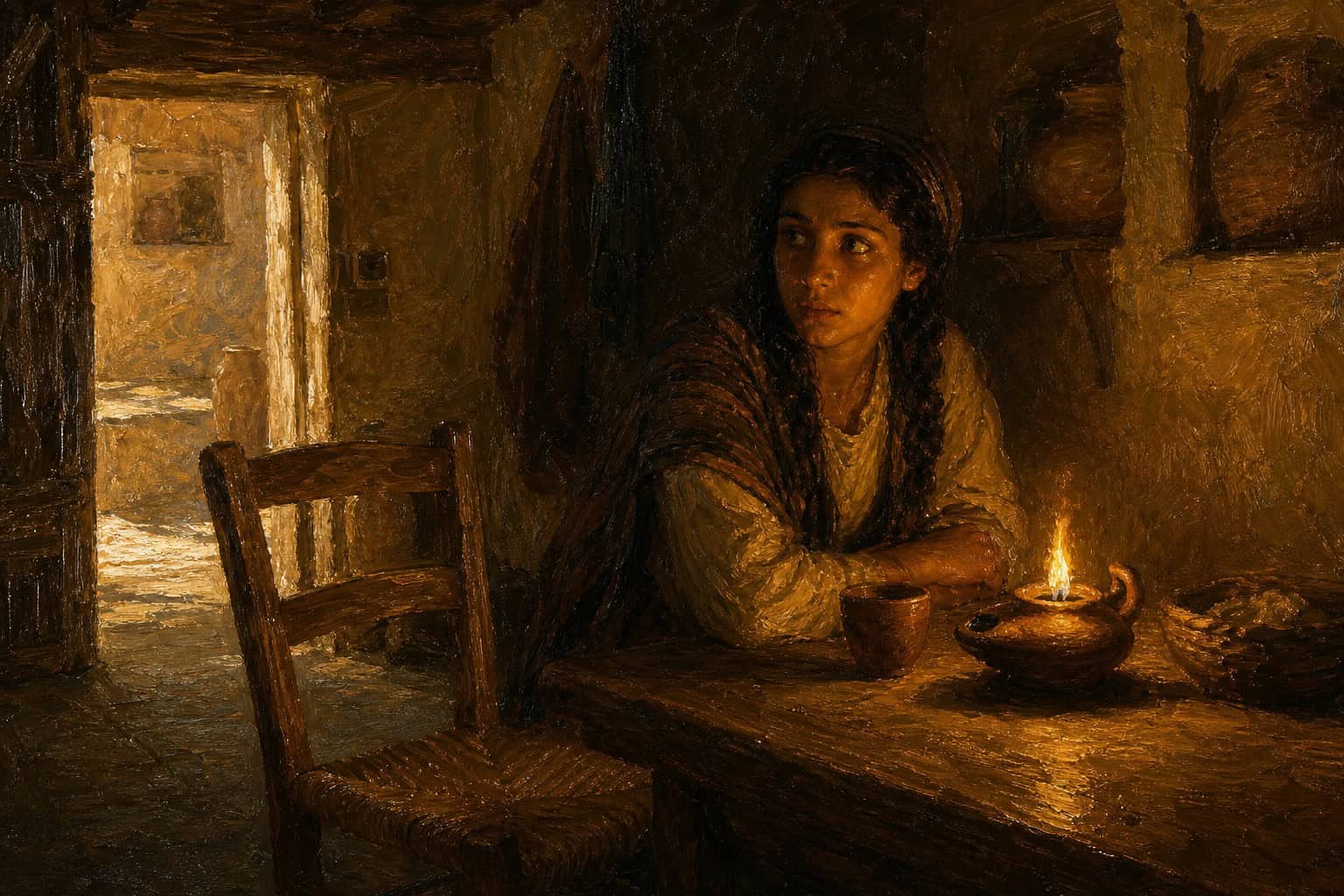
Why a son needs a mother: the first voice that reads his silences, and what the ache for that reading never stops asking of him.
The Voice That Named Your Trouble Before You Did
There was a person once who could hear the trouble in you before you made a sound. You came in with your shoulders set wrong, or you answered too fast, or you did not answer at all, and she glanced up from the sink and asked what was wrong. Not because you told her. Because she had been reading you for years, meal after meal, the door slamming or not slamming, the way you left your shoes. She kept a private record of your tones that no one else on earth possessed. That record is the thing a son hungers for and rarely knows how to name. He wants a first reader. He wants someone who has held the sound of him so long that the smallest wobble in his voice lands, the way a familiar footstep on a familiar stair sounds wrong the one night the foot is dragging. This is not softness. It is a labor, a fierce and unglamorous attention, and it is usually the mother who does it first and does it longest. She learns your grammar. She learns when your quiet is sulk and when your quiet is fear, and she does not confuse the two. In the memoir Confessions to the Empty Chair, the narrator recalls becoming, as a boy, a reader of people through nothing but their words scrolling up a lit screen in the dark. He learned to catch the shift in a familiar writer’s tone, to feel for the wound tucked under a plain sentence, to type back the concerned question. He calls it an education in observation and deduction, a gathering of the small traces people left behind. But look at what that boy was really doing. He was training himself to be the reader he was starving to receive. He built, with his own hands, the exact attention he ached to have turned on him. There is the ache beneath the whole question. A son does not merely want a roof and a plate of food from a mother. He wants to be interpreted kindly by someone who has done the slow work of learning him by heart. He wants his silences taken as messages, not as empty air. When no one reads them, he starts reading everyone else instead, and reading them coldly, to survive. He turns himself into a watcher and forgets he was ever meant to be a son. And here is the bitter joke of it. The boy who learns to decode the whole crowded world often stays the one person no one in that world has ever bothered to sit down and decode.
Fluent in Everyone, Mute in Himself
What happens to a boy who is not read is that he learns to read, brilliantly, and it half saves him and half ruins him. He begins watching people the way a careful stranger watches a party he was not invited to. He collects the pauses, the odd word choices, the small contradictions between what a person says and how they say it, and he assembles from these scraps a picture of them they never handed over. It feels like power. It even feels like love, because close attention looks like love from a distance, and the boy cannot always tell them apart. But there is frost in it. The narrator of this book confesses as much without flinching. He speaks of mapping other lives with an almost mathematical precision while his own inner world stayed entirely unmapped, uncharted, dark. He spoke everyone’s language fluently and offered none of his own. That is the trap that closes on a son when the first reader is missing, or too tired, or too far away. He grows the skill of interpreting and quietly loses the willingness to be interpreted. He can name the exact tremor running under your voice and will never once let you near his. The skill sharpens fastest in the years when the body becomes a riot he cannot govern. The screen felt safe precisely because it stripped away the face. On the boards and in the private messages there were no appearances to negotiate, no cliques ranking each other by looks, no schoolyard where other boys spent their fury through shoves and swung fists. There was only the word, and the word could be studied, weighed, turned over, decoded at his own pace. So he moved in there. He made a whole home inside the practice of interpretation. But a home built entirely on watching other people has no mirror hung in any room. You can pass an entire adolescence like this, and the older self looking back is forced to ask the hard thing plainly. Was I hungry for connection, or was I hungry for control? Did I want to know these people, or did I want to master them so completely that they could never surprise me, never reject me, never catch me standing exposed? A mother, at her best, teaches a son that he can be known without being conquered, that another person can hold the truth of him and hold it gently. When that lesson goes missing, the son learns the knowing without the gentleness. He becomes a scientist of the soul and forgets, somewhere along the way, that he was issued one of his own. The loneliness that grows out of this is not the ordinary loneliness of being unloved. It is the loneliness of being unread, which cuts deeper, because he is the one who built the machine that keeps every last person parked at a safe reading distance.
The Small Hours When the Watcher Went Hungry
There comes a night when the watching turns and stares back at him. He is alone in the small hours, the house gone quiet, the screen’s pale light on his face, the fridge humming in the next room, and it lands on him all at once. The concerned question he keeps typing to others is the exact question no one is typing to him. He has trained himself to hear the wound buried in a stranger’s sentence. He cannot hear his own, because there is no one across the dark to hear it back to him, to say the words that make a wound real by receiving it. This is the reversal that sits at the center of the whole question. The son needs a mother not merely to carry him through childhood alive, but so that he can learn, in his body, what it feels like to be the object of tender attention instead of only its tireless author. He needs to be on the receiving end of the reading, not only performing it for others. Without that, he grows into a man who can decode grief in everyone he meets and quietly dies of it, undecoded, in himself. And here, in the dark, at the exact place of the watching, something gentler than his own cold precision can come. Not a rescue. Not a switch thrown that floods the loneliness away and hands him a clean morning. Something quieter than that. A nearness. The slow sense that in all the years of straining to hear other people, he himself was being heard. That the attention he believed he invented alone in a lit bedroom was itself a gift, set down in him before he had done a single thing to earn it, planted there by someone, by Someone, who had read him first and read him whole.
Before a boy can speak his wound, he needs someone who already reads it in the way he goes quiet.
The Long Bill for a Youth Spent Watching
The cost of all that watching comes due later, and it arrives with interest. A man who spent his youth interpreting instead of being interpreted carries the habit through every doorway he walks. He decodes his friends over dinner. He decodes the woman he loves across the pillow. He reads her tone, files it, predicts her next mood, and mistakes the accuracy of the prediction for intimacy itself. But she does not want to be predicted. She wants to be met, plainly, without the machinery whirring behind his eyes. And here the old wound bares its teeth, because the world of flesh and blood does not trade in the treasures he polished for years in secret. He built himself a hoard of intellect and insight, certain these were the pearls that would finally win him the recognition he starved for. He learns, with a bitterness that genuinely stuns him, that desire and connection catch fire through presence, through the body, through the plain willingness to stand and be seen in ordinary daylight, and not through the most elegant decoded sentence he can produce. This is the humiliation the narrator keeps circling in Confessions to the Empty Chair, unable to leave it alone. The very gift that made him a reader of souls did not make him lovable in the specific way he ached to be loved. So the old temptation walks back in and offers to make him colder still. It whispers that if the treasures go unreceived, the fault must lie with a world too coarse and fleshly to receive them. It hands him a robe of superiority to wrap the shame in. It renames his withdrawal a holy duty, a guarding of sacred things against the trampling of swine, and it lets him refuse the very people he cannot reach and call the refusal virtue. The questioning self has to name this for what it plainly was. It was not holiness. It was fear wearing the costume of principle. It was a boy who never got read teaching himself to punish everyone who failed to read him, and dressing that punishment up as righteousness. The mother-hunger, left unmet and untended, does not stay tender. It hardens in the cold. It curdles into resentment, into a refusal of empathy that swaggers like strength and is only a wall with a man crouched behind it. The cruelest part is how reasonable every brick of it feels from the inside. Every retreat has its scripture ready to quote, every coldness its airtight justification. But no man builds a livable life on the flawless decoding of others while refusing to be decoded himself. The house only grows quieter. The fluent reader of everyone becomes the one address no letter ever reaches. And somewhere in that accumulating silence the future he pictured for himself, arms open, a shepherd of others’ sorrows, collides head-on with the hatred he has been nursing for the very humanity he claims he wants to serve.
The Longing That Turned Out to Be a Compass
What settles at the end is not a tidy answer but a recognition, and it comes slowly, against his own resistance. A son needs a mother because no one is born already knowing he is worth reading. He learns it, or fails to learn it, from a face that studies him with patience, that keeps the long ledger of his moods, that asks what is wrong and actually stays for the answer. That first reading is the ground the rest of a life grows out of. Take it away and the son does not stop needing it for a single day. He carries the empty place forward and keeps trying to pack it full with watching, with analysis, with the cold precision that feels like mastery and delivers only more distance. But the hunger itself was never the enemy. This is the turn the narrator keeps arriving at, reluctantly, like a man returning again and again to the same locked room. The ache to be read was never merely a lack in him. It was a compass needle. It pointed, the whole time, toward the truth that he was made to be known and made to know in return, that the restlessness he despised in himself was itself the evidence of a face already turned toward him in the dark, waiting. The mother is the first icon of that face, and even a flawed mother, even an overwhelmed or absent one, leaves the shape of the longing pressed into the son like a seal, and the shape is itself a kind of promise about what he was built for. Grace does not undo the wasted years of watching. It does not hand the grown man the childhood he wanted or lift the loneliness off his shoulders like a coat. It does something stranger and much quieter than that. It walks into the very room he built to keep the world out, pulls out the one chair standing empty across from him, and simply stays. It reads him without being asked. It knows the tremor in his voice, tells his sulk from his fear, keeps the whole private catalog he was certain no living person had ever bothered to keep. And in that experience of being finally read, the son begins, at last, to loosen his grip on the machinery, because he no longer has to decode the whole world to prove to himself that he is really here. Confessions to the Empty Chair refuses to knot this off neatly. The wound stays a wound; it does not close on cue. But it leaves you holding the thing the question was actually reaching for all along. Not a technique for surviving without a mother, but a way of seeing why the hunger was holy, why it would not leave him in peace, and why being at last truly read may be the nearest thing to being loved that a soul knows how to name.