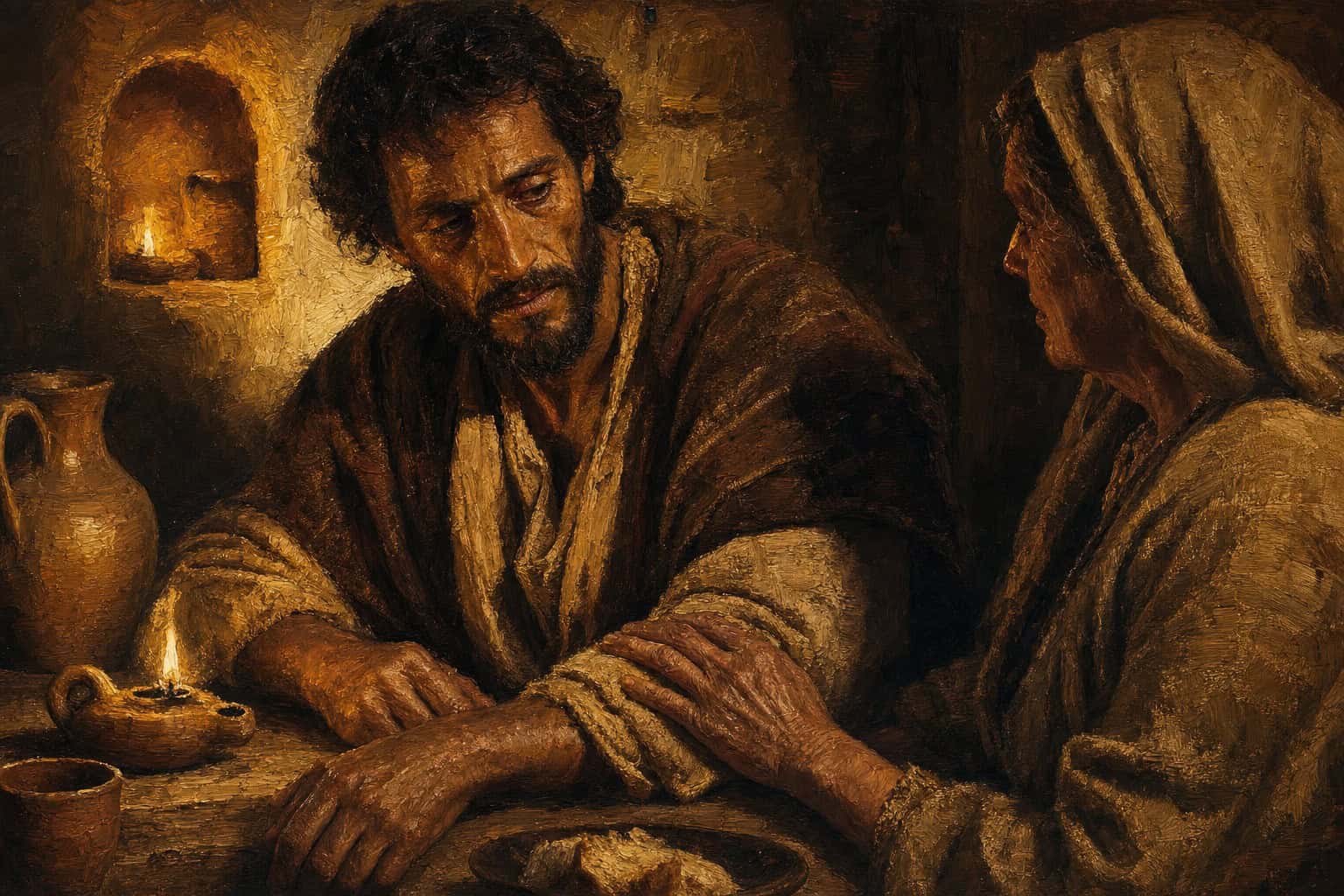
Dealing with a controlling mother? A severe, tender reflection on love, guilt, and the command to honor the one who holds you too tight.
Her Voice in the Kitchen Before You Speak
You already know what she wants before she says it. That is the first sign that something has gone wrong in the house of your soul. You sit at her table, and the food is good, and her eyes track your hands, your posture, the length of your hair, the woman you married, the God you serve or fail to serve. She does not raise her voice. She does not need to. Her disappointment moves through the room like a change in air pressure, and your chest tightens without your permission. Your fork slows. You chew smaller bites, as if smallness itself could keep the peace. You are forty years old and you feel eight, and the smell of whatever is on the stove is the same smell it was when you were eight, and that alone undoes you a little. This is the daily fact of a controlling mother: not the loud fights but the quiet management, the way she has arranged herself as the weather you live inside. You love her. That is the part nobody warns you about. If you only feared her, you could leave. But there is tenderness tangled in the dread, a memory of being small and held, and that memory is real, and she is dying a little every year, and you can see it in the way she grips the counter when she stands. You notice the loose skin at her wrist. You notice she asks you to open the jar now. The contradiction sits in your throat like a bone. She hurt you. She also fed you. She controlled you because, in some crooked way, she could not bear to lose you, and now she is losing you anyway, the way everyone loses everyone, and you cannot decide whether to hate that or to grieve it before it arrives. You were taught to honor your mother. You were also taught to become a man, which means to have a self she does not operate by remote. These two commands stand in the same room and refuse to shake hands. So you sit there, chewing, saying yes, saying fine, watching her hands, hating yourself a little for the boy who still wants her to say he did well. That wanting does not shame you. It only tells you the wound is old and the love is real. Both things are true at the table, and you carry both home in the car, the radio off, your knuckles pale on the wheel, wondering when honoring her became the same act as disappearing.
The Yes You Give That Costs You Your Own Name
There is a specific ache in giving in to her, and it lives in the body before it reaches the mind. Your shoulders drop. Your jaw unclenches for one second, then clenches harder, because you have bought a moment of her peace with a piece of your own. This is the pattern of the man who keeps loving the one who hurts him, believing endurance will finally be rewarded. He thinks if he is soft enough, obedient enough, present enough, she will one day give him the unconditional warmth he never quite got, the childhood approval that stayed just out of reach. He is chasing a return to being held without conditions, a peace he half-remembers and cannot locate on any map. So he pours himself out. He cancels his plans. He drives across town on a weeknight because her voice went thin on the phone. He apologizes for things he did not do, hears his own mouth forming the words, and marvels at how easily it comes. He watches his love disappear into her like water poured onto dry ground, and the ground stays dry, and he tells himself next time will be different. It is not that he grew wiser. It is that he learned to bleed quietly, which he mistook for maturity. And here the older, honest voice inside must ask hard questions of itself, not just of her. Do you give in because you love her, or because you fear the silence when she withdraws? Is your patience virtue, or is it cowardice wearing the costume of virtue? Are you honoring her, or feeding the same hunger for her approval that made you obey when you were a child with no choice and no other roof? These questions do not have clean answers, and the man who pretends they do is lying to himself in a voice that sounds a lot like calm. The truth is uglier and more human. You keep saying yes because part of you still believes her love is a thing you must qualify for, and you are still trying to meet the terms. That belief is the trap under everything. It builds the whole relationship on your weakness and her acceptance of your weakness, and a house set there is set on sand. It shelters you both for a season, and the shelter feels like kindness. But the season ends. One day the debt of every swallowed word comes due all at once, and you feel the floor tilt under you, and you understand you have been making payments toward a love that was never going to be sold to you at that counter, at that price, no matter how long you stood in line with your hands full.
The Command That Will Not Release You From Loving Her
Here is the sharpest edge, and you have felt it cut. God commands you to love her. Not to obey her, not to be swallowed by her, but to love her with something real, and she is among the ones who have wounded you most. That command feels less like comfort and more like a second injury laid over the first. You are asked to love your God with all your heart and mind and soul. You are asked to love your neighbor as yourself. And the neighbor closest to you, closer than any stranger on any road, is this woman whose love arrives with hooks buried in it. The soft heart caught in this command sees only two roads, and both are terrible. It can harden into stone, cut her off, go cold, guard itself and call the coldness freedom. Or it can stay open and be worn down, day after day, into fine gray dust. There seems to be no third way, and anyone who sells you a tidy middle path is selling you air. But the command is not cruelty, even when it feels like it. It asks you to love her without becoming her instrument. To honor her is not to obey her; it is to stay tender toward the wound she made without letting her make you again. That is the narrow, nearly impossible calling, and you will fail at it in small ways every week. Yet God does not stand at the far end of the kitchen barking orders you cannot fill. He is in the room with you. He is in the tightening of your chest and the tears you hide in the parked car with the engine still ticking. He does not lift the burden off your back and set it down somewhere clean. He bends under it and walks beside you, matching your slow steps. This is the strange mercy, and it is not the mercy you asked for: not that He removes the mother, not that He repairs her overnight, not that He hands you a forgiveness so easy it costs nothing and means nothing. He stays. He is present in the exact place where you are asked to do the impossible thing, to love the one who makes you smaller. His nearness does not erase the ache; it sits down inside it. And that quiet, stubborn company is the one thing that keeps the love from curdling into the wall or crumbling into the dust. He holds you where she could not, so that from that holding you might offer her the very thing she was never able to give you.
To honor her is not to obey her; it is to stay tender toward the wound she made without letting her make you again.
Grief for Her While She Is Still Alive
When you stop expecting her to change, a different sorrow moves in, and it is quieter than anger and heavier. You begin to grieve her while she is still here, still setting the table, still asking why you never call. You see how small her world became, how her control was fear wearing armor it never took off, how she gripped you because somewhere she had learned that everything she loved could be taken from her hands in the dark. This does not excuse what she did. It does not give you back the years you spent shrinking to fit the space she allowed. But it changes the way you look at her across the room, and the change is not defeat. It is the beginning of loving the actual woman instead of the mother you kept waiting to arrive. Her hands shake now when she pours. Her hearing is going, and she leans in with her good ear. She repeats the same story, and you let her tell it, and something in your own chest unclenches that you did not know you had been gripping for thirty years. You start to feel the nearness of her ending, and it quietly reorders the whole house of your resentments. The arguments you were saving lose their heat. The scorecard you kept in your head begins to smear and run. She will die. You will stand at her grave with your hat in your hands, unable to fix a single thing between you, and the only question left standing will be whether you loved her as she actually was, fear and cruelty and limits and all, or whether you spent her last years still auditioning for a part she was never going to cast you in. That knowledge changes how you sit at her table. It does not make her easy company. It makes her mortal, and mortal people are somehow easier to forgive, because you can finally see the edge of the map and how little of it is left. This long fight does not end in victory. It ends in a slow letting-go of the demand that she be someone else, and in that letting-go your lungs open and you find you can love her and also stand up and leave the room when the air gets thin. You learn that a boundary and a tenderness are not enemies sharing a fence. You can refuse her hands on your life and still break down weeping when she is gone. Both. Always both. The man who learns this does not stop hurting. He only stops mistaking the hurt for a debt with no end.
What You Keep When You Stop Waiting for Her to Change
In the end you are left holding something smaller and truer than the reconciliation you rehearsed for years. Not the mother who finally says she is proud. Not the clean apology delivered in a soft voice. Not the warm scene where all the wasted years dissolve like sugar. You are left with the plain, unglamorous work of loving a difficult woman without letting her rewrite the man you are, and with a God who does not remove the difficulty but keeps company inside it with you. That is less than you wanted and more than you had the nerve to hope for. You come to see that your hunger for her unconditional love was, underneath, a hunger for the real thing, the love that is already present beneath the layers of conflict and grievance, hidden mostly because you kept refusing the painful parts of your own life and living only half of it. When you stop refusing the pain, when you let the whole of it come and sit with you, the tenderness you were starving for turns out to have been within reach the entire time, only not from her, and never on the terms you kept demanding at the door. Love is not the easy warmth you chased down every hallway. It is an art and a crucible, a giving that comes with no promise of return, and you were enrolled in it before you understood the tuition. This is the ground the first memoir walks with unflinching nerve, the inherited weakness handed down like the shape of a family’s hands, the ache of loving the ones who wound us, the search for a peace that does not come from being approved of but from being accompanied through the long dark. If any of this has found you at your mother’s table, breath held, hating that you still want her to say you did well, then you already stand where this book stands. Fractions of the Soul does not hand you a method to fix her. It sits down with you in the harder truth: that you can honor her, grieve her, refuse her, and love her all in the same trembling hour, and that you are not alone in the doing of it. The One who commands the love is the same One who carries you through it. That is not a rescue pulling you clear of the water. It is a hand that stays in the water with you. And on the nights her table feels like a courtroom, that hand is the mercy that lets you stay in your seat and keep breathing.